All species › Passerines › Wagtails and pipits › Peruvian Pipit
Peruvian Pipit | Anthus peruvianus
Peruaanse pieper | Bisbita peruano | Caminheiro-peruano
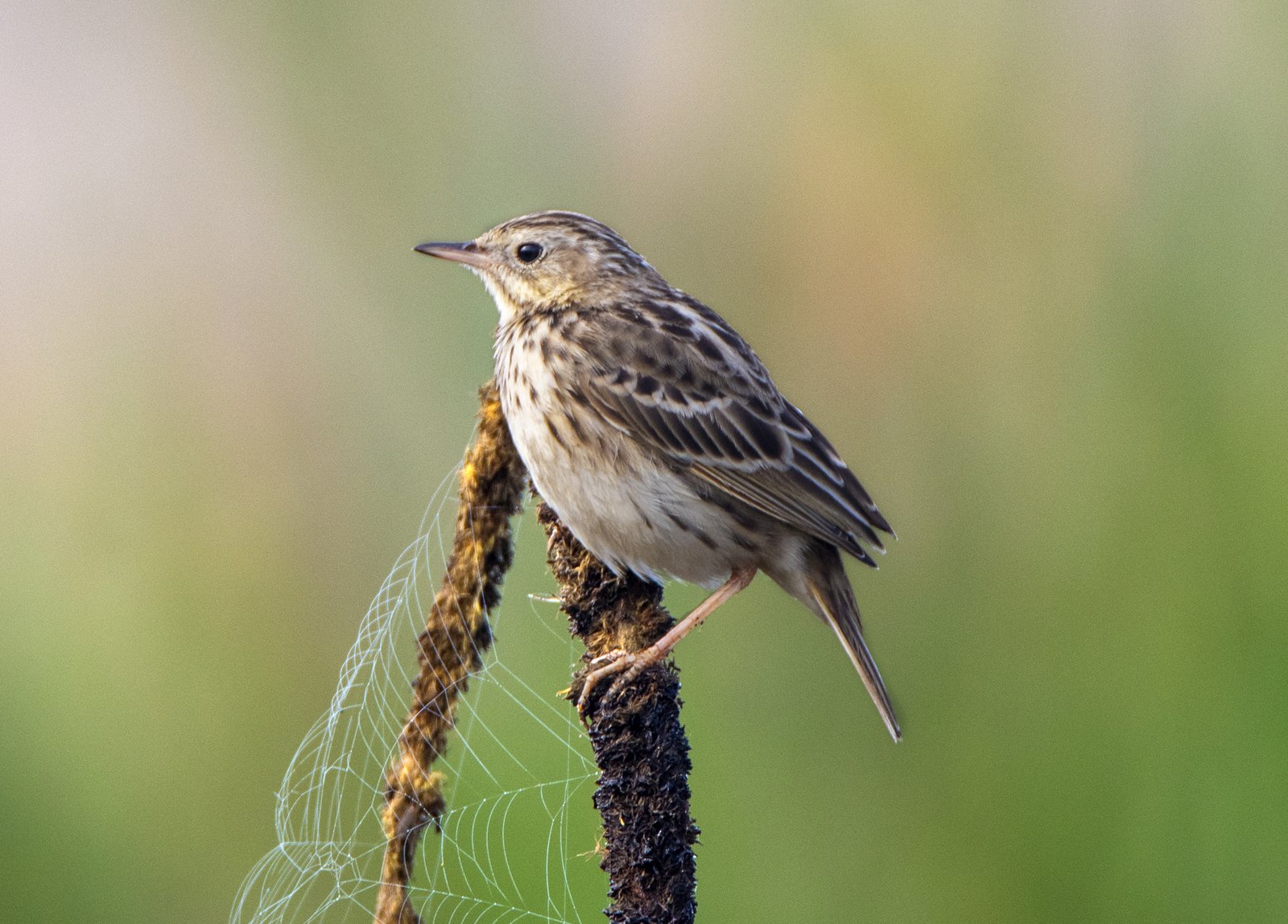
The Peruvian Pipit is a small pipit of the narrow coastal strip along the Pacific Ocean, almost confined to Peru. It was long treated as a subspecies of Yellowish Pipit, but differs in song and genetics. In the barren coastal desert it lives in the green patches: irrigated fields, river mouths and lomas.
Voice
The song, given in a song flight, is a series of quick, high notes ending in a long, descending, buzzy zzzeeeuuu. The call is a dry tsip.
Recording: Dan Lane — CC BY-NC-SA 3.0 · xeno-canto
Identification
13 cm, small and slender, with a thin bill and a long hind claw. The upperparts are pale greyish brown to buffy brown with blackish streaks. The underparts are whitish with a faint yellowish or buffy wash, and fine dark streaks on the breast. The outer tail feathers are white. The sexes are alike.
Confusion species
Yellowish Pipit Anthus chii is very similar, but lives east of the Andes and has a different song; the ranges do not meet. Correndera Pipit Anthus correndera is larger and more heavily streaked, and lives in the Andes. Common Miner Geositta cunicularia and Coastal Miner Geositta peruviana have unstreaked backs and walk more upright over bare ground.
Habitat
Short grass and low vegetation in the coastal desert: irrigated fields and pastures, grassy edges of river mouths and coastal marshes, and lomas, mostly from sea level to a few hundred metres, locally higher in the coastal valleys. It searches the ground for small insects. The nest is on the ground in a grass tussock.
Where the bird is most at home, classified by the vegetation units of the Andes and the west coast.


Range and movements
In Peru along almost the entire coast, from the north to Tacna in the south. Possibly also in south-western Ecuador; pipits there are sometimes assigned to this species and sometimes to Yellowish Pipit. Absent from Colombia, Bolivia and the Galápagos. Outside the guide area only in the far north of Chile.
- Resident
- dark = core range, pale = thinly spread
How and when to look
Search the grassy edges of irrigated fields and coastal marshes, or the lomas after the winter fog season (about July–October). Singing males can be heard high above the grass.
Conservation status
Least Concern. Its range is narrow, but the species tolerates farmland and is locally common.
Scientific name
Anthus peruvianus | Nicholson, 1878
Nicholson described the species in 1878 and placed it straight away in the genus where it still stands. The genus Anthus was introduced in 1805 by Bechstein. The genus name is Latin anthus, a small bird of grasslands mentioned by Pliny the Elder. The species name refers to Peru. The specimen the first description was based on came from Catarindo near Islay, Arequipa, Peru.