All species › Passerines › Wagtails and pipits › Puna Pipit
Puna Pipit | Anthus brevirostris
Punapieper | Bisbita puneño | Caminheiro-da-puna
The Puna Pipit is a compact, short-billed pipit of the open grasslands of the puna. It was long considered a subspecies of Short-billed Pipit, but it lives much higher and is now usually treated as a separate species. In the breeding season the male sings in a high song flight over short grass.
Voice
The song is a short series of chirping notes that runs into a dry, buzzy trill, usually given in a song flight high above the ground. The call is a short tsip.
Recording: Sjoerd Mayer — CC BY-NC-SA 3.0 · xeno-canto
Identification
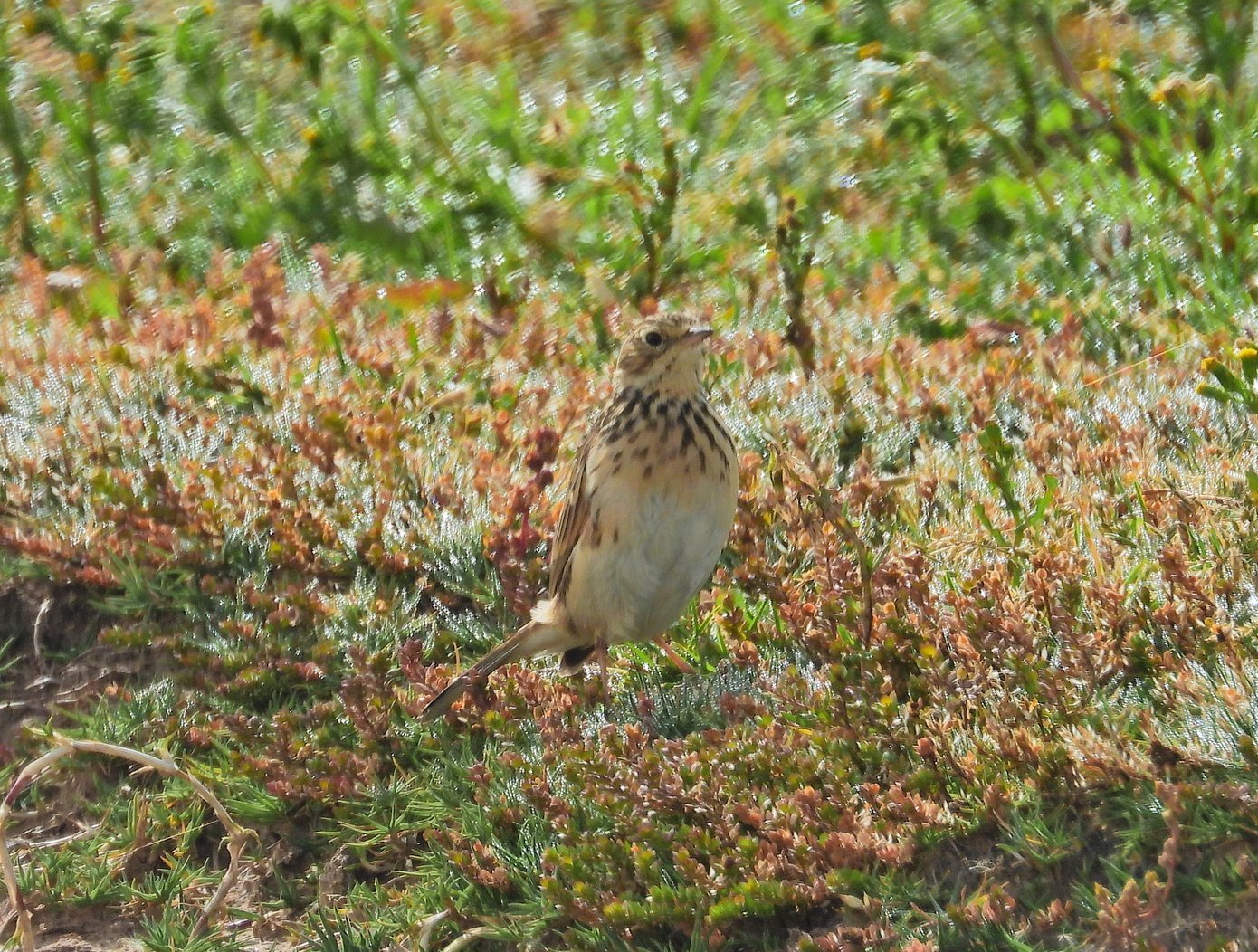
14–15 cm, compact, with a short, thin bill. The upperparts are buffy brown, heavily streaked and scaled with blackish. The breast is yellowish with dense dark streaks forming an obvious band; the belly and flanks are white to pale buff and barely streaked. The outer tail feathers are white. The sexes are alike.
Confusion species
Correndera Pipit Anthus correndera has two pale stripes on the back and heavily streaked flanks, and often lives in wetter parts of the puna. Paramo Pipit Anthus bogotensis is larger, warmer buff below, with only fine breast streaks. Hellmayr's Pipit Anthus hellmayri is slimmer, with finer streaks and a longer bill, and usually lives lower. Miners such as Common Miner Geositta cunicularia are unstreaked on the back and show rufous in the wing and tail.
Habitat
Short, dry to damp puna grassland, often with bare patches and cushion plants, and grassy edges of bofedales, at roughly 3500 to 4500 m. It walks on the ground, feeding on small insects. The nest is on the ground, hidden in a grass tussock.
Where the bird is most at home, classified by the vegetation units of the Andes and the west coast.


Range and movements
In Peru in the puna of the central and southern Andes. In Bolivia on the altiplano and in the puna of the western Andes. Absent from Colombia, Ecuador and the Galápagos. Outside the guide area in north-western Argentina and possibly the far north of Chile.
- Resident
- dark = core range, pale = thinly spread
How and when to look
Search short, grazed puna grassland, especially in the austral spring and summer, when singing males hover over the grass. Outside the breeding season the birds walk inconspicuously among the tussocks.
Conservation status
Least Concern. Its habitat is extensive and largely used as extensive grazing land, in which the species persists well.
Scientific name
Anthus brevirostris | Taczanowski, 1875
Taczanowski described the species in 1875 and placed it straight away in the genus where it still stands. The genus Anthus was introduced in 1805 by Bechstein. The genus name is Latin anthus, a small bird of grasslands mentioned by Pliny the Elder. The species name comes from Latin brevis, 'short', and rostrum, 'bill'. The specimen the first description was based on came from Junín, Peru.