All species › Passerines › Wagtails and pipits › Short-billed Pipit
Short-billed Pipit | Anthus furcatus
Kortsnavelpieper | Bisbita piquicorto | Caminheiro-de-unha-curta
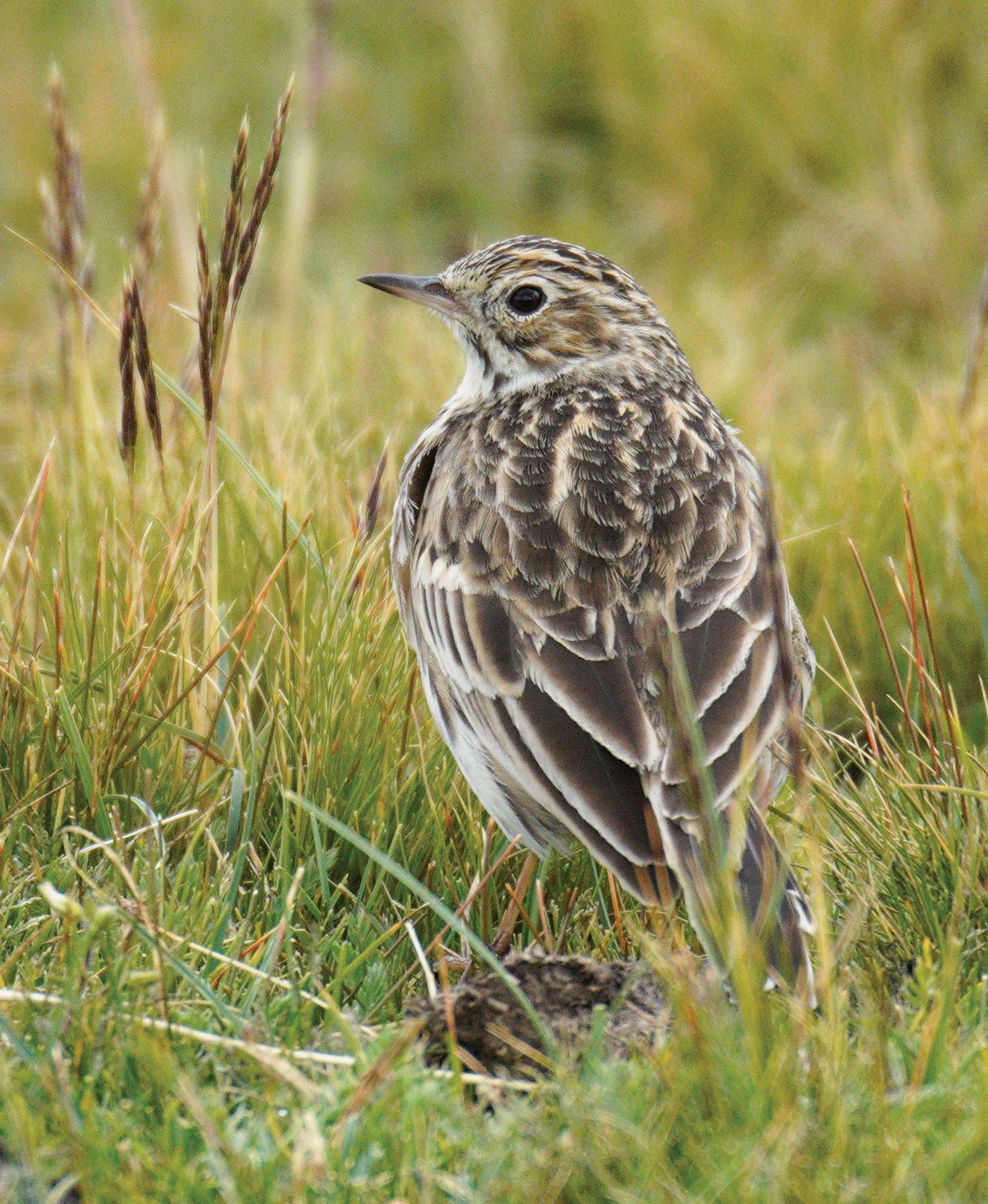
The Short-billed Pipit is a pipit of the temperate grasslands of south-eastern South America. Since the Puna Pipit of the high Andes has been treated as a separate species, it is only a scarce visitor to the lowlands of Bolivia in the guide area. Distinctive features are the short bill and the sharply defined, streaked breast band.
Voice
The song, usually given in a song flight, is a short series of clear notes followed by a buzzy trill. The call is a short tsip.
Recording: Pedro Rinaldi — CC BY-NC-SA 4.0 · xeno-canto
Identification
14–15 cm, compact, with a short, thin bill. The upperparts are buffy brown, scaled and streaked with blackish. The breast is yellowish white with dense dark streaks forming an obvious band; the belly and flanks are white and almost unstreaked. The outer tail feathers are white. The sexes are alike.
Confusion species
Puna Pipit Anthus brevirostris is very similar, but lives high in the Andes. Yellowish Pipit Anthus chii has a longer bill, finer breast streaks and yellowish underparts. Correndera Pipit Anthus correndera has pale stripes on the back and heavily streaked flanks. Hellmayr's Pipit Anthus hellmayri is warmer buff below, with finer streaks.
Habitat
Short, dry grassland, grazed pasture and grassy marsh edges in the lowlands. It walks on the ground, feeding on insects. It breeds outside the guide area; the nest is on the ground in a grass tussock.
Where the bird is most at home, classified by the vegetation units of the Andes and the west coast.


Range and movements
In the guide area only as a scarce and irregular visitor during the austral winter to the lowlands of eastern and southern Bolivia; its exact status is uncertain. Absent from Colombia, Ecuador, Peru and the Galápagos. Outside the guide area it breeds in Argentina, Uruguay, southern Brazil and Paraguay.
- Winter visitor (c. Oct–Mar)
- Passage (Mar–Apr, Oct–Nov)
- dark = core range, pale = thinly spread
How and when to look
During the austral winter (mainly May–September), check pipits with a sharply defined breast band in short grassland in eastern Bolivia. Records from the Andes almost always refer to Puna Pipit.
Conservation status
Least Concern. Locally common in its breeding range, but sensitive to the conversion of natural grassland to cropland.
Scientific name
Anthus furcatus | d'Orbigny, ACVMD & de Lafresnaye, 1837
D'Orbigny, ACVMD & de Lafresnaye described the species in 1837 and placed it straight away in the genus where it still stands. The genus Anthus was introduced in 1805 by Bechstein. The genus name is Latin anthus, a small bird of grasslands mentioned by Pliny the Elder. The species name is Latin furcatus, 'forked', for the slightly forked tail. The specimen the first description was based on came from Carmen de Patagones, Argentina.