All species › Passerines › Wagtails and pipits › Yellowish Pipit
Yellowish Pipit | Anthus chii
Gele pieper | Bisbita amarillento | Caminheiro-zumbidor
The Yellowish Pipit is a small, slender pipit of short grass in the lowlands, with the widest range of any pipit in tropical America. In the guide area it lives in the llanos savannas of Colombia and in eastern Bolivia. The male draws attention mainly through its song flight, in which it climbs and then parachutes down with a buzzy song.
Voice
The song, usually given in flight, is a series of quick, high notes followed by a long, descending buzz, roughly tsi-tsi-tsi-tsiiizzzzz, delivered as the bird parachutes down on spread wings. The call is a short, dry tsip.
No recording with a suitable Creative Commons licence is available for this species yet.
Identification
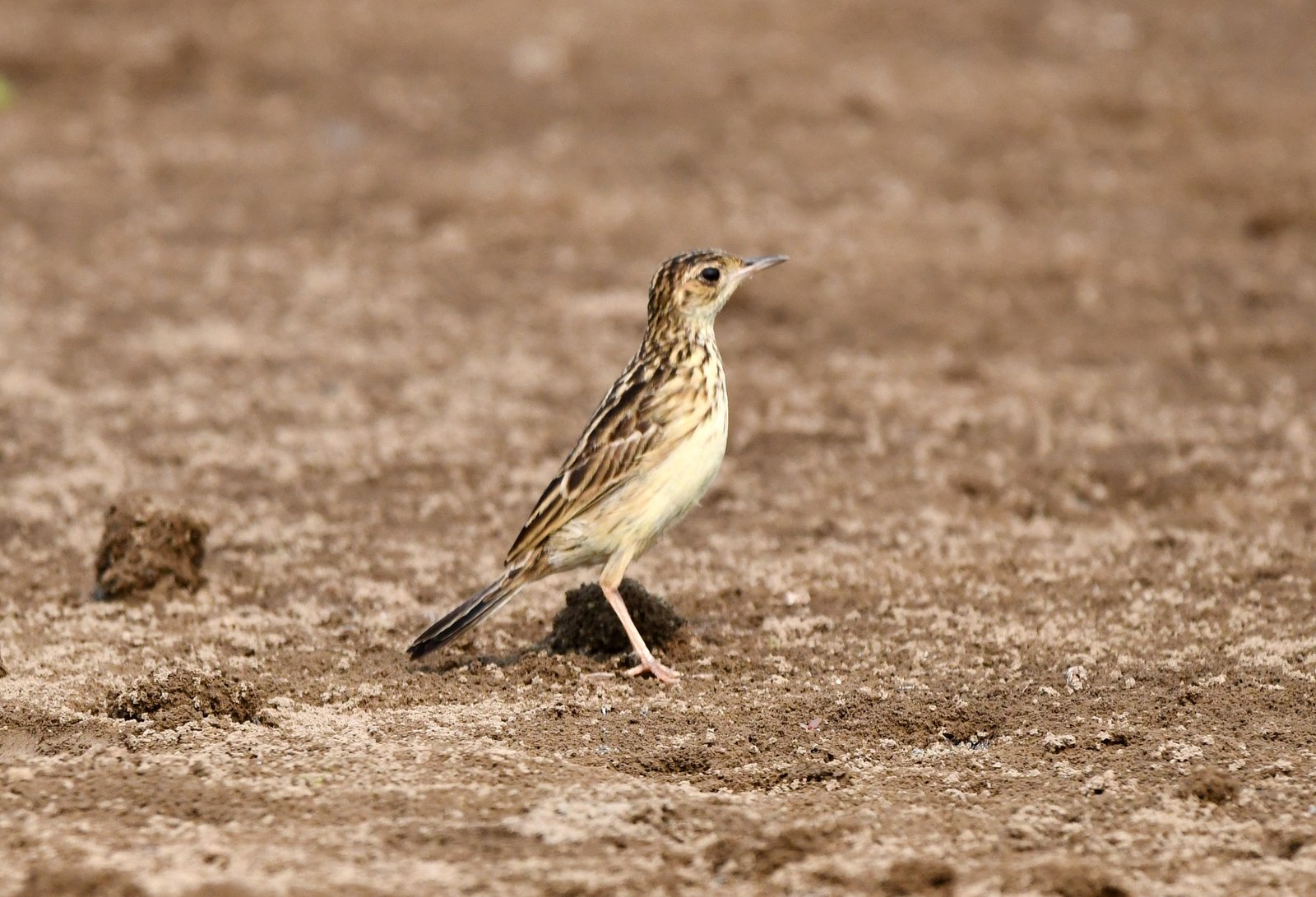
13–14 cm, small and slender, with a thin bill, a fairly short tail and a long hind claw. The upperparts are buffy brown with blackish streaks. The underparts are pale yellowish white to soft yellowish, with fine dark streaks across the breast and almost unstreaked flanks. The outer tail feathers are white. The legs are pale pinkish. The sexes are alike; in worn plumage the yellow on the underparts is fainter.
Confusion species
Peruvian Pipit Anthus peruvianus is very similar, but lives only along the Pacific coast and has a different song. Short-billed Pipit Anthus furcatus has a shorter bill and a more densely streaked breast band that contrasts sharply with the white belly. Hellmayr's Pipit Anthus hellmayri is larger, warmer buff below and lives mainly in the Andes. Grassland Sparrow Ammodramus humeralis has a thick conical bill and no white tail sides.
Habitat
Short grassland in the lowlands: savannas, pastures, wet grasslands, airfields and grassy roadsides, mostly below 1000 m. It walks on the ground, feeding on small insects and spiders. The nest is a cup of grasses on the ground, hidden in a grass tussock.
Where the bird is most at home, classified by the vegetation units of the Andes and the west coast.


Range and movements
In Colombia in the llanos east of the Andes and locally in the northern lowlands. In Ecuador scarce and very local. In Peru only in the savannas of the far south-east (Pampas del Heath, Madre de Dios). In Bolivia in the savannas of Beni and Santa Cruz. Absent from the Galápagos. Outside the guide area from Panama and Venezuela through the Guianas and Brazil to Paraguay, Uruguay and northern Argentina.
- Resident
- dark = core range, pale = thinly spread
How and when to look
Search open savanna or closely grazed pasture and listen in the morning for the buzzy song of males displaying overhead. On the ground the bird blends into the grass; it flushes with a short tsip, showing its white tail sides.
Conservation status
Least Concern. Common over most of its range, and benefits from forest clearance and the creation of pasture.
Scientific name
Anthus chii | Vieillot, 1818
Vieillot described the species in 1818 and placed it straight away in the genus where it still stands. The genus Anthus was introduced in 1805 by Bechstein. The genus name is Latin anthus, a small bird of grasslands mentioned by Pliny the Elder. The species name is possibly 'Chií', the name Félix de Azara gave for this pipit from Paraguay, perhaps after its call. The specimen the first description was based on came from (per the description).