All species › Passerines › Snowfinches and Old World sparrows › House Sparrow
House Sparrow | Passer domesticus
Huismus | Gorrión común | Pardal
The House Sparrow is naturally a bird of Europe, North Africa and large parts of Asia that is closely tied to people. In 1872 it was released in Buenos Aires, and from there it has spread over a large part of South America. In the guide area it lives in towns and villages from the coast up to the altiplano, and it is still spreading in the north.
Voice
A monotonous, repeated chirp, chilp or cheerp, given all day from roofs, hedges and trees; flocks keep up a continuous twittering. In alarm a rattling cherrr.
Recording: Thierry THOMAS — CC BY-NC-SA 4.0 · xeno-canto
Identification
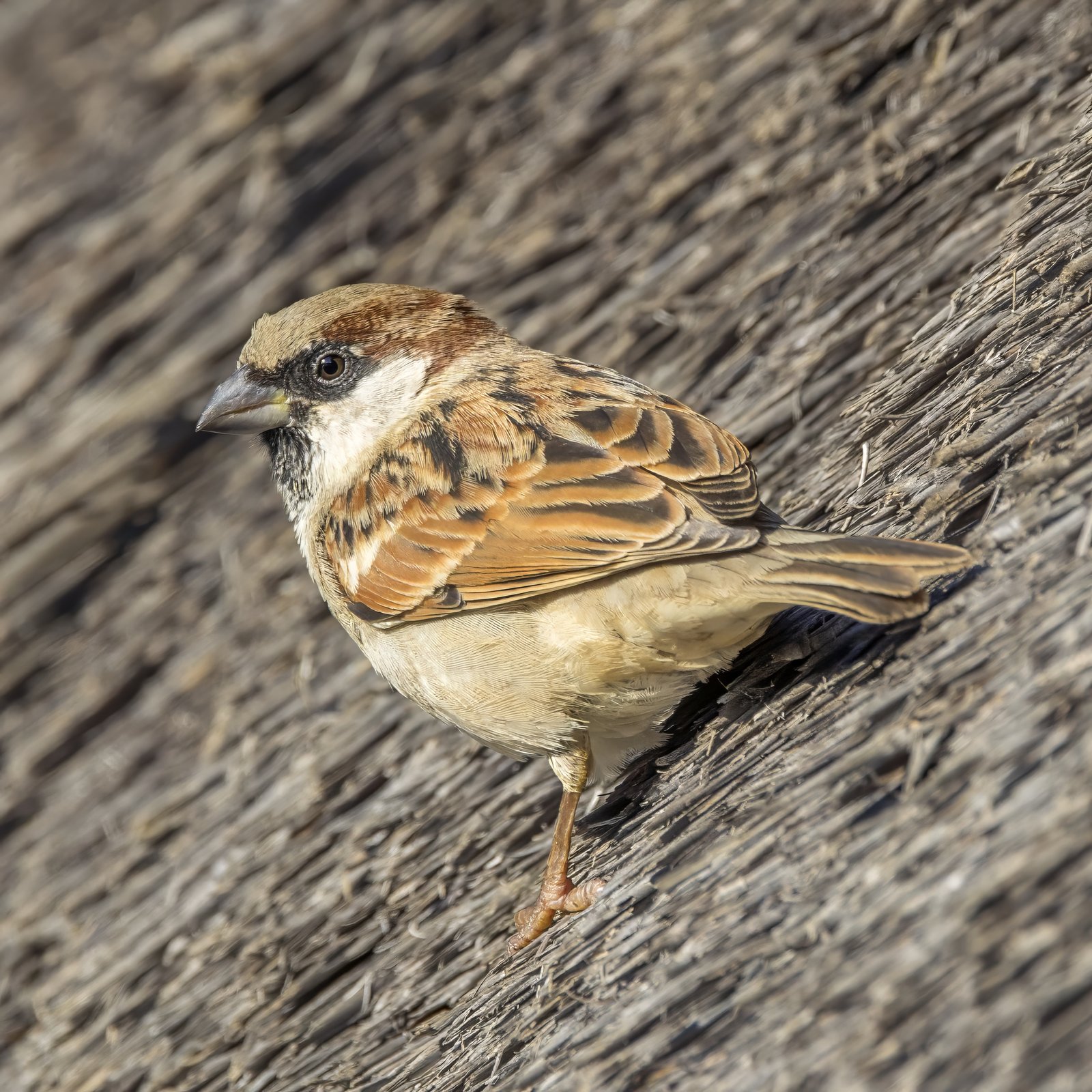
14–16 cm, stocky, with a thick, conical bill. The male has a grey crown, a chestnut band from behind the eye to the nape, pale grey cheeks and a black throat and bib, which is larger and sharper in the breeding season, when the bill is black. The back is brown with black streaks, the wing has a white wing bar, and the underparts are grey. The female is greyish brown, with a buff stripe behind the eye, a streaked back and plain, dingy grey underparts. Juveniles resemble the female.
Confusion species
Rufous-collared Sparrow Zonotrichia capensis lives in the same places, but has a grey head with black stripes, a small crest, a rufous collar and a black patch on the breast sides. Females and juveniles resemble female seedeaters such as Chestnut-throated Seedeater Sporophila telasco, but are larger, with a streaked back and a pale eyestripe. Juvenile Saffron Finches Sicalis flaveola are greyer and finely streaked, with a yellow wash on the breast and undertail.
Habitat
Towns, villages, markets, ports, farms and fields, from the coast to above 4000 m on the altiplano; absent from closed forest. It eats seeds, grain, food scraps and, especially for the young, insects. The nest is an untidy ball of grass and feathers in a cavity in a building, a lamp post or a nest box, sometimes free in a tree.
Where the bird is most at home, classified by the vegetation units of the Andes and the west coast.


Range and movements
In Peru and Bolivia common in nearly all towns and villages, along the coast, in the Andes and in the eastern lowlands. In Ecuador widespread along the coast and in the Andes, spreading east. In Colombia mainly in the south-west and at a few places on the Caribbean coast, still spreading. No established population known on the Galápagos. Native to Europe, North Africa and Asia; introduced on all inhabited continents.
- Resident
- dark = core range, pale = thinly spread
How and when to look
In any town or village in Peru and Bolivia around squares, markets and bus stops. In Colombia and north-eastern Ecuador a record is worth noting for the spread of the species.
Conservation status
Least Concern, although numbers are declining in parts of Europe. In the guide area an introduced species that is still spreading; it has been linked to the disappearance of the Rufous-collared Sparrow from town centres, but the extent of this is uncertain.
Scientific name
Passer domesticus | (Linnaeus, 1758)
Linnaeus described the species in 1758 as Fringilla domestica; because it was later moved to another genus, the author and year stand in brackets. The genus Passer was introduced in 1760 by Brisson. The genus name is Latin passer, 'sparrow'. The species name is Latin domesticus, 'of the house', referring to its life around human dwellings. The specimen the first description was based on came from Sweden.