All species › Passerines › Munias, parrotfinches, waxbills and allies › Tricolored Munia
Tricolored Munia | Lonchura malacca
Driekleurennon | Capuchino tricolor | Capuchinho-tricolor
The Tricolored Munia is a small seed-eating estrildid finch from India and Sri Lanka that has been traded worldwide as a cage bird. Escaped and released birds have founded populations in the Caribbean and in northern South America. In the guide area it has become established in Colombia and western Ecuador, mainly in rice-growing areas.
Voice
A thin, nasal contact call, roughly peet or chee, often in chorus from a flock. The song is soft and barely audible: a series of clicks and high, drawn-out notes.
Recording: David Ricardo Rodríguez-Villamil — CC BY-NC-SA 4.0 · xeno-canto
Identification
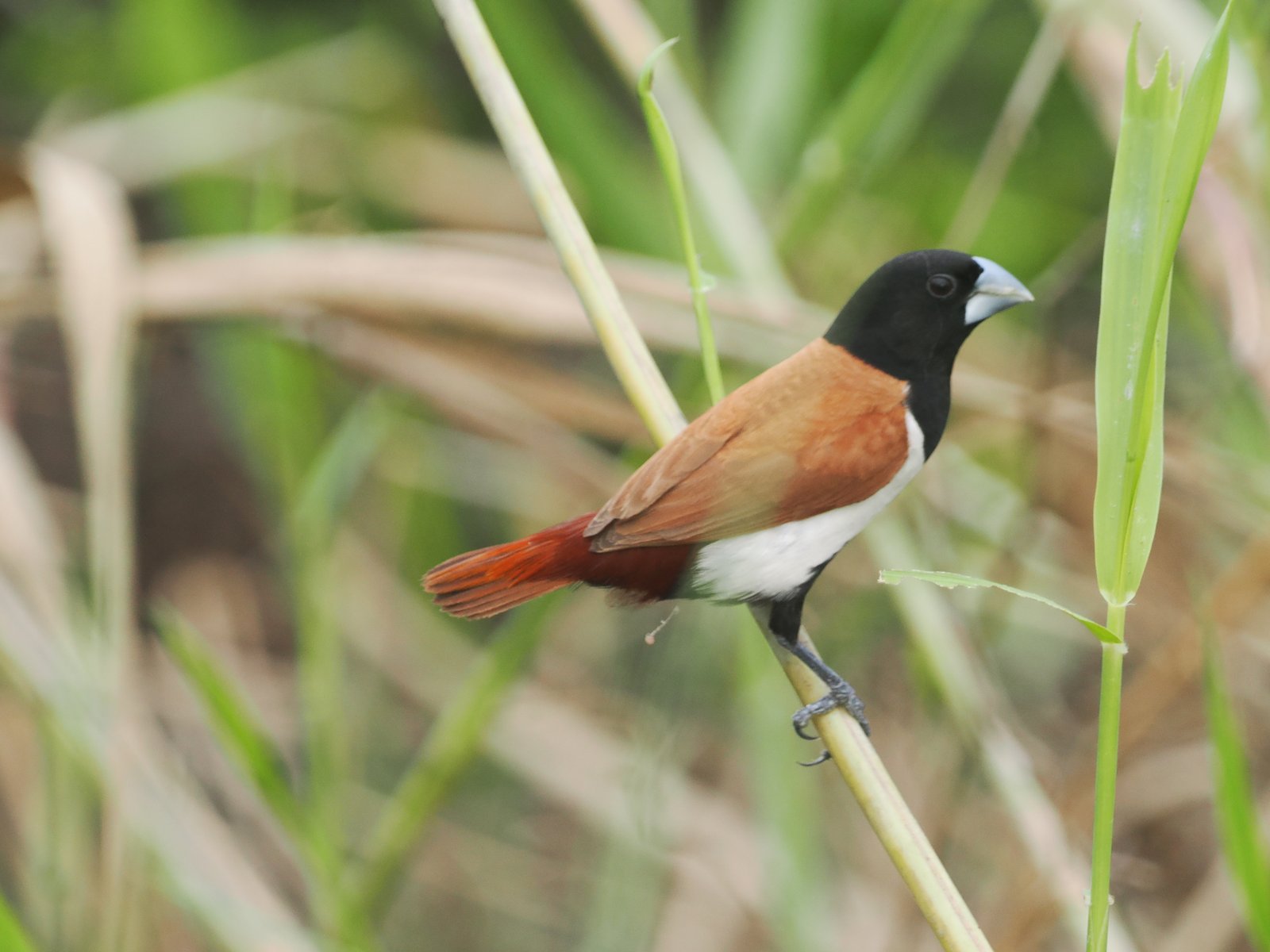
11–12 cm, stocky, with a thick, conical, blue-grey bill. The head, neck and upper breast are black, the breast sides, flanks and lower breast white, and the centre of the belly, the thighs and the undertail coverts black. The back and wings are chestnut-brown, the rump and uppertail coverts dark reddish brown. The sexes are alike. Juveniles are plain brown above and paler buff below, with a dark bill.
Confusion species
Chestnut Munia Lonchura atricapilla has the same black head but entirely chestnut underparts without white; juveniles of the two species can hardly be separated in the field. The male Chestnut-bellied Seed Finch Sporophila angolensis is black with a chestnut belly, but has a black back, a white wing patch and a black bill. Young munias resemble female seedeaters such as Yellow-bellied Seedeater Sporophila nigricollis, but have a heavier, paler bill and plain, unstreaked underparts.
Habitat
Rice fields, sugar cane, wet grassland, marsh edges with tall grass and reeds, roadsides and rank vegetation in the warm lowlands and valleys, mostly below 1500 m. It lives in groups, which join into flocks outside the breeding season. It feeds mainly on grass seeds and rice, taken straight from the heads. The nest is a domed structure of grasses with a side entrance, low in tall grass, reeds or a shrub.
Where the bird is most at home, classified by the vegetation units of the Andes and the west coast.


Range and movements
In Colombia established in the Caribbean lowlands, the Magdalena and Cauca valleys and the llanos; its range is expanding. In Ecuador in the western lowlands, mainly in rice-growing areas. No established population known in Peru, Bolivia or the Galápagos. Native to India and Sri Lanka; feral in, among other places, Venezuela and some Caribbean islands.
- Resident
- dark = core range, pale = thinly spread
How and when to look
Search rice fields and wet grassland, especially when the grass is in seed; flocks flush low and tightly packed and drop into tall grass. Note in any record that this is an introduced species.
Conservation status
Least Concern. In the guide area an introduced species that is still spreading; in rice-growing areas it can damage the crop, and it may compete with native seed-eaters.
Scientific name
Lonchura malacca | (Linnaeus, 1766)
Linnaeus described the species in 1766 as Loxia malacca; because it was later moved to another genus, the author and year stand in brackets. The genus Lonchura was introduced in 1832 by Sykes. The genus name comes from Greek lonchē, 'spearhead, lance', and oura, 'tail', after the pointed tail. The species name refers to Malacca on the Malay Peninsula, not necessarily the type locality. The specimen the first description was based on came from Belgaum (Belagavi), India.