All species › Passerines › Manakins › Helmeted Manakin
Helmeted Manakin | Chiroxiphia galeata
Helmmanakin | Saltarín de yelmo | Soldadinho
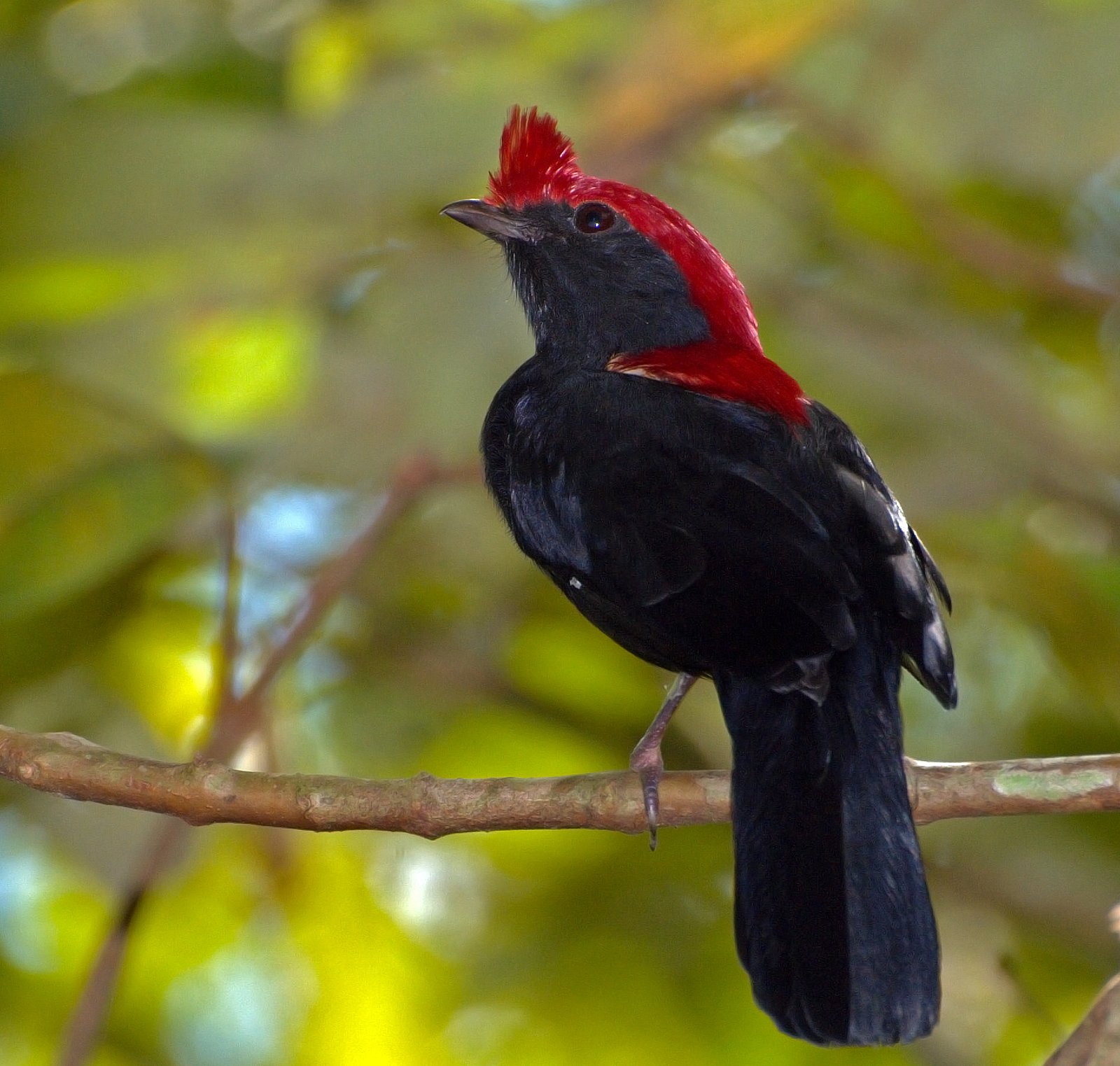
The Helmeted Manakin is a fairly large manakin of gallery forest in the cerrado of Brazil. The male is black with a red crown, nape and mantle and a red, forward-pointing crest on the forehead. In the guide area it is known only from the far east of Bolivia, where it is very local.
Voice
A loud, liquid, whistled phrase of a few rapid notes, often repeated, and a short wheet.
No recording with a suitable Creative Commons licence is available for this species yet.
Identification
14–15 cm, with a fairly long tail. The male is black, with a bright red crown, nape and upper back and an erect red crest that projects forwards from the forehead over the bill. The female is plain olive-green, slightly paler below, with a smaller green frontal crest. The bill is dark and the legs are dark pinkish grey.
Confusion species
Female Blue-backed Manakin Chiroxiphia pareola is smaller, lacks the frontal crest and has orange legs; the male is black with a blue back. The male Flame-crested Manakin Heterocercus linteatus has a red crown stripe, but grey and rufous underparts. Other olive-green female manakins are smaller and lack a crest.
Habitat
Gallery forest along streams and rivers in savanna, humid forest in valleys and forest edges, in the lowlands and on low plateaus. It lives in the lower and middle storeys and eats mainly fruit, also insects. The nest is a cup slung in the fork of a low branch, often over water.
Where the bird is most at home, classified by the vegetation units of the Andes and the west coast.


Range and movements
In the guide area only in the far east of Bolivia, in eastern Santa Cruz on the Brazilian border; very local there and seldom reported. Absent from Colombia, Ecuador, Peru and the Galápagos. Outside the guide area in central Brazil and north-eastern Paraguay.
How and when to look
In the guide area best searched for in gallery forest in eastern Santa Cruz, along the Brazilian border. Listen for the loud whistled song along streams in savanna.
Conservation status
Least Concern. The species has a large range in Brazil; gallery forest is locally lost there through expansion of farming and ranching.
Scientific name
Chiroxiphia galeata | (Lichtenstein, 1823)
Lichtenstein described the species in 1823 as Pipra galeata; because it was later moved to another genus, the author and year stand in brackets. The genus Chiroxiphia was introduced in 1847 by Cabanis. The genus name combines Greek kheir, 'hand', with xiphos, 'sword', probably after the narrow, sword-shaped primaries of the male. The species name is Latin galeatus, 'helmeted', referring to the male's red frontal crest. The specimen the first description was based on came from São Paulo, Brazil.