All species › Passerines › Manakins › Lance-tailed Manakin
Lance-tailed Manakin | Chiroxiphia lanceolata
Lancetmanakin | Saltarín lanceolado | Tangará-de-cauda-de-lança
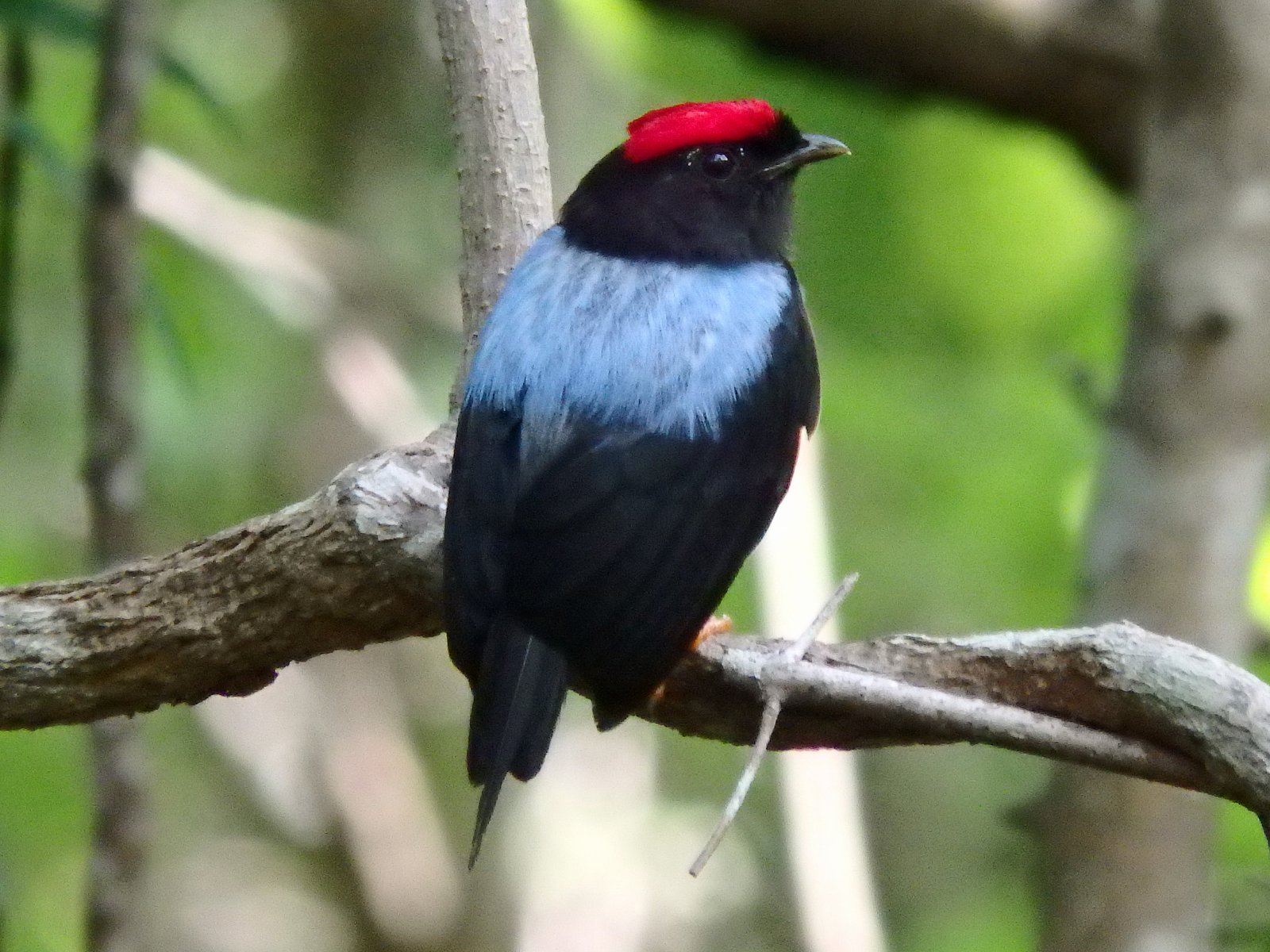
The Lance-tailed Manakin is a small manakin with two pointed, projecting central tail feathers. In the guide area it occurs only in northern Colombia, in drier forest than most other manakins. Two males display together: on a bare branch they jump up and down in turn in front of a female.
Voice
A clear, whistled call, rendered as toe-LEE-do, and a soft curry-ho. Displaying males give a croaking, buzzing sound.
Recording: Nelson Cumare — CC BY-NC-SA 4.0 · xeno-canto
Identification
13–14 cm, including the pointed central tail feathers, which project a few centimetres. The male is black, with a sky-blue mantle and a red crown. The female is olive-green, slightly paler below, with shorter tail points; some females have a reddish crown. Both sexes have orange legs. Young males are at first green like the female and over more than two years acquire first the red crown and then the blue mantle.
Confusion species
Blue-backed Manakin Chiroxiphia pareola has the same plumage pattern but a short, square tail without points, and in Colombia lives only east of the Andes. The female White-bearded Manakin Manacus manacus is smaller, with a short tail and a paler, yellowish-green belly. The female Red-capped Manakin Ceratopipra mentalis is smaller, with a short tail and brownish legs.
Habitat
Dry and semi-humid deciduous forest, gallery forest, mature second growth and shrubby forest edges, in the lowlands and on the lower slopes. It feeds mainly on small fruits, plucked in flight, and also on insects. The female builds an open cup nest in the fork of a shrub or sapling and incubates the two eggs alone, for about 20 days.
Where the bird is most at home, classified by the vegetation units of the Andes and the west coast.


Range and movements
In Colombia in the Caribbean lowlands and lower foothills of the north, from Córdoba east to the area around the Sierra Nevada de Santa Marta and La Guajira, and in the northern Magdalena Valley. Absent from Ecuador, Peru, Bolivia and the Galápagos. Outside the guide area from Costa Rica and Panama to northern Venezuela.
- Resident
- dark = core range, pale = thinly spread
How and when to look
Search in the morning in dry forest in the foothills around the Sierra Nevada de Santa Marta and elsewhere in northern Colombia. The toe-LEE-do call often reveals the birds before they are seen. Display perches are used for a long time in succession.
Conservation status
Least Concern. In northern Colombia much dry forest has been converted to pasture and fields; the species does tolerate second growth and forest edges.
Scientific name
Chiroxiphia lanceolata | (Wagler, 1830)
Wagler described the species in 1830 as Pipra lanceolata; because it was later moved to another genus, the author and year stand in brackets. The genus Chiroxiphia was introduced in 1847 by Cabanis. The genus name combines Greek kheir, 'hand', with xiphos, 'sword', probably after the narrow, sword-shaped primaries of the male. The species name is Latin lanceolatus, 'lance-shaped', referring to the elongated, pointed central tail feathers. The specimen the first description was based on came from Cerro Turumiquire, Sucre, Venezuela.