All species › Passerines › Manakins › Blue-backed Manakin
Blue-backed Manakin | Chiroxiphia pareola
Prachtmanakin | Saltarín dorsiazul | Tangará-falso
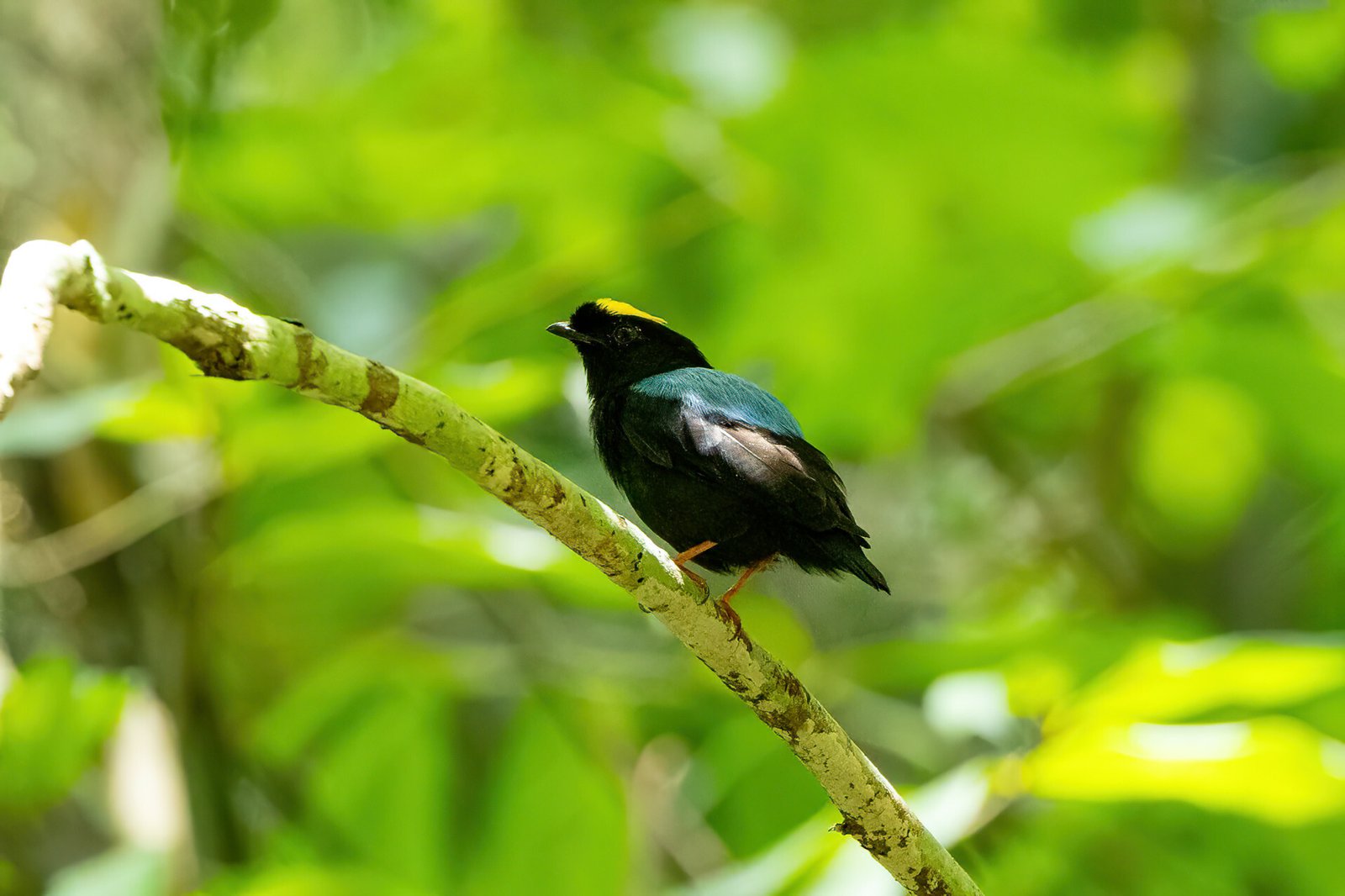
The Blue-backed Manakin is a small, black manakin with a sky-blue mantle from the Amazonian lowlands. As in the other Chiroxiphia species, the males display together: two or more males bob in a row over a low branch and leapfrog over each other in turn in front of a female.
Voice
A clear, whistled chew-wee or wee-o, often given by two males in turn or together. During display buzzing, croaking notes.
Recording: JAYRSON ARAUJO DE OLIVEIRA — CC BY-NC-SA 4.0 · xeno-canto
Identification
12–13 cm, with a short, square tail. The male is velvety black, with a sky-blue mantle, a red crown patch and a short tuft on the forehead. The legs are orange. The female is olive-green, paler and somewhat greyer below, also with orangey legs. Young males are green with a red crown. In part of Amazonian Brazil the males have a yellow crown (regina).
Confusion species
Yungas Manakin Chiroxiphia boliviana has slightly elongated, pointed central tail feathers and a smaller, darker red crown patch, and lives higher, in montane forest on the east slope of the Andes in Peru and Bolivia. Lance-tailed Manakin Chiroxiphia lanceolata has pointed tail projections and lives in northern Colombia. The female White-bearded Manakin Manacus manacus is smaller, with a paler, yellowish-green belly.
Habitat
The understorey and middle storey of humid lowland terra firme forest, mature second growth and the edges of flooded forest, from the lowlands to roughly 1000 m in the foothills. It feeds mainly on small fruits and also on insects. The nest is a shallow cup, low in a horizontal fork of a shrub.
Where the bird is most at home, classified by the vegetation units of the Andes and the west coast.


Range and movements
In Colombia in the lowlands east of the Andes. In Ecuador locally in the eastern lowlands. In Peru in the eastern lowlands, mainly in the north and centre. In Bolivia in the northern lowlands. Absent from the Galápagos. Outside the guide area in Venezuela, the Guianas, Amazonian and eastern Brazil and on Tobago.
- Resident
- dark = core range, pale = thinly spread
How and when to look
Listen in the morning in the understorey of lowland forest for the whistled calls. Males keep to a fixed display site on a low, bare branch, to which they return day after day.
Conservation status
Least Concern. The range is large; locally forest is lost to clearing.
Scientific name
Chiroxiphia pareola | (Linnaeus, 1766)
Linnaeus described the species in 1766 as [Pipra] pareola; because it was later moved to another genus, the author and year stand in brackets. The genus Chiroxiphia was introduced in 1847 by Cabanis. The genus name combines Greek kheir, 'hand', with xiphos, 'sword', probably after the narrow, sword-shaped primaries of the male. The species name is Modern Latin pareola, 'little tit', a diminutive of the genus Parus, 'tit'. The specimen the first description was based on came from Cayenne, French Guiana.