All species › Passerines › Manakins › Yungas Manakin
Yungas Manakin | Chiroxiphia boliviana
Yungasmanakin | Saltarín yungueño | Tangará-das-yungas
The Yungas Manakin is the Chiroxiphia manakin of montane forest in the south of the guide area. It lives in the yungas on the east slope of the Andes of southern Peru and Bolivia, often along forest edges with fruiting trees. It was formerly treated as a subspecies of Blue-backed Manakin.
Voice
A loud, rising series of short notes, often by several males in chorus. In display a soft, nasal buzzing note, repeated a few times, and a rising, croaking call.
Recording: Dries Van de Loock — CC BY-NC-SA 4.0 · xeno-canto
Identification
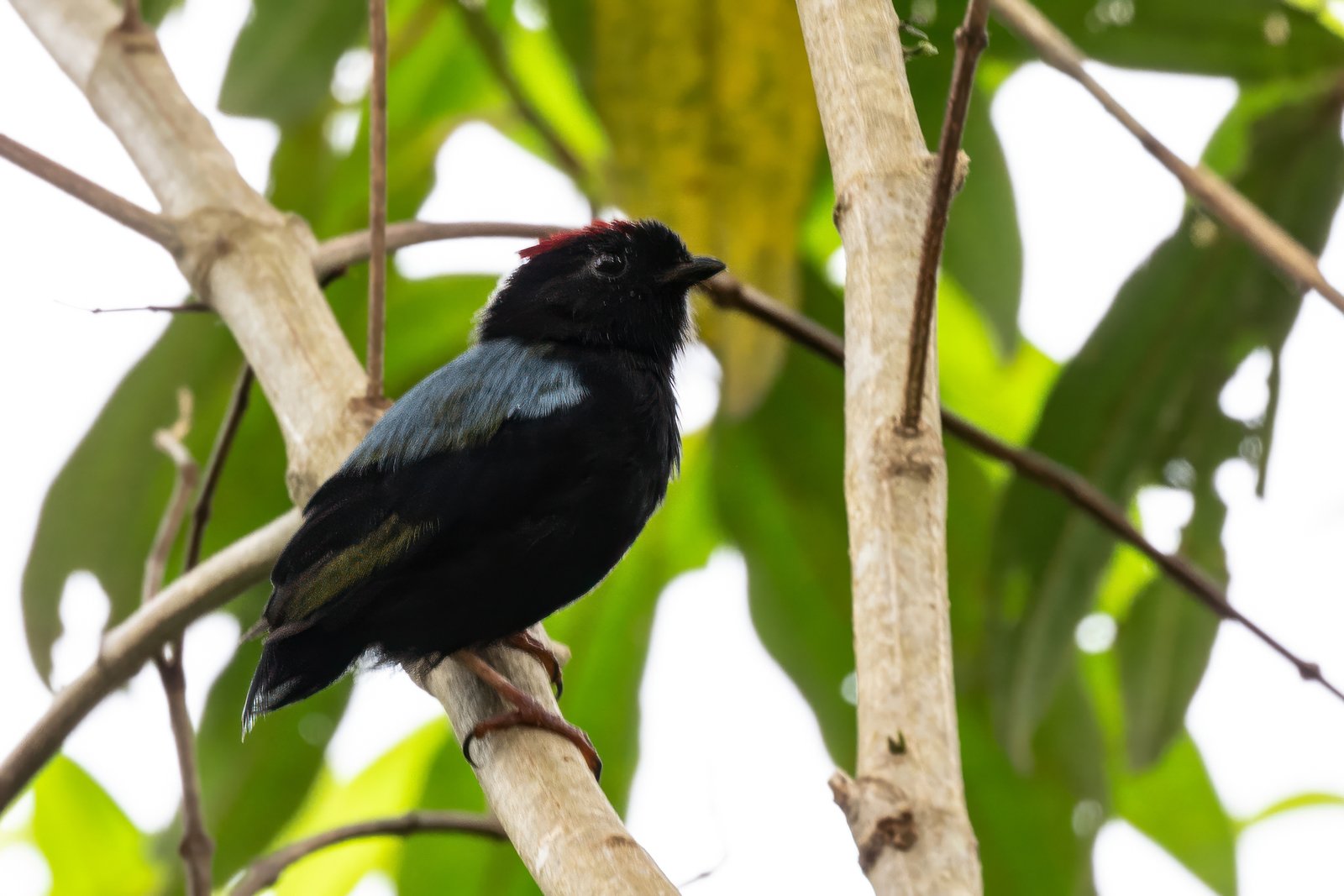
12–13 cm, with slightly elongated, pointed central tail feathers. The male is black, with a pale blue mantle and a small, dark red crown patch. Both sexes have a short tuft on the forehead. The female is olive-green, with browner wings, paler green below and almost white on the lower belly. The legs vary from purplish brown to pale yellowish.
Confusion species
Blue-backed Manakin Chiroxiphia pareola has a short, square tail and a larger, brighter red crown patch, and lives lower, in the lowlands. The female Green Manakin Cryptopipo holochlora is smaller and brighter grass-green, with a yellowish belly, and lives lower, in foothill forest. The female Jet Manakin Chloropipo unicolor is darker and greyer olive, with a greyish throat.
Habitat
Humid montane forest and its edges in the yungas, especially where trees are fruiting, roughly between 900 and 2000 m in Peru and between 400 and 2600 m in Bolivia. It feeds mainly on small fruits and also on insects. Males display alone or at shared display sites. It breeds mainly from August to November.
Where the bird is most at home, classified by the vegetation units of the Andes and the west coast.


Range and movements
In Peru on the east slope of the Andes from Cusco south to Puno; there are also a few records from San Martín. In Bolivia on the east slope of the Andes from La Paz southwards. Absent from Colombia, Ecuador and the Galápagos. Outside the guide area in extreme northern Argentina.
- Resident
- dark = core range, pale = thinly spread
How and when to look
Search along forest edges and roads through the yungas, such as the road to Manu in Cusco and the roads in the yungas of La Paz. Males sing from dense vegetation near fruiting trees, often several at once.
Conservation status
Least Concern. Part of the montane forest on the east slope is being lost to farming, but the species tolerates forest edges and second growth.
Scientific name
Chiroxiphia boliviana | Allen, 1889
Allen described the species in 1889 and placed it straight away in the genus where it still stands. The genus Chiroxiphia was introduced in 1847 by Cabanis. The genus name combines Greek kheir, 'hand', with xiphos, 'sword', probably after the narrow, sword-shaped primaries of the male. The species name refers to Bolivia. The specimen the first description was based on came from Apolo, La Paz, Bolivia.