All species › Passerines › Manakins › Black Manakin
Black Manakin | Xenopipo atronitens
Zwarte manakin | Saltarín negro | Pretinho
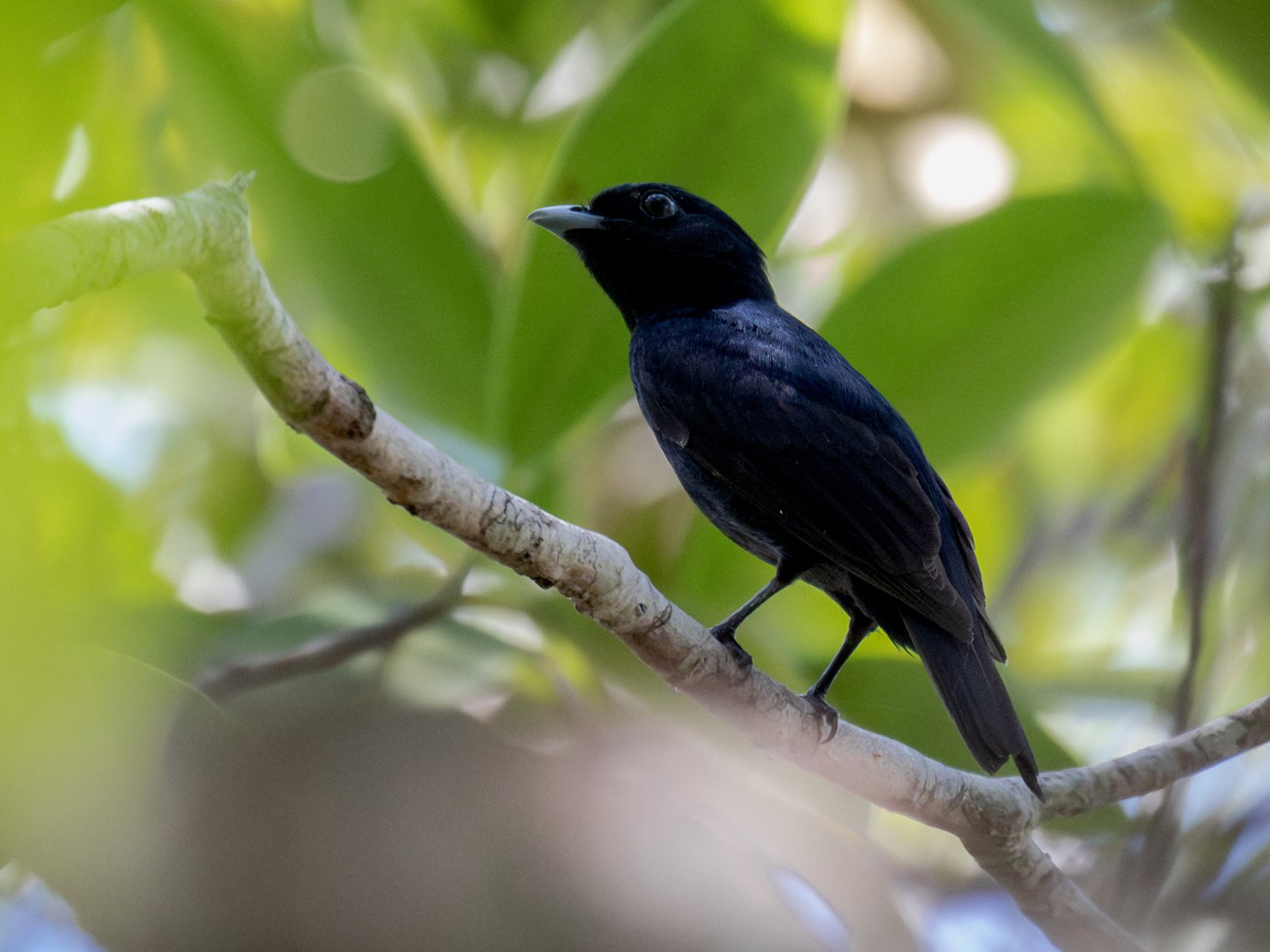
The Black Manakin is a glossy black manakin of savanna woodland and white-sand forest on poor, sandy soils. In the guide area it occurs only locally: in eastern Colombia and in a few isolated areas in Peru and Bolivia. The display is simple and consists mainly of calling and chasing.
Voice
Loud, sharp calls, such as skee! kip-kip-kip-krrr, with variations, a dry, rattling trill and a very high, chirping note.
Recording: Iván Lau — CC BY-NC-SA 4.0 · xeno-canto
Identification
12–13 cm, with a short tail and a stout bill. The male is entirely glossy blue-black, with slightly duller, browner wings and tail, and a pale, bluish-grey bill. The female is dark olive-green, with a greyish throat and yellowish olive-green underparts; the upper mandible is blackish, the lower mandible bluish grey. The legs are dark olive-grey.
Confusion species
The male Jet Manakin Chloropipo unicolor is also entirely black, but has white underwing coverts and lives in montane forest on the east slope of the Andes. Males of Blue-capped Manakin Lepidothrix coronata are much smaller and have a blue crown. The male White-crowned Manakin Pseudopipra pipra has a white crown.
Habitat
Savanna woodland, thickets and gallery forest on sandy, nutrient-poor soils, low and dense white-sand forest and stunted flooded forest, mainly below 500 m. It feeds on small fruits and insects. Males call and chase each other at display sites. Little is known about the nest.
Where the bird is most at home, classified by the vegetation units of the Andes and the west coast.


Range and movements
In Colombia in the eastern lowlands, from Meta east to Guainía and Vaupés. In Peru only in small, isolated areas in Loreto, Ucayali and southern Madre de Dios. In Bolivia locally in Beni and Santa Cruz. Absent from Ecuador and the Galápagos. Outside the guide area in Venezuela, the Guianas and Amazonian Brazil.
- Resident
- dark = core range, pale = thinly spread
How and when to look
In Colombia in the white-sand areas around Inírida in Guainía; males call loudly from low, dense scrub. In Peru and Bolivia only in the isolated savannas and white-sand areas, such as the Pampas del Heath.
Conservation status
Least Concern. In the guide area local and tied to a restricted habitat; savanna woodland is locally lost to fires and clearing.
Scientific name
Xenopipo atronitens | Cabanis, 1847
Cabanis described the species in 1847 and placed it straight away in the genus where it still stands. He introduced the genus Xenopipo in that same work. The genus name comes from Greek xenos, 'stranger', and New Latin pipo, 'manakin'. The species name comes from Latin ater, 'black', and nitens, 'shining': 'glossy black'. The specimen the first description was based on came from Guyana.