All species › Passerines › Manakins › Yellow-headed Manakin
Yellow-headed Manakin | Chloropipo flavicapilla
Geelkopmanakin | Saltarín dorado | Dançarino-de-cabeça-amarela
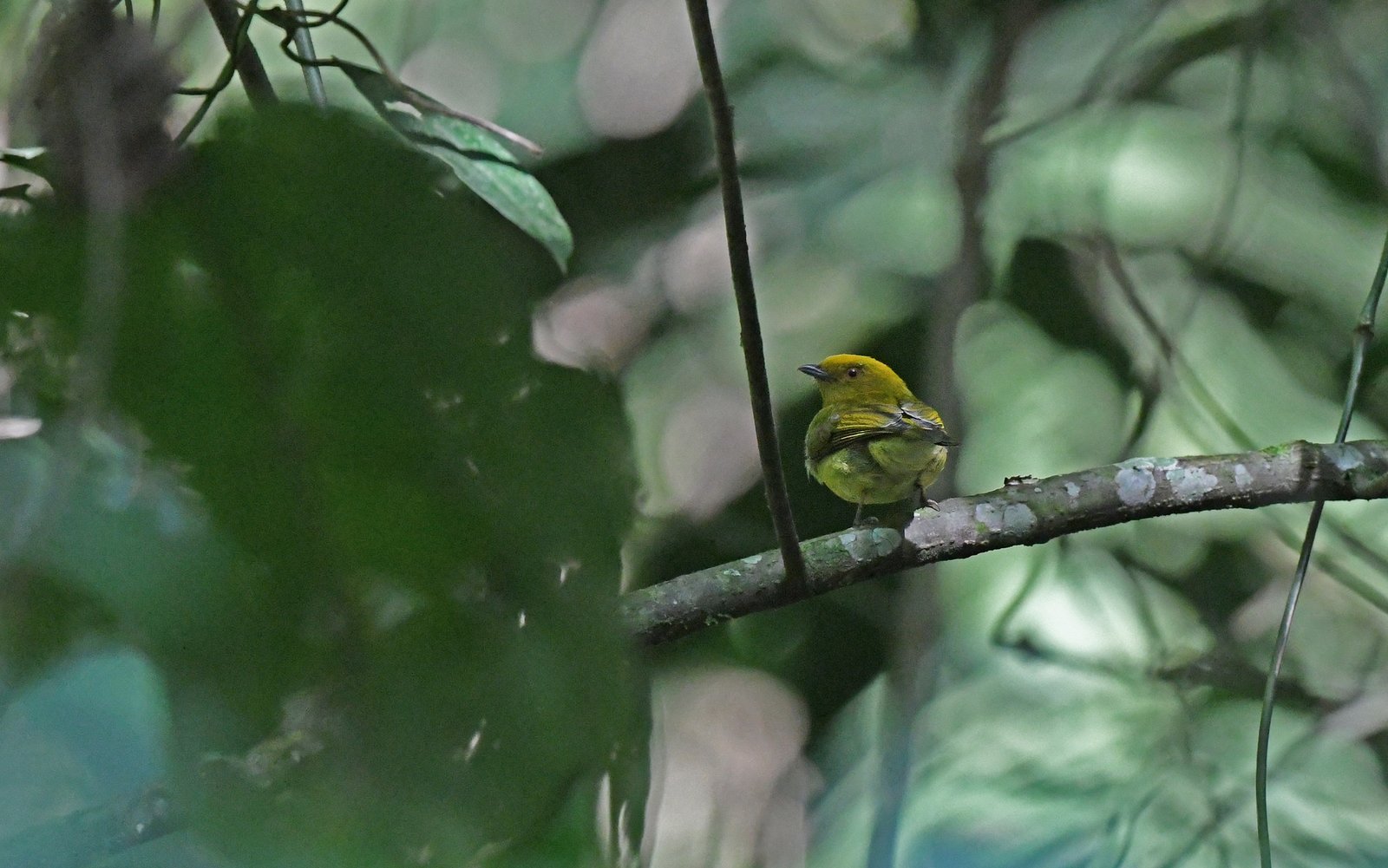
The Yellow-headed Manakin is a green manakin with a golden-yellow crown and nape, found almost only in the Andes of Colombia. The species is scarce and local and has disappeared from many areas through the clearing of montane forest. It lives quietly in the middle storey of the forest and is seldom heard.
Voice
Seldom heard. Recordings exist, but the vocalizations have hardly been described.
Recording: Fabio Agudelo Zapata — CC BY-NC-SA 4.0 · xeno-canto
Identification
12–13 cm. The male has a golden-yellow crown and nape, bright olive-green upperparts and a paler, yellower olive-green face, throat and breast; the belly is pale yellow. The female is duller, with less yellow on the head and breast. Both sexes have a pale orange to red iris, a blackish upper mandible, a bluish-grey lower mandible and grey legs. Young birds resemble the female but are duller.
Confusion species
The female Golden-winged Manakin Masius chrysopterus is olive-green with a yellow throat and a dark iris, and lacks the yellow crown. Green Manakin Cryptopipo holochlora has a uniformly green head and a dark iris and lives on the east slope of the Andes. Females of other manakins in montane forest lack a yellow crown and have a dark iris.
Habitat
Humid montane forest, mature second growth and forest edges, roughly between 1200 and 2400 m. It forages in the middle storey and lower canopy for small fruits and insects. Almost nothing is known about the nest.
Where the bird is most at home, classified by the vegetation units of the Andes and the west coast.


Range and movements
In Colombia scattered in the Western Andes and on the west slope of the Central Andes, in Valle del Cauca and Cauca, and in the Central Andes from southern Antioquia south to Huila. For Ecuador a few records from the east slope (Napo, Tungurahua) are cited, but they are unconfirmed. Absent from Peru, Bolivia and the Galápagos. Does not occur outside the guide area.
- Resident
- dark = core range, pale = thinly spread
How and when to look
Visit forest remnants at middle elevations in the Central Andes of Colombia, such as La Romera park near Itagüí, south of Medellín. Search the middle storey near fruiting trees and shrubs.
Conservation status
Vulnerable. The population is estimated at a few thousand mature individuals and is declining. The main threat is the loss and fragmentation of montane forest, as much of the range is in use as farmland.
Scientific name
Chloropipo flavicapilla | (Sclater, 1852) (GBIF: Xenopipo flavicapilla)
Sclater described the species in 1852 as Pipra flavicapilla; because it was later moved to another genus, the author and year stand in brackets. The genus Chloropipo was introduced in 1860 by Cabanis & Heine. The genus name combines Greek khlōros, 'light green, yellow', with pipōn or piprō, an unknown small bird (compare the genus Pipra). The specific name comes from Latin flavus, 'yellow', and capillus, 'hair of the head', after the yellow crown. The specimen the first description was based on came from Bogotá, Colombia.