All species › Birds of prey › Kites, Old World vultures, eagles and hawks › Hook-billed Kite
Hook-billed Kite | Chondrohierax uncinatus
Langsnavelwouw | Gavilán piquiganchudo | Caracoleiro
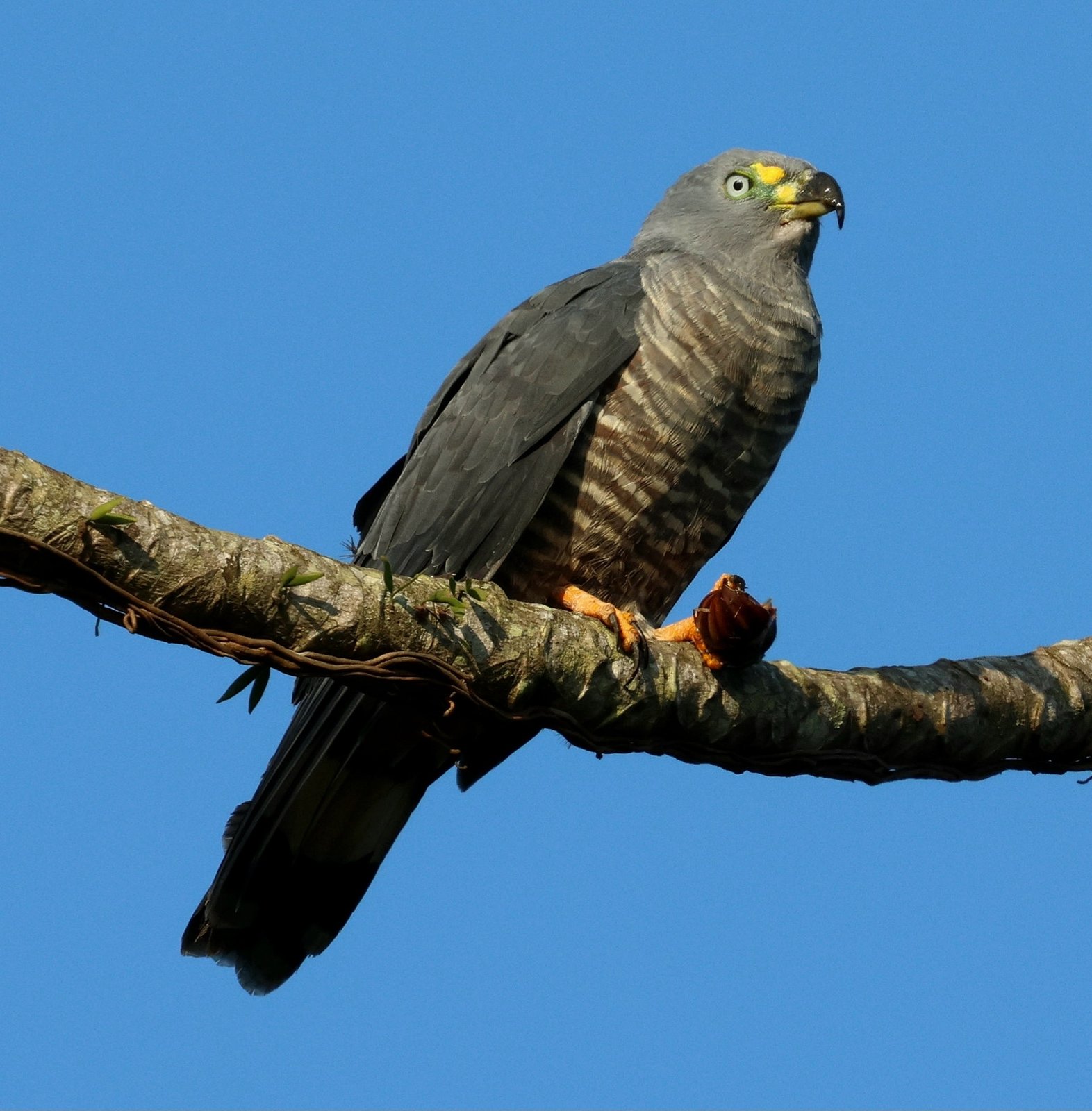
The Hook-billed Kite is a kite that feeds almost entirely on tree snails, which it extracts from their shells with its strongly hooked bill. Bill size varies greatly between populations, probably in line with the size of the local snails. The plumage is very variable, with grey, brown and all-black birds.
Voice
A fast, chattering series of calls, mainly around the nest; otherwise fairly quiet.
Recording: JAYRSON ARAUJO DE OLIVEIRA — CC BY-NC-SA 4.0 · xeno-canto
Identification
38–46 cm, with broad, paddle-shaped wings that narrow at the base, a long tail and a large, strongly hooked bill. Above the eye there is a bare, greenish-yellow patch of skin, and the iris is pale. The male is slate grey, with grey-and-white barred underparts. The female is brown above, with a rufous nuchal collar and rufous-and-white barred underparts. There is also a dark morph that is entirely blackish. The tail has two or three broad pale bands. In flight the primaries are clearly barred below. Juveniles are white to creamy below with narrow brown bars and have a dark crown.
Confusion species
Roadside Hawk Rupornis magnirostris has rufous panels in the primaries, a yellow iris without a bare skin patch and a smaller bill. Double-toothed Kite Harpagus bidentatus is smaller, with a white throat with a dark central stripe. Snail Kite Rostrhamus sociabilis has a slimmer bill, a white tail base and lives in marshes. Dark birds resemble Great Black Hawk Buteogallus urubitinga, which is larger, with long yellow legs.
Habitat
Humid and dry forest, gallery forest, forest edges and swamp forest, from the lowlands to about 2500 m in the Andes, locally higher. It searches the lower and middle levels of the forest for tree snails, sometimes also for land snails on the ground, and also eats frogs, salamanders and insects. Piles of empty snail shells often lie beneath regular feeding perches. The nest is a small, flimsy stick nest in a tree.
Where the bird is most at home, classified by the vegetation units of the Andes and the west coast.


Range and movements
In Colombia scattered in the lowlands and in the Andes. In Ecuador in the western and eastern lowlands and on the Andean slopes. In Peru east of the Andes and in the north-west. In Bolivia in the lowlands and the Yungas. Scarce and local everywhere. Absent from the Galápagos. Outside the guide area from southern Texas and Mexico to Venezuela, the Guianas, Brazil and northern Argentina, and on Grenada.
- Resident
- dark = core range, pale = thinly spread
How and when to look
In the late morning, look for a kite with paddle-shaped wings circling low over the forest. A spot with many empty tree-snail shells below a branch indicates a regular feeding perch.
Conservation status
Least Concern. The species is scarce and local, and depends on forest with a rich snail fauna.
Scientific name
Chondrohierax uncinatus | (Temminck, 1822)
Temminck described the species in 1822 as Falco uncinatus; because it was later moved to another genus, the author and year stand in brackets. The genus Chondrohierax was introduced in 1843 by Lesson. The genus name comes from Greek khondros, 'coarse, gross', and hierax, 'hawk'. Holloway (2003) links the first part with khondros, 'cartilage', because the bony shield above the eye is lacking. Lesson erected the genus in 1843. The species name is Latin uncinatus, 'hooked', after the strongly hooked bill. The specimen the first description was based on came from northern Brazil and the Guianas.