All species › Birds of prey › Kites, Old World vultures, eagles and hawks › Swallow-tailed Kite
Swallow-tailed Kite | Elanoides forficatus
Zwaluwstaartwouw | Elanio tijereta | Gavião-tesoura
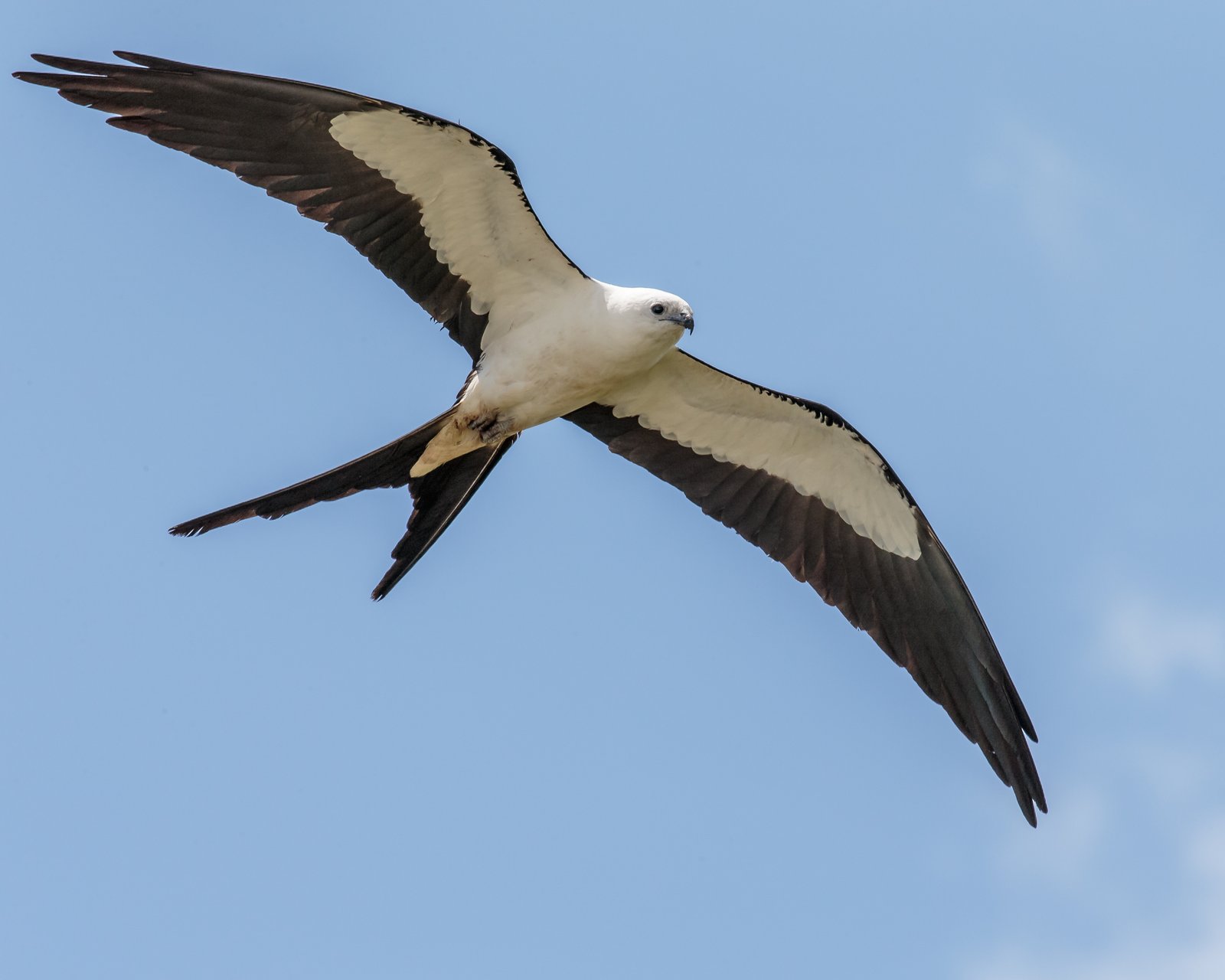
The Swallow-tailed Kite is a black-and-white raptor with a deeply forked tail that spends almost all its life in the air. It catches insects and lizards in flight or plucks them from treetops, and also eats on the wing. In addition to the local breeders, birds from North America pass through the guide area in autumn and spring.
Voice
A high, whistled klee-klee-klee or a thin, repeated pee-pee-pee, mainly in flight and around the nest.
Recording: Mateus Gonçalves Santos — CC BY-NC-SA 4.0 · xeno-canto
Identification
52–62 cm, much of it tail; the tail is black and very deeply forked, with long outer feathers. The head, neck and underparts are bright white, the back, wings and tail black with a bluish or greenish gloss. In flight the wings are long and narrow; the underwing coverts are white and the flight feathers black. The sexes are alike. Juveniles have a shorter tail fork, fine dark streaks on the head and breast and pale tips to the flight feathers.
Confusion species
With its black-and-white plumage and deeply forked tail, the species is almost unmistakable in the guide area. Swallow-tailed Gull Creagrus furcatus of the open sea and the Galápagos has a grey back and a much less deeply forked tail. Plumbeous Kite Ictinia plumbea glides over the forest in the same way, but is uniform grey, with a square tail and rufous in the primaries.
Habitat
Humid lowland, foothill and montane forest, also over forest edges and open country with scattered trees, from sea level to about 2000 m, locally higher. It hunts by gliding over the canopy, taking large insects, lizards, frogs and nestlings, and drinks by skimming over water. The nest is high in the crown of a tree. Migrants often travel in flocks.
Where the bird is most at home, classified by the vegetation units of the Andes and the west coast.


Range and movements
In Colombia widespread in the lowlands and on the Andean slopes. In Ecuador in the western and eastern lowlands and on the Andean slopes. In Peru mainly east of the Andes. In Bolivia in the lowlands and the Yungas. North American migrants pass through Colombia and winter mainly in Amazonia. Absent from the Galápagos. Outside the guide area breeding in the south-eastern United States and from Mexico to Venezuela, the Guianas, Brazil, Paraguay and northern Argentina.
- Resident
- dark = core range, pale = thinly spread
How and when to look
In the late morning, look up over forested slopes and river valleys, when the birds glide low over the canopy. During migration small groups may pass together.
Conservation status
Least Concern. The species is declining locally through loss of forest.
Scientific name
Elanoides forficatus | (Linnaeus, 1758)
Linnaeus described the species in 1758 as Falco forficatus; because it was later moved to another genus, the author and year stand in brackets. The genus Elanoides was introduced in 1818 by Vieillot. The genus name means 'resembling Elanus': Elanus with the Greek suffix -oidēs, 'resembling'. The species name comes from Latin forficatus, 'scissor-shaped' (from forfex, 'scissors'), for the deeply forked tail. The specimen the first description was based on came from Carolina, United States.