All species › Passerines › Larks › Horned Lark
Horned Lark | Eremophila alpestris
Strandleeuwerik | Alondra cornuda | Cotovia-de-chifres
The Horned Lark is the only lark in South America. A small, isolated population of the subspecies peregrina lives on the high plateaus of the Eastern Andes of Colombia, thousands of kilometres from its nearest relatives in Mexico. It walks over short grassland and bare fields, where its black-and-yellow head makes it unmistakable.
Voice
The call is a high, thin tsee-tee or tseet. The song is a fast series of high, tinkling and twittering notes, given from the ground, a low perch or high in flight.
Recording: Bo Shunqi 薄顺奇 — CC BY-NC-SA 4.0 · xeno-canto
Identification
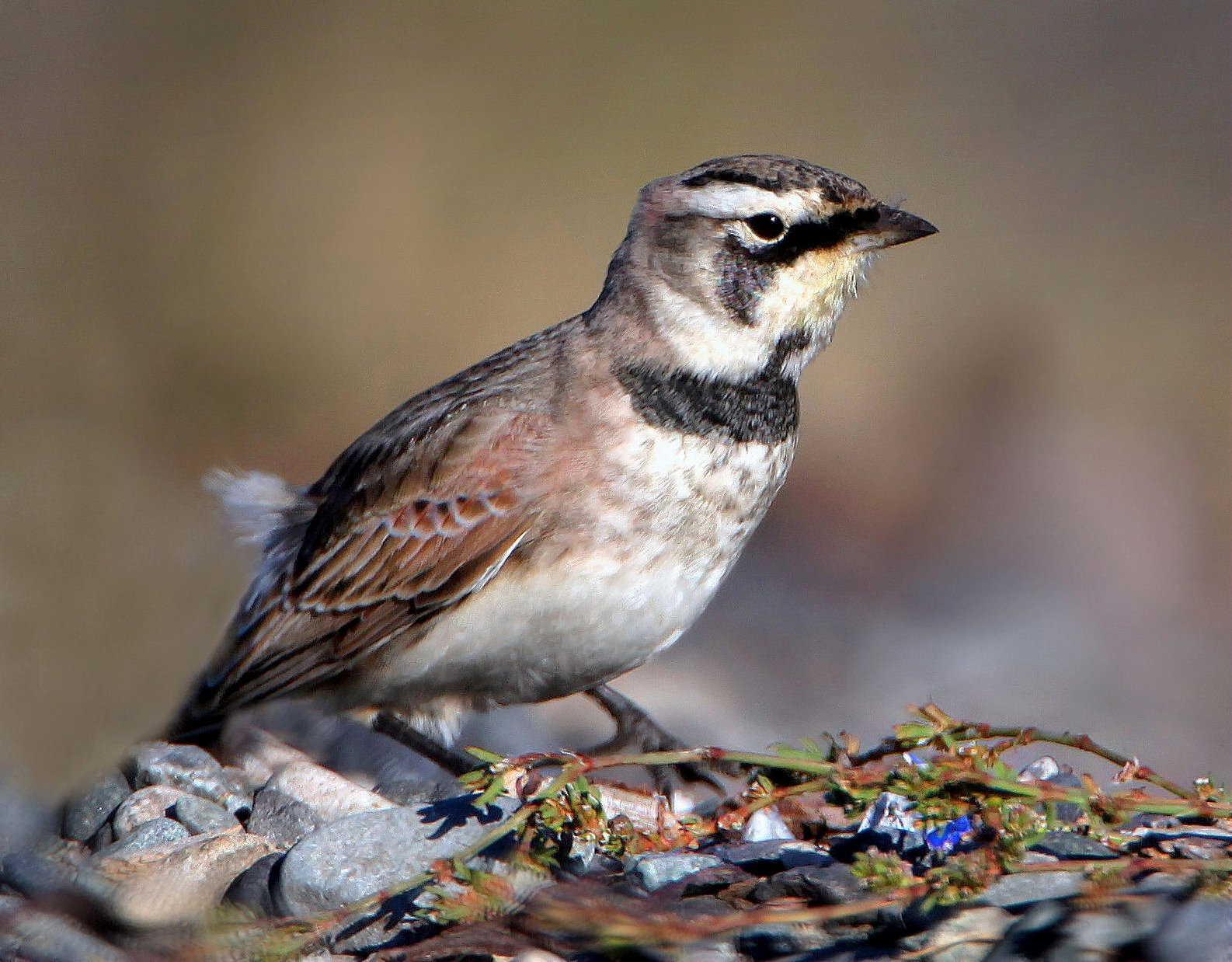
15–17 cm, a compact lark with a short, pointed bill. The male has a yellowish-white face and throat, a black mask from the bill below the eye to the cheek, a black breast band and two small black feather tufts like horns at the sides of the crown. The nape and shoulders are pinkish cinnamon, the back brown with dark streaks, and the belly white. The tail is black with white outer edges, conspicuous in flight. The female is duller, with less black and smaller or no horns. Young birds are brown with pale spots and lack the head pattern.
Confusion species
Paramo Pipit Anthus bogotensis lives in the same area, but is slimmer, with a thinner bill, a streaked breast and no black on the face. Eastern Meadowlark Sturnella magna shares the grassland, but is much larger, with yellow underparts and a black V on the breast.
Habitat
Short grassland, closely grazed pasture, fallow and freshly ploughed fields and dry, open ground with sparse vegetation on the high plateaus, roughly between 2500 and 3100 m. It forages on foot for seeds and insects. The nest is a scrape on the ground lined with grass, often next to a tussock or clod.
Where the bird is most at home, classified by the vegetation units of the Andes and the west coast.


Range and movements
In Colombia only in the Eastern Andes, on the Sabana de Bogotá and some adjacent high plateaus in Cundinamarca and Boyacá. Absent from Ecuador, Peru, Bolivia and the Galápagos. Outside the guide area widespread in North America and Mexico and in Europe, Asia and North Africa.
- Resident
- dark = core range, pale = thinly spread
How and when to look
All year on short grassland and bare fields on the plateau north and west of Bogotá; birds walk low over the ground and flush with high calls when disturbed.
Conservation status
Least Concern. The Colombian population is small and considered threatened in Colombia, owing to urban expansion, flower farms and intensive farming on the Sabana de Bogotá.
Scientific name
Eremophila alpestris | (Linnaeus, 1758)
Linnaeus described the species in 1758 as Alauda alpestris; because it was later moved to another genus, the author and year stand in brackets. The genus Eremophila was introduced in 1828 by Boie. The genus name comes from Greek erēmos, 'desert', and philos, 'loving'. The species name is Latin for 'of the high mountains', from Alpes, the Alps. The specimen the first description was based on came from Coast of South Carolina, United States.