All species › Passerines › Donacobius › Black-capped Donacobius
Black-capped Donacobius | Donacobius atricapilla
Zwartkopdonacobius | Donacobio | Japacanim
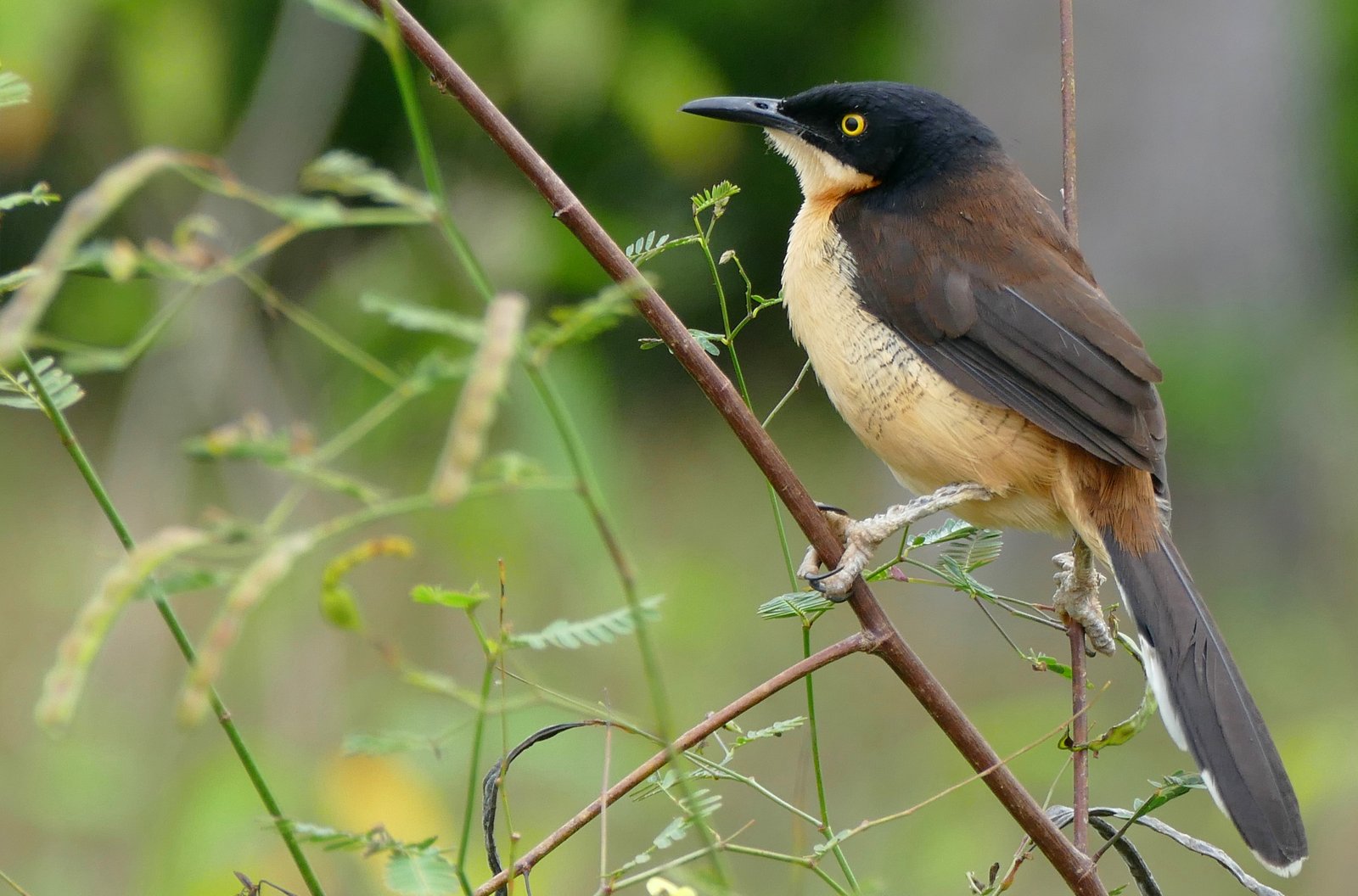
The Black-capped Donacobius is the only species in its family: a noisy, long-tailed marsh bird with a black head, a golden-yellow eye and buffy-yellow underparts. Pairs sing in duet from the tops of reeds and tall grass, swinging their tails and inflating a bare orange patch of skin on the side of the neck. It occurs in almost all lowland marshes east of the Andes.
Voice
Loud duets of clear, repeated whistles such as kwoit-kwoit-kwoit or choo-choo-choo, alternating with rasping and grating notes from the partner; also harsh, hoarse calls.
Recording: JAYRSON ARAUJO DE OLIVEIRA — CC BY-NC-SA 4.0 · xeno-canto
Identification
21–23 cm, with a fairly long, slightly decurved black bill and a long, graduated tail. The crown and sides of the head are black, the back and wings dark chocolate brown, and the rump warmer brown. The underparts are buffy yellow, with fine dark barring on the flanks. On the side of the neck there is a bare, orange-yellow patch of skin. The tail is black with white tips; in flight a white patch shows at the base of the primaries. The iris is golden yellow. The sexes are alike; young birds are duller, with a browner head and a dark iris.
Confusion species
Hardly confusable. Tropical Mockingbird Mimus gilvus and Chalk-browed Mockingbird Mimus saturninus also have a long, white-tipped tail, but are grey or grey-brown, with a white supercilium and without a black head or yellow underparts, and live in drier, open country.
Habitat
Tall grass, reeds and floating vegetation along marshes, oxbow lakes and lakes, wet pastures and rice fields, also rank riverbanks; in the lowlands, mostly below 600 m, locally higher. It eats insects and other invertebrates, which it seeks low in the vegetation and just above the water. The nest is a deep cup of grass and plant fibres in dense vegetation over or near water; young birds from earlier broods often help to raise the chicks.
Where the bird is most at home, classified by the vegetation units of the Andes and the west coast.


Range and movements
In Colombia in the Caribbean lowlands, the Magdalena valley and throughout the lowlands east of the Andes. In Ecuador and Peru throughout the Amazonian lowlands. In Bolivia in the lowlands of the north and east, from Pando and Beni to Santa Cruz. Absent west of the Andes in Ecuador and Peru and from the Galápagos. Outside the guide area from eastern Panama through Venezuela and the Guianas to Brazil, Paraguay and north-eastern Argentina.
- Resident
- dark = core range, pale = thinly spread
How and when to look
Along the edges of oxbow lakes and marshes in the Amazonian lowlands, from a canoe or the shore; in the morning pairs sit singing on top of the tall grass.
Conservation status
Least Concern. Common in suitable marsh; locally benefits from rice fields and wet pastures.
Scientific name
Donacobius atricapilla | (Linnaeus, 1766)
Linnaeus described the species in 1766 as [Turdus] atricapilla; because it was later moved to another genus, the author and year stand in brackets. The genus Donacobius was introduced in 1831 by Swainson. The genus name comes from Greek donax (donakos), 'reed', and bios, 'life': 'living in reeds'. The species name comes from Latin ater, 'black', and capillus, 'hair of the head': 'black-capped'. The specimen the first description was based on came from Eastern Brazil.