All species › Passerines › Swallows › Bank Swallow
Bank Swallow | Riparia riparia
Oeverzwaluw | Avión zapador | Andorinha-do-barranco
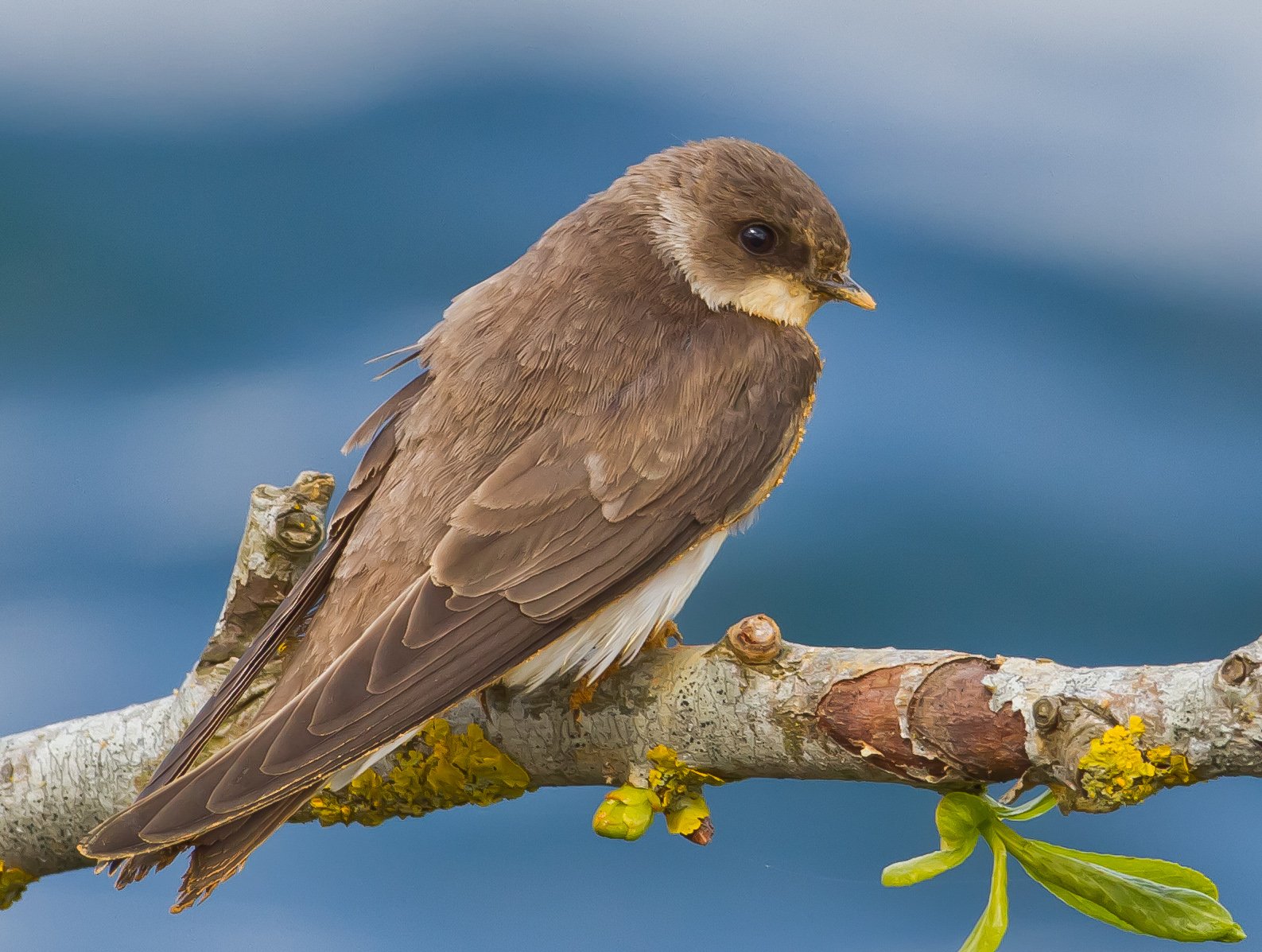
The Bank Swallow is a small, brown-and-white swallow that breeds in colonies in steep sand and earth banks in North America and Eurasia. It reaches the guide area as a migrant from North America, often in flocks over rivers, lakes and marshes. The narrow brown breast band on the white underparts separates it from the other brown swallows in the guide area.
Voice
A dry, rasping trrrt or chrrt, often repeated by flocks into a continuous twittering.
Recording: Esperanza Poveda — CC BY-NC-SA 4.0 · xeno-canto
Identification
12–13 cm, small and slender, with pointed wings and a slightly forked tail. The upperparts are plain greyish brown. The throat and underparts are white, with a distinct greyish-brown breast band that often extends slightly downward in the centre. The underwing is dark greyish brown. The sexes are alike. Juveniles have pale fringes to the feathers of the back and wings.
Confusion species
Southern Rough-winged Swallow Stelgidopteryx ruficollis is larger, with an ochre throat, a pale rump and no breast band. Northern Rough-winged Swallow Stelgidopteryx serripennis has a dingy greyish-brown throat and breast without a sharp band. Brown-chested Martin Progne tapera is much larger, with a mottled brown breast band that continues as a line of spots onto the belly. Juvenile Tree Swallows Tachycineta bicolor sometimes show a vague grey breast band, but are larger, with a cleaner white throat and darker upperparts.
Habitat
Open country near water: rivers with sandbars, lakes, marshes, wet grassland, rice fields and coastal lagoons, mainly in the lowlands, on migration also higher in the Andes. It hunts flying insects low over water and grass, often together with Barn Swallows. It does not breed in the guide area; outside the breeding season it roosts in flocks in reeds and tall grass.
Where the bird is most at home, classified by the vegetation units of the Andes and the west coast.


Range and movements
In Colombia a passage migrant and winter visitor, mainly in the lowlands east of the Andes and in the north. In Ecuador mainly a passage migrant, on both sides of the Andes, and a scarce winter visitor. In Peru a passage migrant and winter visitor along the coast and in the Amazonian lowlands. In Bolivia a winter visitor in the lowlands of the north and east. On the Galápagos a rare passage migrant. It breeds in North America and Eurasia and winters in South America, Africa and southern Asia.
- Resident
- Winter visitor (c. Oct–Mar)
- Passage (Mar–Apr, Oct–Nov)
- dark = core range, pale = thinly spread
How and when to look
During migration in September–October and March–April, check over lowland rivers, lakes and marshes and at coastal lagoons; the species often mixes with flocks of Barn Swallows.
Conservation status
Least Concern. The North American population has declined strongly in recent decades, partly through loss of breeding sites in banks and a decrease in flying insects.
Scientific name
Riparia riparia | (Linnaeus, 1758)
Linnaeus described the species in 1758 as Hirundo riparia; because it was later moved to another genus, the author and year stand in brackets. The genus Riparia was introduced in 1817 by Forster. The genus name comes from Latin riparius, 'of the riverbank' (ripa, 'bank'), after the nests dug in banks. Latin riparius, 'of the riverbank', like the genus name, after its nesting in banks. The specimen the first description was based on came from Sweden.