All species › Passerines › Swallows › Tree Swallow
Tree Swallow | Tachycineta bicolor
Boomzwaluw | Golondrina bicolor | Andorinha-bicolor
The Tree Swallow is a sturdy, blue-green-and-white swallow from North America that nests in tree cavities and nest boxes. It winters mainly in the southern United States, Mexico and the Caribbean and reaches the guide area only in small numbers, in northern Colombia. Unlike most swallows it eats berries as well as insects in winter.
Voice
A clear, liquid chleet or cheet, strung together by flocks into a twittering song.
Recording: Stanislas Wroza — CC BY-NC-SA 4.0 · xeno-canto
Identification
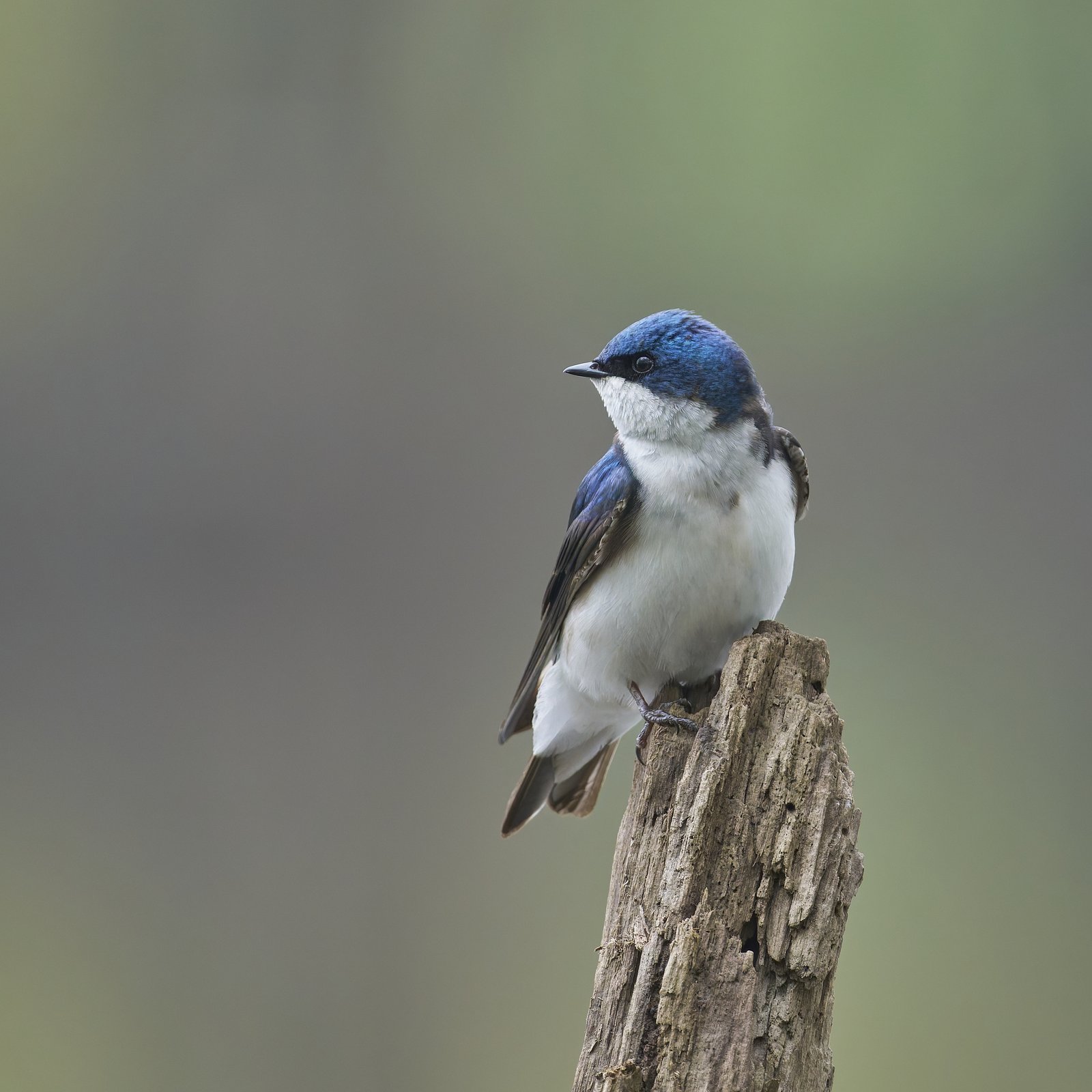
13–14 cm, with broad triangular wings and a slightly forked tail. Adult males are glossy blue-green above and pure white below, without a white rump and without white in the wing. The white of the cheek does not reach above the eye. Females are duller, with partly brown upperparts. Juveniles are plain greyish brown above, sometimes with a vague grey breast band.
Confusion species
Mangrove Swallow Tachycineta albilinea and White-winged Swallow Tachycineta albiventer are smaller, with a white rump and white in the wing. Blue-and-white Swallow Pygochelidon cyanoleuca is smaller and darker blue, with black undertail coverts. Bank Swallow Riparia riparia is smaller and brown, with a sharp brown breast band; juvenile Tree Swallows show at most a vague, broken band.
Habitat
Open country near water: marshes, lakes, lagoons, mangroves and rice fields in the lowlands. It often hunts flying insects in flocks low over water, and in winter also eats berries. It does not breed in the guide area; it roosts in large flocks in reeds or scrub.
Where the bird is most at home, classified by the vegetation units of the Andes and the west coast.


Range and movements
In Colombia a rare winter visitor in the north, mainly in the Caribbean lowlands. Further south in the guide area only a vagrant; there are a few records from Ecuador. Absent from the Galápagos. It breeds in Canada and the northern and central United States and winters from the southern United States to Central America and the Caribbean.
- Winter visitor (c. Oct–Mar)
- dark = core range, pale = thinly spread
How and when to look
Check flocks of swallows over marshes and lagoons in the Caribbean lowlands of Colombia, especially between December and March.
Conservation status
Least Concern. The population is large and the species makes much use of nest boxes, although it has declined in parts of North America.
Scientific name
Tachycineta bicolor | (Vieillot, 1808)
Vieillot described the species in 1808 as Hirundo bicolor; because it was later moved to another genus, the author and year stand in brackets. The genus Tachycineta was introduced in 1851 by Cabanis. The genus name comes from Greek takhukinētos, 'moving quickly'. Latin bicolor means 'two-coloured', after the blue-green upperparts and white underparts. The specimen the first description was based on came from New York, United States.