All species › Passerines › Swallows › Tumbes Swallow
Tumbes Swallow | Tachycineta stolzmanni
Stolzmanns zwaluw | Golondrina de Tumbes | Andorinha-de-tumbes
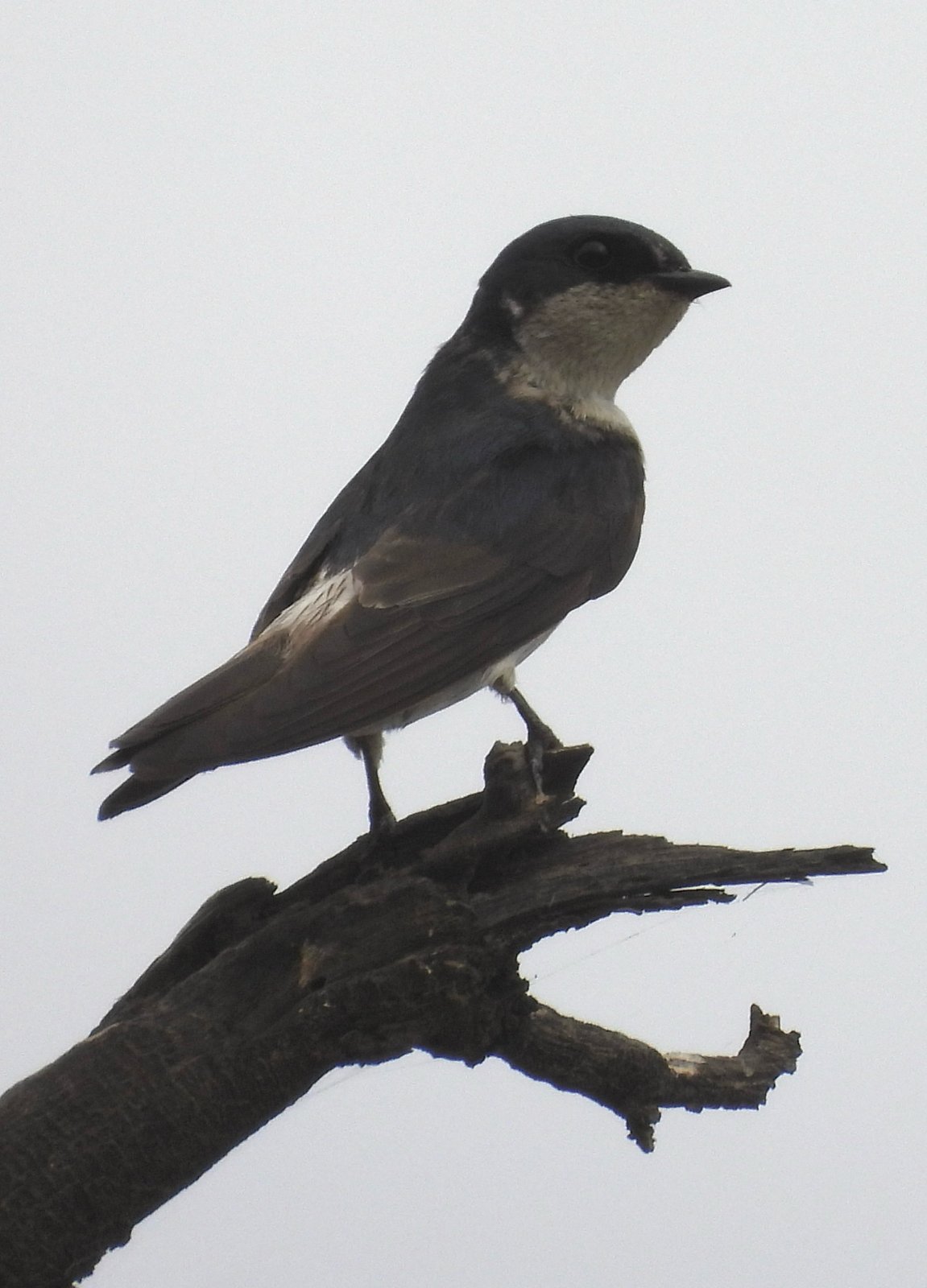
The Tumbes Swallow is a small, blue-and-white swallow with a restricted range in the dry north-west of Peru and the far south-west of Ecuador. It was formerly treated as a subspecies of Mangrove Swallow. Pairs and small groups hunt low over dry forest, scrub and fields, often along river valleys.
Voice
A short, dry, somewhat rasping call, and a soft twittering from small groups in flight.
Recording: Paul Coopmans — CC BY-NC-SA 4.0 · xeno-canto
Identification
12–13 cm, small, with a short, almost square tail. The upperparts are glossy blue to blue-green, with a narrow white line above the lores. The rump is white with fine dark streaks. On the wing the inner secondaries and tertials have narrow white edges. The underparts, including the undertail coverts, are white. The sexes are nearly alike. Juveniles are greyish brown above.
Confusion species
Mangrove Swallow Tachycineta albilinea is slightly larger, with a pure white, unstreaked rump and more white in the wing; it lives in Central America and the far north-west of Colombia and does not overlap with Tumbes Swallow. Blue-and-white Swallow Pygochelidon cyanoleuca lacks a white rump and has black undertail coverts. Chestnut-collared Swallow Petrochelidon rufocollaris has a rufous collar and a rufous rump.
Habitat
Tumbesian dry forest, thorn scrub and open country with scattered trees, especially along rivers, streams and irrigated fields, from the coast to roughly 1000 m. It hunts small flying insects low over the vegetation and open ground. It nests in cavities in trees and posts.
Where the bird is most at home, classified by the vegetation units of the Andes and the west coast.


Range and movements
In Peru in the north-west, mainly in Tumbes, Piura and Lambayeque. In Ecuador rare in the far south-west, in the border area with Peru. Absent from Colombia, Bolivia and the Galápagos. It does not occur outside the guide area.
- Resident
- dark = core range, pale = thinly spread
How and when to look
Search river valleys with dry forest and fields in Tumbes and Piura, for example in the dry forest of Pomac in Lambayeque; small groups often hunt low along the forest edge and over fields.
Conservation status
Least Concern. The range is small and the dry forest of the Tumbes region is being degraded, but the species tolerates partly agricultural land.
Scientific name
Tachycineta stolzmanni | (Philippi, 1902)
Philippi described the species in 1902 as Hirundo Stolzmanni; because it was later moved to another genus, the author and year stand in brackets. The genus Tachycineta was introduced in 1851 by Cabanis. The genus name comes from Greek takhukinētos, 'moving quickly'. Named after Jan Sztolcman (Jean Stolzmann, 1854–1928), Polish zoologist who collected birds in Peru. The specimen the first description was based on came from Chepén, La Libertad, Peru.