All species › Passerines › Swallows › White-winged Swallow
White-winged Swallow | Tachycineta albiventer
Witvleugelzwaluw | Golondrina aliblanca | Andorinha-do-rio
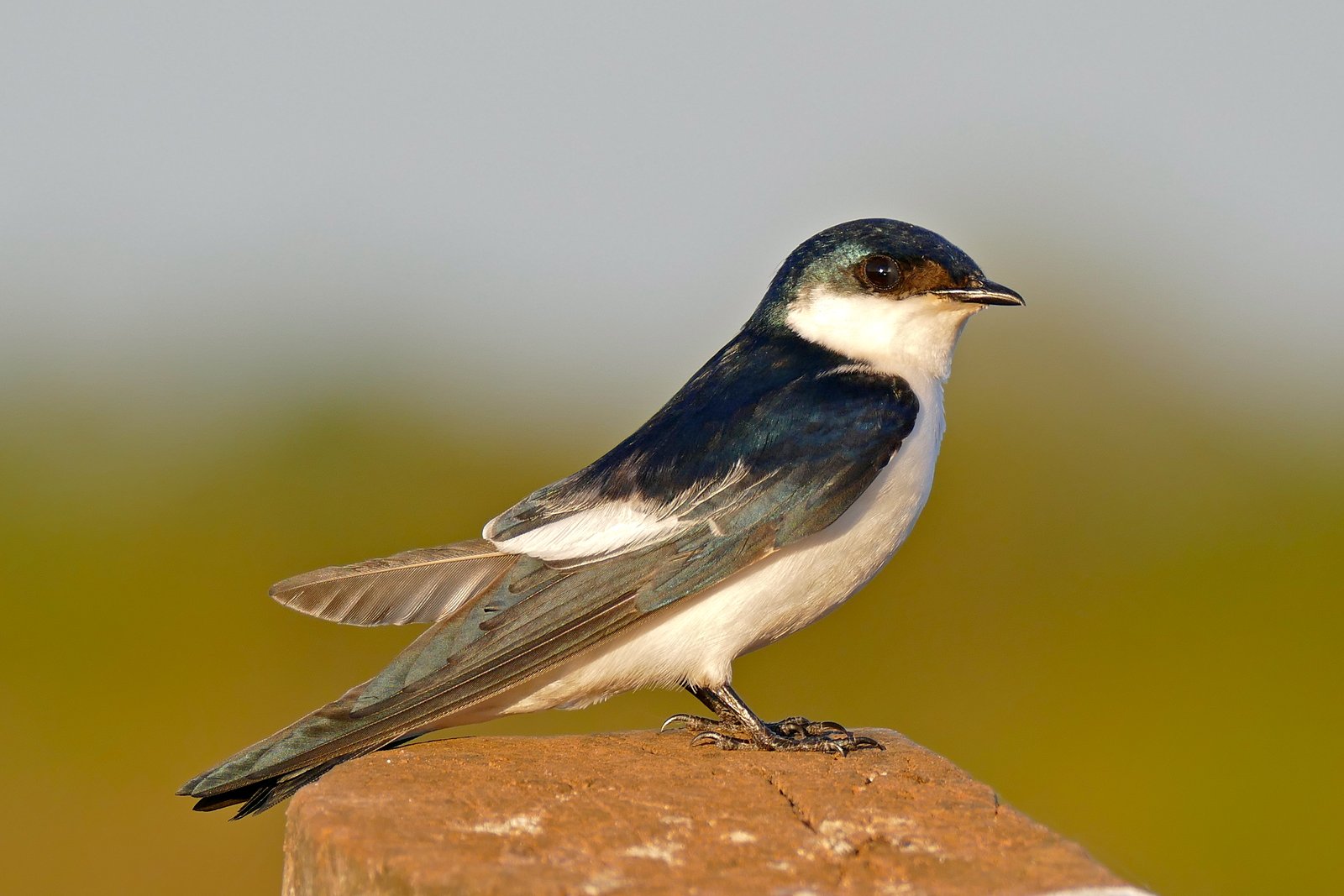
The White-winged Swallow is a blue-green-and-white swallow of rivers and lakes in the lowlands east of the Andes. With its large white wing patch and white rump it can be recognised in flight as well. Pairs and small groups often perch on dead branches, posts and snags projecting above the water.
Voice
A short, somewhat buzzy drreet or chirrt, often repeated in flight and from a perch.
Recording: JAYRSON ARAUJO DE OLIVEIRA — CC BY-NC-SA 4.0 · xeno-canto
Identification
13–14 cm, compact, with a short, slightly forked tail. The upperparts are glossy blue-green. The rump is white. The closed wing shows a large white patch, formed by the white edges of the inner secondaries, tertials and greater coverts. The underparts are pure white. There is no white line above the lores. The sexes are nearly alike. Juveniles are greyish brown above, with less white in the wing.
Confusion species
White-rumped Swallow Tachycineta leucorrhoa has a white line above the lores and much less white in the wing; it lives in south-eastern Bolivia. Mangrove Swallow Tachycineta albilinea is smaller, with less white in the wing and a white line above the lores, and occurs only in the far north-west of Colombia. Blue-and-white Swallow Pygochelidon cyanoleuca lacks a white rump and white in the wing and has black undertail coverts. White-banded Swallow Atticora fasciata is blue-black, with a white breast band.
Habitat
Large and small rivers, lakes, oxbow lakes (cochas), marshes and flooded forest in the lowlands, mostly below 500 m, locally higher. It hunts flying insects low over the water and often returns to a regular perch. It nests in cavities in dead trees, posts, bridges and banks.
Where the bird is most at home, classified by the vegetation units of the Andes and the west coast.


Range and movements
In Colombia in the lowlands east of the Andes and in the Magdalena valley. In Ecuador in the Amazonian lowlands. In Peru in the Amazonian lowlands. In Bolivia in the lowlands of the north and east. Absent west of the Andes and from the Galápagos. Outside the guide area in Venezuela, the Guianas, Brazil, Paraguay and north-eastern Argentina.
- Resident
- dark = core range, pale = thinly spread
How and when to look
During a boat trip on Amazonian rivers and cochas, watch dead branches above the water; pairs often perch there and make repeated short foraging flights.
Conservation status
Least Concern. The species is widespread and common along lowland rivers and lakes.
Scientific name
Tachycineta albiventer | (Boddaert, 1783)
Boddaert described the species in 1783 as Hirundo albiventer; because it was later moved to another genus, the author and year stand in brackets. The genus Tachycineta was introduced in 1851 by Cabanis. The genus name comes from Greek takhukinētos, 'moving quickly'. From Latin albus, 'white', and venter, 'belly', after the white underparts. The specimen the first description was based on came from Cayenne, French Guiana.