All species › Waders, gulls and terns › Sandpipers and allies › Hudsonian Godwit
Hudsonian Godwit | Limosa haemastica
Rode grutto | Aguja café | Maçarico-de-bico-virado
The Hudsonian Godwit breeds in Alaska and around Hudson Bay and winters at the southern tip of South America. On the way it overflies much of the continent in long non-stop flights, so in the guide area it appears fairly scarcely and irregularly on passage, on the coast, in the lowlands and on lakes in the Andes.
Voice
A high, whistled ke-weet or god-wit, mainly in flight.
Recording: Avery Bartels — CC BY-NC-SA 4.0 · xeno-canto
Identification
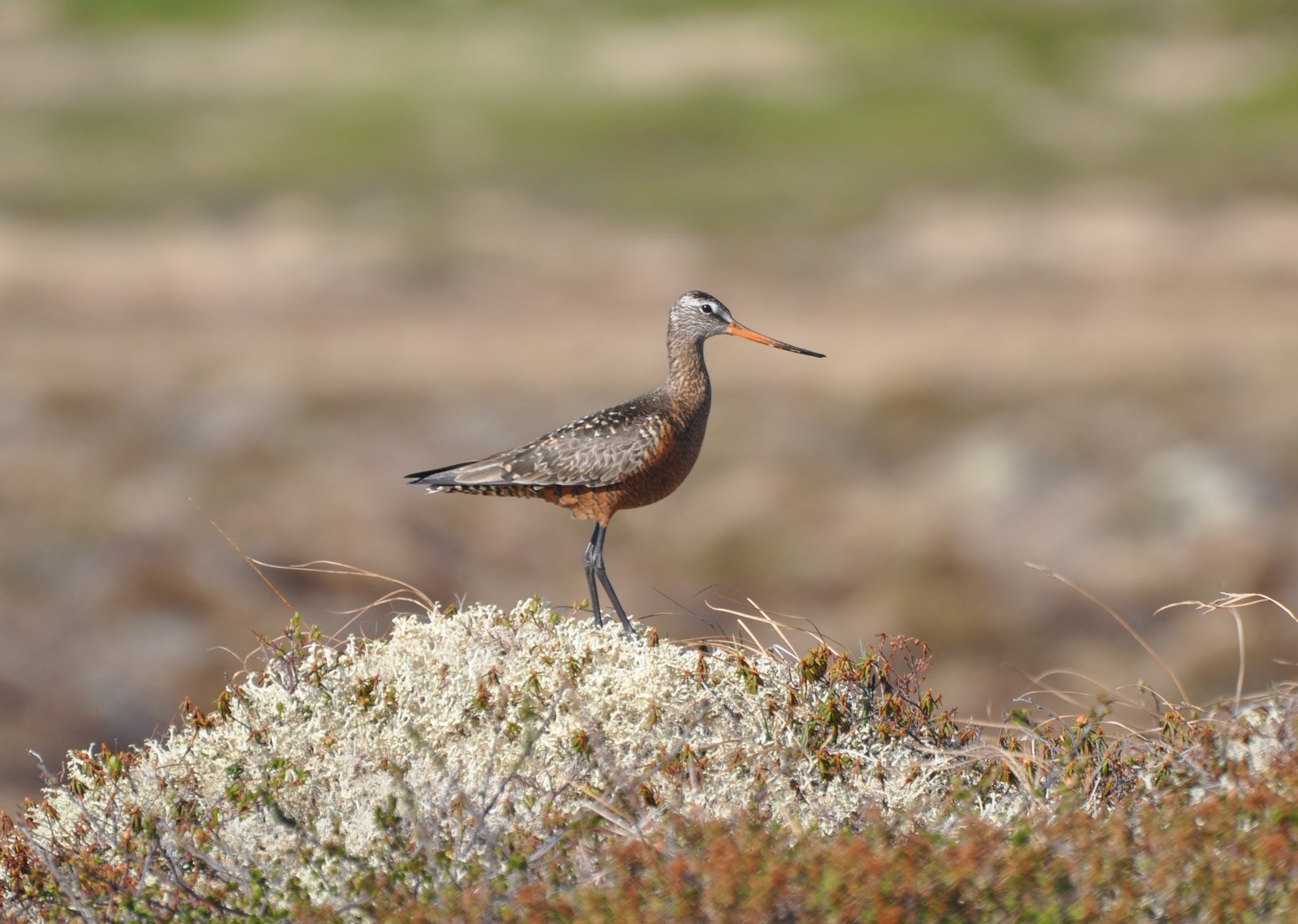
36–42 cm, a slender godwit with a long, slightly upturned bill, pink at the base and black at the tip, and long, dark legs. In non-breeding plumage plain grey on the upperparts and breast, with a pale supercilium and a white belly. In breeding plumage the male is deep chestnut on the underparts, with fine dark barring, and has dark-spotted upperparts; the female is paler. In flight black underwing coverts, a narrow white wing bar, a white rump and a black tail. Juveniles are brownish grey with pale feather fringes.
Confusion species
Bar-tailed Godwit Limosa lapponica, a very rare vagrant, has no wing bar, pale underwings, a barred tail and streaked upperparts. Marbled Godwit Limosa fedoa is larger and cinnamon brown, with cinnamon-rufous underwings. Short-billed Dowitcher Limnodromus griseus is smaller, with a straight bill, shorter legs and a white wedge on the back.
Habitat
On migration mudflats, lagoons and estuaries on the coast, shallow lakes and wet grasslands in the lowlands, river sandbars and lakes on the puna. It probes the mud for worms, insect larvae and crustaceans, often wading belly-deep. It does not breed in the guide area.
Where the bird is most at home, classified by the vegetation units of the Andes and the west coast.


Range and movements
In Colombia a rare passage migrant, mainly in the Amazonian lowlands and on the coast. In Ecuador rare on passage on the coast and in the Amazonian lowlands. In Peru a passage migrant on the coast, in the Amazonian lowlands and on lakes in the Andes, with a few birds on the coast in the northern winter and summer. In Bolivia a passage migrant in the lowlands and rare on the altiplano. Breeds in Alaska and around Hudson Bay and winters mainly in southern Chile, especially on Chiloé, and in Argentina south to Tierra del Fuego.
- Resident
- Winter visitor (c. Oct–Mar)
- Passage (Mar–Apr, Oct–Nov)
- dark = core range, pale = thinly spread
How and when to look
In September and October and again in April and May on shallow lagoons and mudflats on the coast of Peru or on wet grasslands in the lowlands; usually a few birds among yellowlegs and other shorebirds. In flight look for the black tail and the black underwings.
Conservation status
Vulnerable. The population is declining; the species depends on a small number of stopover sites along the migration route, and climate change disrupts the timing between the breeding season and the food supply on the breeding grounds.
Scientific name
Limosa haemastica | (Linnaeus, 1758)
Linnaeus described the species in 1758 as Scolopax Haemastica; because it was later moved to another genus, the author and year stand in brackets. The genus Limosa was introduced in 1760 by Brisson. The genus name comes from Latin limosus, 'muddy', from limus, 'mud'. The species name comes from Greek haimatikos, 'bloody', after the reddish breeding plumage. The specimen the first description was based on came from Hudson Bay, Canada.