All species › Waders, gulls and terns › Sandpipers and allies › Marbled Godwit
Marbled Godwit | Limosa fedoa
Marmergrutto | Aguja canela | Maçarico-marmóreo
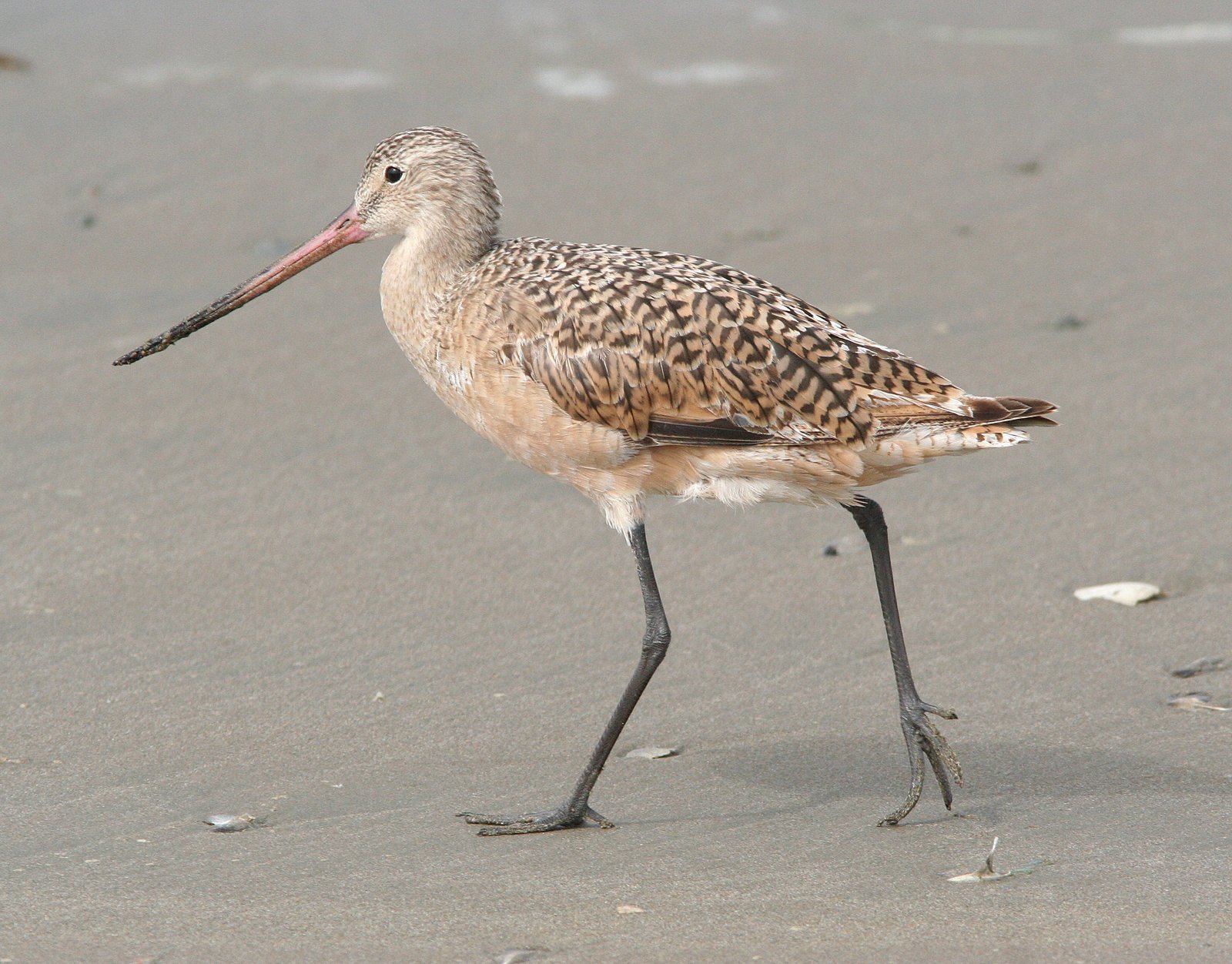
The Marbled Godwit is the largest godwit of the Americas, a cinnamon-brown shorebird with a very long, slightly upturned bill. It breeds on the prairies of North America and winters mainly along the coasts from California to Central America. In the guide area it is a scarce winter visitor along the Pacific coast, mainly in Colombia and Ecuador.
Voice
A loud, nasal ka-wek or ker-ek, often in flight.
Recording: Nancy Salem — CC BY-NC-SA 4.0 · xeno-canto
Identification
42–48 cm, a large, cinnamon-brown godwit with a very long, slightly upturned bill, pink at the base and black at the tip, and long, dark grey legs. Upperparts spotted and barred dark with cinnamon; underparts warm buff, finely barred dark in breeding plumage and almost plain in non-breeding plumage. In flight cinnamon-rufous underwings and inner primaries, without a white rump or wing bar. The sexes are alike; the female is larger with a longer bill.
Confusion species
Long-billed Curlew Numenius americanus has the same cinnamon colour but a down-curved bill. Hudsonian Godwit Limosa haemastica is smaller and grey in non-breeding plumage, with a white rump, a black tail, a white wing bar and black underwings. Bar-tailed Godwit Limosa lapponica, a very rare vagrant, is greyer, with streaked upperparts and a white or barred rump. Hudsonian Whimbrel Numenius hudsonicus is greyish brown, with crown stripes and a curved bill.
Habitat
Mudflats, estuaries, sandy beaches and salt pans on the coast. It probes deep into mud and sand for worms, molluscs and crustaceans, often in shallow water. At high tide it roosts among Hudsonian Whimbrels and Willets. It does not breed in the guide area.
Where the bird is most at home, classified by the vegetation units of the Andes and the west coast.


Range and movements
In Colombia a scarce winter visitor along the Pacific coast and rare on the Caribbean coast. In Ecuador scarce along the coast, especially around the Gulf of Guayaquil and the Santa Elena peninsula. In Peru rare on the north coast and very rare further south. Absent from Bolivia. Breeds on the prairies of North America and in small numbers near Hudson Bay and in Alaska, and winters along the coasts from California to Central America and north-western South America.
- Resident
- Winter visitor (c. Oct–Mar)
- Passage (Mar–Apr, Oct–Nov)
- dark = core range, pale = thinly spread
How and when to look
From September to April on mudflats and beaches on the coast of Ecuador, for example around Santa Elena and in the Gulf of Guayaquil; usually singly or in small groups among other large shorebirds.
Conservation status
Vulnerable. The population is declining through the loss of prairie wetlands on the breeding grounds and of mudflats and roosts on the coast.
Scientific name
Limosa fedoa | (Linnaeus, 1758)
Linnaeus described the species in 1758 as Scolopax Fedoa; because it was later moved to another genus, the author and year stand in brackets. The genus Limosa was introduced in 1760 by Brisson. The genus name comes from Latin limosus, 'muddy', from limus, 'mud'. The species name is an old English name for a godwit; in 1544 William Turner wrote that the English called the bird 'Godwitt' or 'Fedoa'. The specimen the first description was based on came from Hudson Bay, Canada.