All species › Waders, gulls and terns › Sandpipers and allies › Long-billed Curlew
Long-billed Curlew | Numenius americanus
Amerikaanse wulp | Zarapito pico largo | Maçarico-de-bico-comprido
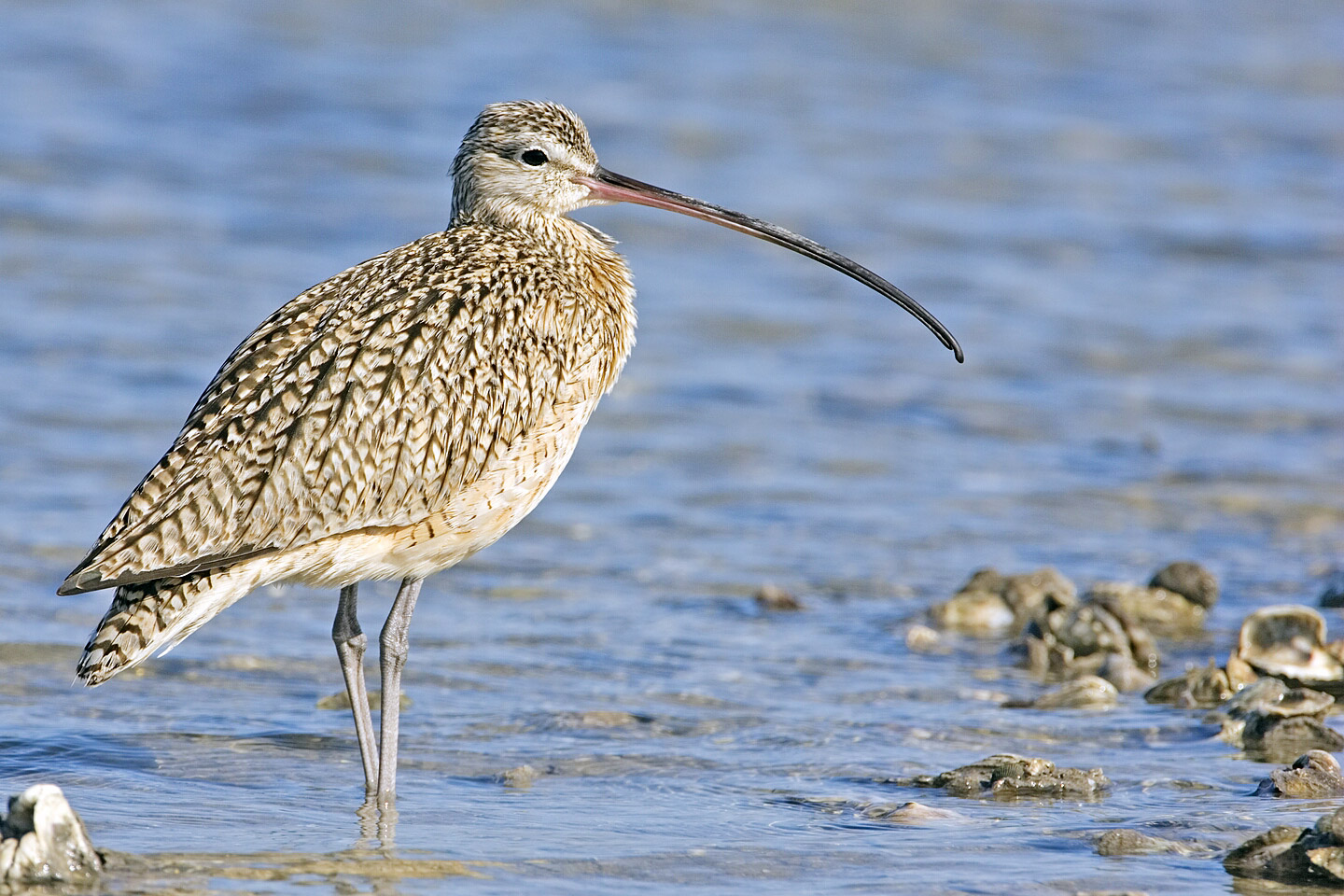
The Long-billed Curlew is the largest shorebird of North America, with a very long, curved bill. It breeds on the prairies of the western United States and Canada and winters mainly from California to Mexico. The guide area lies at the southern edge of its winter range: here it is a rare winter visitor, mainly in Colombia.
Voice
A loud, rising cur-lee and, when disturbed, a rapid, rattling kli-li-li-li.
Recording: Paul Marvin — CC BY-NC-SA 4.0 · xeno-canto
Identification
50–65 cm, a large curlew with a very long, strongly down-curved bill, up to about 20 cm in the female and shorter in the male and juveniles. Plumage warm cinnamon brown, with dark spots and barring on the upperparts and fine streaks on the neck and breast; the head is rather plain, without clear crown stripes. In flight cinnamon-rufous underwings and cinnamon inner primaries. Legs bluish grey. The sexes are alike in plumage; the female is larger.
Confusion species
Hudsonian Whimbrel Numenius hudsonicus is smaller and greyer, with a shorter bill, distinct dark crown stripes and brown, barred underwings. Marbled Godwit Limosa fedoa has a similar cinnamon colour and cinnamon-rufous underwings, but a straight to slightly upturned pink bill with a black tip.
Habitat
Mudflats, estuaries, sandy beaches and salt marshes; in the north of its range also grasslands and pastures. It probes deep into the mud with its long bill for crabs, shrimps and worms, or picks up insects on dry land. It does not breed in the guide area.
Where the bird is most at home, classified by the vegetation units of the Andes and the west coast.


Range and movements
In Colombia a rare winter visitor to the Caribbean and Pacific coasts. In Ecuador very rare on the coast. From Peru and Bolivia there are at most a few records. Breeds on the prairies of western North America and winters mainly from California and Texas to Mexico, in small numbers south to Central America.
- Winter visitor (c. Oct–Mar)
- Passage (Mar–Apr, Oct–Nov)
- dark = core range, pale = thinly spread
How and when to look
From October to March among Hudsonian Whimbrels on mudflats and sandy beaches on the Caribbean coast of Colombia; its size, cinnamon colour and very long bill set it apart.
Conservation status
Least Concern. On the breeding grounds the population has declined locally through the ploughing of prairies.
Scientific name
Numenius americanus | Bechstein, 1812
Bechstein described the species in 1812 and placed it straight away in the genus where it still stands. The genus Numenius was introduced in 1760 by Brisson. The genus name comes from Greek noumēnios, a bird mentioned by Hesychius. It appears to derive from neos, 'new', and mēnē, 'moon', after the crescent-shaped bill. The species name refers to America. The specimen the first description was based on came from New York, United States.