All species › Waders, gulls and terns › Sandpipers and allies › Hudsonian Whimbrel
Hudsonian Whimbrel | Numenius hudsonicus
Amerikaanse regenwulp | Zarapito trinador americano | Maçarico-galego
The Hudsonian Whimbrel is the most widespread curlew in the guide area. It breeds on the tundra of Alaska and Canada and winters along the coasts of the Americas, including the whole Pacific coast from Colombia to Peru and the Galápagos. It is now often treated as a separate species from the Eurasian Whimbrel.
Voice
A rapid series of clear whistles on one pitch, pi-pi-pi-pi-pi-pi-pi, often in flight and when disturbed.
Recording: JAYRSON ARAUJO DE OLIVEIRA — CC BY-NC-SA 4.0 · xeno-canto
Identification
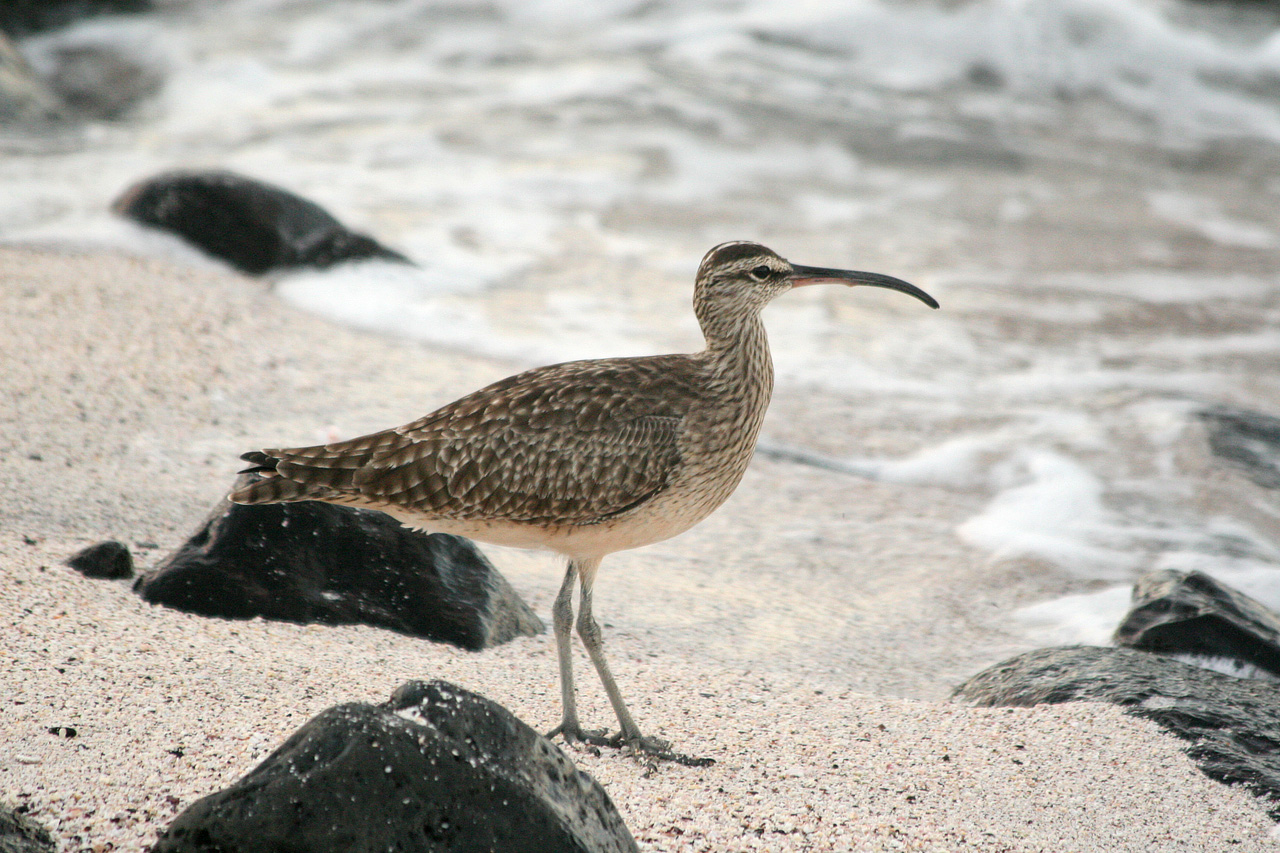
40–46 cm, a medium-sized, greyish brown curlew with a long, down-curved bill, longer in the female than in the male. The head has a dark crown with a pale central stripe, a pale supercilium and a dark eye-stripe. Upperparts greyish brown with pale spots and fringes; neck and breast pale brown and finely streaked, belly dull white. In flight uniformly brown above, without a white rump, and with brown, barred underwings. Legs bluish grey. The sexes are alike; juveniles have a shorter bill and more spotted upperparts.
Confusion species
Eurasian Whimbrel Numenius phaeopus, at most a very rare vagrant, has a white lower back and rump and whitish underwings. Long-billed Curlew Numenius americanus is larger and warmer cinnamon brown, with a much longer bill, cinnamon underwings and no clear head stripes. Marbled Godwit Limosa fedoa is also cinnamon brown but has a slightly upturned, two-toned bill.
Habitat
Mudflats, estuaries, sandy and rocky shores, mangroves, salt marshes and the edges of salt pans and shrimp ponds, almost only at sea level; on the Galápagos also lava shores. With its curved bill it takes crabs, worms and other invertebrates, often from burrows in the mud or between rocks. At high tide it roosts in flocks, also in mangroves. It does not breed in the guide area.
Where the bird is most at home, classified by the vegetation units of the Andes and the west coast.


Range and movements
In Colombia along the entire Pacific and Caribbean coasts. In Ecuador and Peru along the entire coast, in smaller numbers in southern Peru. On the Galápagos a regular winter visitor to the shores of all the main islands. Inland, including Bolivia, only a rare passage migrant. Breeds in Alaska and northern Canada and winters along the coasts from the southern United States to southern South America.
- Resident
- Winter visitor (c. Oct–Mar)
- Passage (Mar–Apr, Oct–Nov)
- dark = core range, pale = thinly spread
How and when to look
Year-round on the coast, most numerous from September to April: on mudflats and in mangroves, for example in the Gulf of Guayaquil, and on the rocky shores of the Galápagos. The rapid whistled call is often heard as birds take off.
Conservation status
Not evaluated as a separate species. The population is declining in parts of the range; hunting along the migration route in the Caribbean and the loss of mudflats and mangroves play a role.
Scientific name
Numenius hudsonicus | Latham, 1790
Latham described the species in 1790 and placed it straight away in the genus where it still stands. The genus Numenius was introduced in 1760 by Brisson. The genus name comes from Greek noumēnios, a bird mentioned by Hesychius. It appears to derive from neos, 'new', and mēnē, 'moon', after the crescent-shaped bill. The species name refers to Hudson Bay. The specimen the first description was based on came from Hudson Bay, Canada.