All species › Waders, gulls and terns › Sandpipers and allies › Upland Sandpiper
Upland Sandpiper | Bartramia longicauda
Bartrams ruiter | Correlimos batitú | Maçarico-do-campo
The Upland Sandpiper is a shorebird of dry grassland, related to the curlews, that rarely comes to water. It breeds on the prairies and in open country of North America and winters on the pampas of South America. In the guide area it passes mainly through the lowlands east of the Andes, usually singly or in small groups.
Voice
In flight a soft, rolling quip-ip-ip-ip, often on taking off. The long, rising and falling whistle of the breeding grounds is rarely heard in the guide area.
Recording: Stanislas Wroza — CC BY-NC-SA 4.0 · xeno-canto
Identification
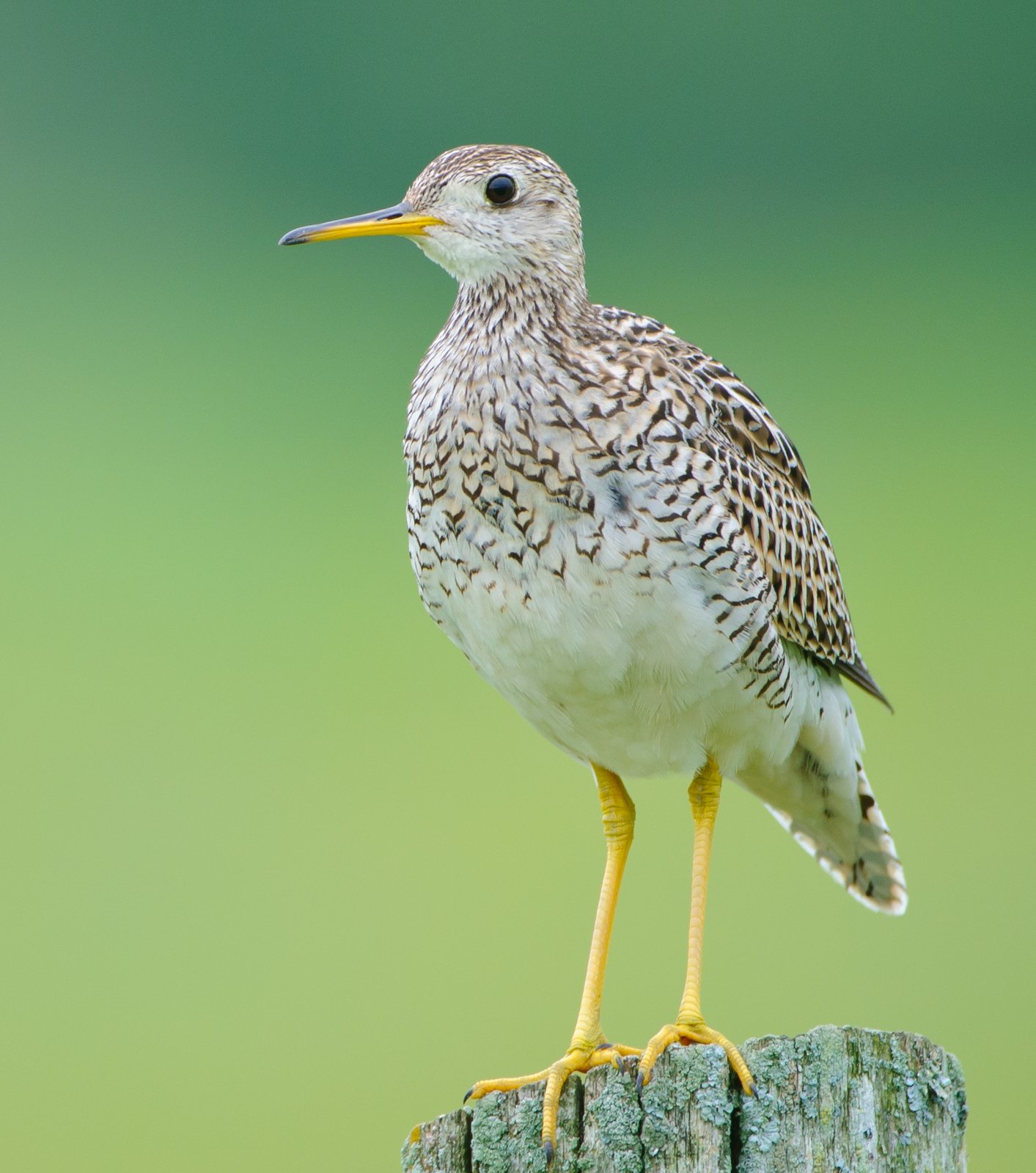
28–32 cm, a slender shorebird with a small, round head on a long, thin neck, a short, straight yellow bill with a dark tip, large dark eyes in a pale face, a long tail projecting beyond the wingtips and yellow legs. Upperparts brown, with dark centres and pale fringes to the feathers, giving a scaly look; neck and breast buff with fine dark streaks and arrowhead marks, flanks barred dark and belly white. In flight dark primaries contrast with a paler upperwing and a dark rump; the wingbeats are shallow and jerky. After landing it often holds its wings raised for a moment. The sexes are alike; juveniles have a warmer breast with fewer markings.
Confusion species
Buff-breasted Sandpiper Calidris subruficollis uses the same grasslands but is smaller, with a shorter neck and tail, a shorter black bill and a plain buff face and underparts without streaks. American Golden-Plover Pluvialis dominica has a larger head, a shorter neck, a black bill and dark grey legs. Lesser Yellowlegs Tringa flavipes also has yellow legs but a longer, thin black bill and a white rump, and keeps to the water's edge.
Habitat
On migration on short grassland, pastures, savannas, airfields and bare fields, mostly in the lowlands and sometimes on grasslands higher in the Andes. It walks through the grass with a bobbing head, picking up insects, especially grasshoppers and beetles, and spiders. It does not breed in the guide area.
Where the bird is most at home, classified by the vegetation units of the Andes and the west coast.


Range and movements
In Colombia a passage migrant in the Llanos and the Amazonian lowlands, rare in the Andes and on the coast. In Ecuador a scarce passage migrant in the Amazonian lowlands and rare in the Andes. In Peru a passage migrant in the Amazonian lowlands, rare in the Andes and on the coast. In Bolivia a passage migrant in the lowlands, especially in the savannas of the Beni, where a few birds also winter. Breeds on the prairies and open grasslands of North America, north to Alaska, and winters mainly on the grasslands of Argentina, Uruguay and southern Brazil.
- Winter visitor (c. Oct–Mar)
- Passage (Mar–Apr, Oct–Nov)
- dark = core range, pale = thinly spread
How and when to look
In September and October and again in March and April on airfields, pastures and savannas in the lowlands, for example in the Beni or the Llanos. Birds often stand upright in the grass or on fence posts and are often noticed only when they fly up calling.
Conservation status
Least Concern. The population fell sharply through hunting around 1900 and has partly recovered since; the loss of prairies and grasslands on the breeding and wintering grounds causes local declines.
Scientific name
Bartramia longicauda | (Bechstein, 1812)
Bechstein described the species in 1812 as Tringa longicauda; because it was later moved to another genus, the author and year stand in brackets. The genus Bartramia was introduced in 1831 by Lesson. The genus name honours the American naturalist William Bartram (1739–1823), who taught Alexander Wilson ornithology and natural history illustration. The specific name comes from Latin longus, 'long', and cauda, 'tail', after the tail, long for a sandpiper. The specimen the first description was based on came from North America.