All species › Waders, gulls and terns › Jacanas › Northern Jacana
Northern Jacana | Jacana spinosa
Midden-Amerikaanse jacana | Jacana centroamericana | Jaçanã-do-norte
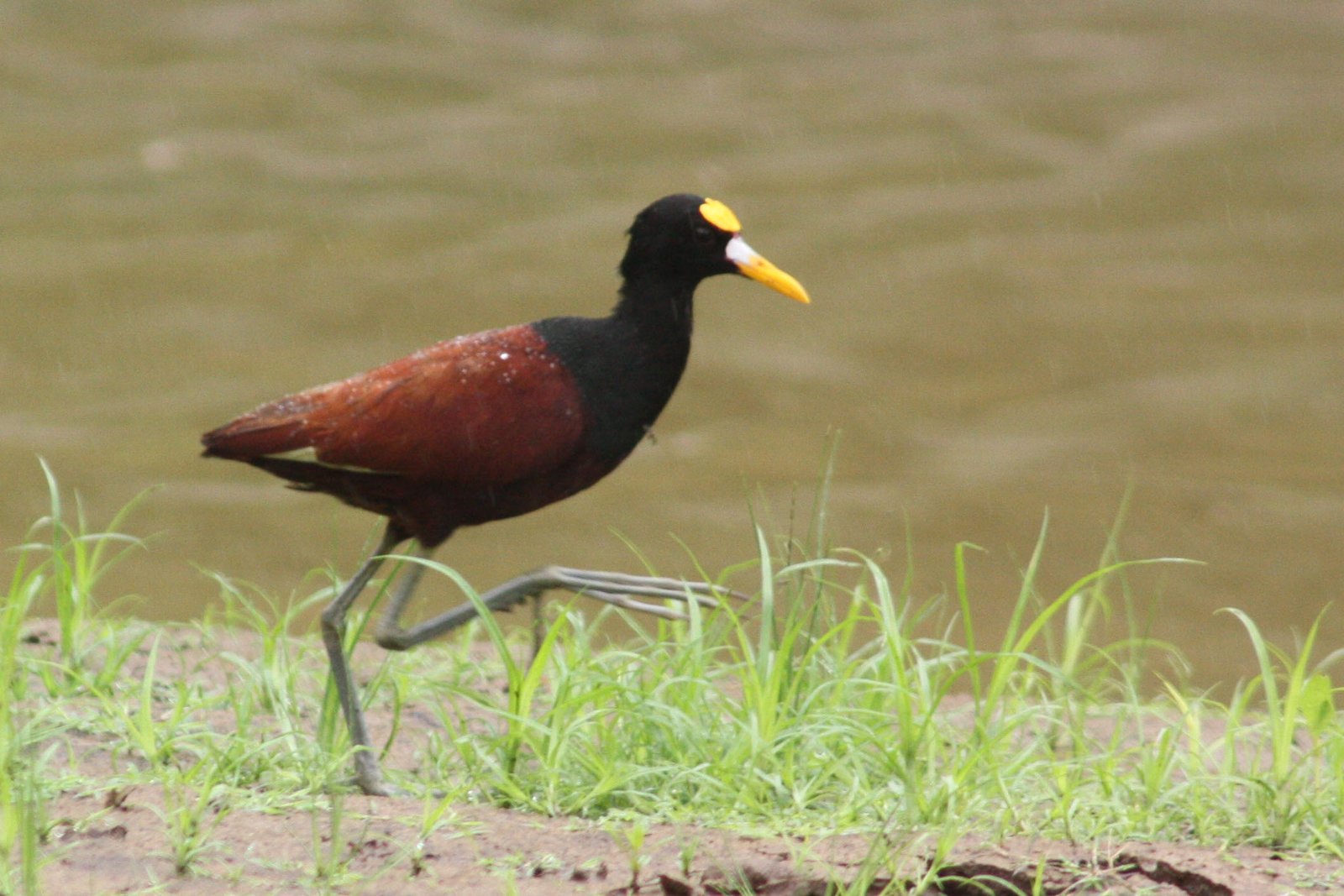
The Northern Jacana is the northern counterpart of the Wattled Jacana and lives from Mexico to western Panama and in the Caribbean. With its extremely long toes it walks over floating water plants. In the guide area it has been recorded only as a very rare vagrant.
Voice
A rapid, shrill chatter and rasping, cackling calls, mainly when disturbed and in flight.
Recording: Zsombor Károlyi — CC BY-NC-SA 4.0 · xeno-canto
Identification
17–23 cm, with a small head, long, greenish legs and very long toes and claws. Adults have a black head, neck and breast and a dark chestnut body. The bill is yellow with a whitish base, and on the forehead there is a yellow, three-lobed shield; wattles at the base of the bill are absent. The flight feathers are yellow-green and show in flight and when the wings are raised. The female is larger than the male. Juveniles are brown above and white below, with a white supercilium.
Confusion species
Wattled Jacana Jacana jacana has a red frontal shield and red wattles at the base of the bill; juveniles of the two species cannot be separated with certainty in the field. Purple Gallinule Porphyrio martinica also walks over water plants, but is purple-blue and green, with a red bill with a yellow tip and without yellow-green flight feathers.
Habitat
Lakes, ponds and marshes with floating vegetation such as water lilies and water hyacinth. It takes insects, snails and seeds from the leaves. It does not breed in the guide area.
Where the bird is most at home, classified by the vegetation units of the Andes and the west coast.


Range and movements
In the guide area only as a very rare vagrant, with only a few records in northern Colombia. Absent from the Galápagos. It breeds from Mexico to western Panama and in the Greater Antilles.
How and when to look
Check jacanas on marshes in northern Colombia, especially near the border with Panama, for the colour of the frontal shield and the absence of wattles.
Conservation status
Least Concern. The species is common within its range.
Scientific name
Jacana spinosa | (Linnaeus, 1758)
Linnaeus described the species in 1758 as Fulica spinosa; because it was later moved to another genus, the author and year stand in brackets. The genus Jacana was introduced in 1760 by Brisson. The genus name is the Latin spelling of Portuguese jaçanã, which goes back to a Tupi name for the bird. The species name is Latin spinosus, 'thorny', after the spurs at the bend of the wing. The specimen the first description was based on came from Panama.