All species › Waders, gulls and terns › Jacanas › Wattled Jacana
Wattled Jacana | Jacana jacana
Leljacana | Jacana suramericana | Jaçanã
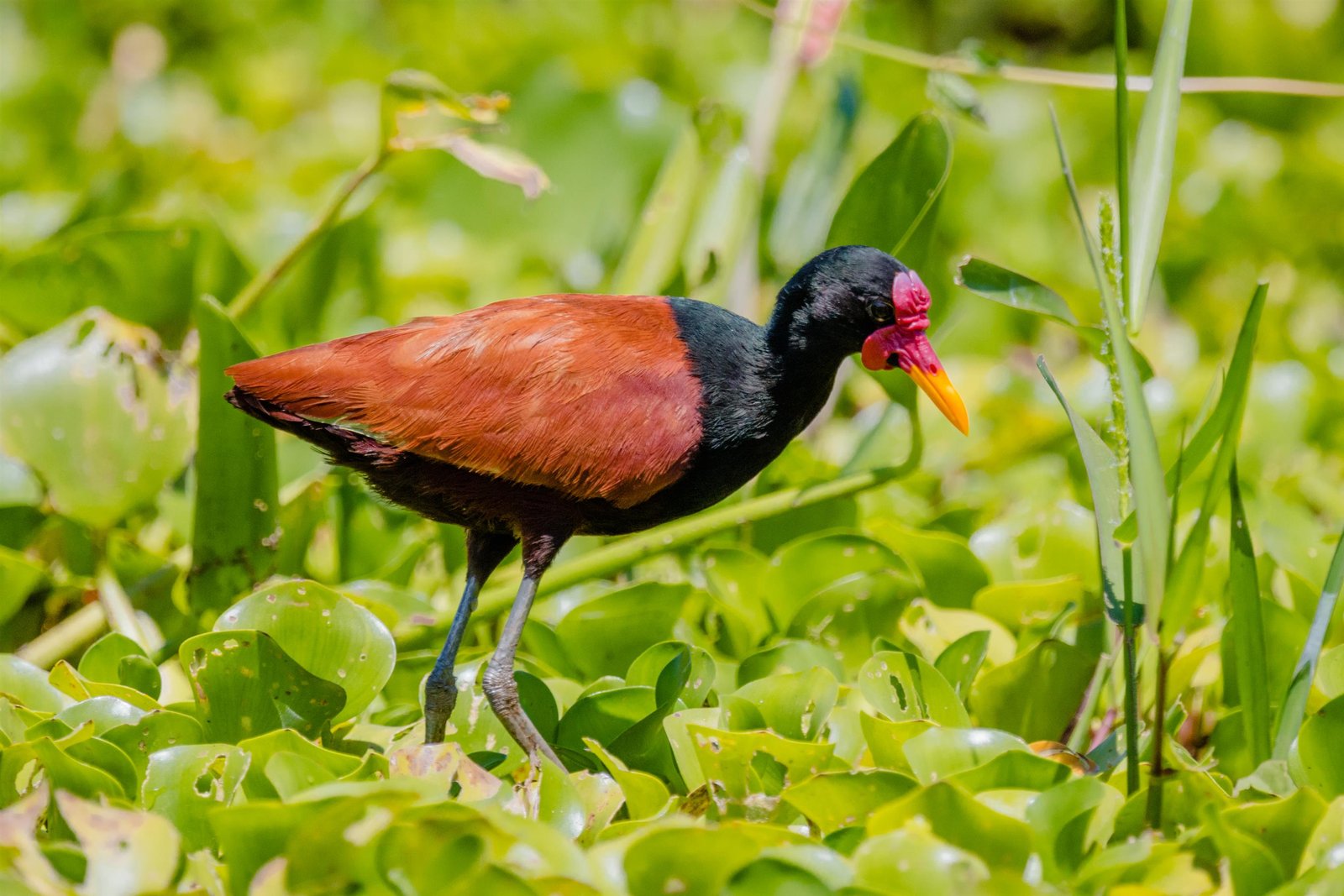
The Wattled Jacana is the jacana of South America, a familiar bird of marshes, rice fields and lakes with floating plants in the lowlands. With its very long toes it spreads its weight over the leaves and walks across the water. In this species the roles are reversed: the larger female defends a territory with several males, which incubate and care for the young.
Voice
Loud, rasping and cackling calls, kreek-kreek-kreek, and a shrill chatter, mainly when disturbed and in flight; several birds often call together.
Recording: Jacob Wijpkema — CC BY-NC-SA 4.0 · xeno-canto
Identification
21–25 cm, with long, grey-green legs and very long toes and claws. Adults of most subspecies have a black head, neck and underparts and a chestnut back and wing coverts; in north-western Colombia they are almost entirely black, and intermediate forms occur in western Ecuador and north-western Peru. The bill is yellow, with a red frontal shield and red wattles at the base of the bill. The flight feathers are yellow-green and show in flight; there is a yellow spur at the bend of the wing. The female is larger than the male. Juveniles are brown above and white below, with a white supercilium and a dark eye-stripe.
Confusion species
Northern Jacana Jacana spinosa has a yellow frontal shield and no wattles, and occurs only as a very rare vagrant in the north. Common Moorhen Gallinula chloropus and Purple Gallinule Porphyrio martinica also walk over water plants, but have short toes, a red bill with a yellow tip and no yellow-green flight feathers.
Habitat
Marshes, the edges of lakes and oxbows with floating plants, wet grassland, ditches, rice fields and flooded pastures in the lowlands, locally higher in Andean valleys. It takes insects, snails and seeds from floating leaves and in shallow water. The nest is a loose pile of plant material on floating vegetation.
Where the bird is most at home, classified by the vegetation units of the Andes and the west coast.


Range and movements
In Colombia common in the lowlands on both sides of the Andes, in the large river valleys, the llanos and Amazonia. In Ecuador in the western lowlands and Amazonia. In Peru in Amazonia and in the north-west along the coast. In Bolivia in the lowlands of the north and east. Absent from the Galápagos. Outside the guide area from Panama to northern Argentina and Uruguay.
- Resident
- dark = core range, pale = thinly spread
How and when to look
On almost any marsh or rice field with floating plants in the lowlands, for example in the llanos of Colombia, along the Guayas in Ecuador and in the oxbow lakes of Amazonia. On landing the bird briefly holds its wings raised, showing the yellow-green flight feathers.
Conservation status
Least Concern. The species is common and benefits locally from rice fields and wet pastures.
Scientific name
Jacana jacana | (Linnaeus, 1766)
Linnaeus described the species in 1766 as Parra Jacana; because it was later moved to another genus, the author and year stand in brackets. The genus Jacana was introduced in 1760 by Brisson. The genus name is the Latin spelling of Portuguese jaçanã, which goes back to a Tupi name for the bird. The species name repeats the genus name, the Latin spelling of Portuguese jaçanã, from Tupi. The specimen the first description was based on came from Suriname.