All species › Waders, gulls and terns › Seedsnipes › Least Seedsnipe
Least Seedsnipe | Thinocorus rumicivorus
Patagonische kwartelsnip | Agachona chica | Agachadeira-mirim
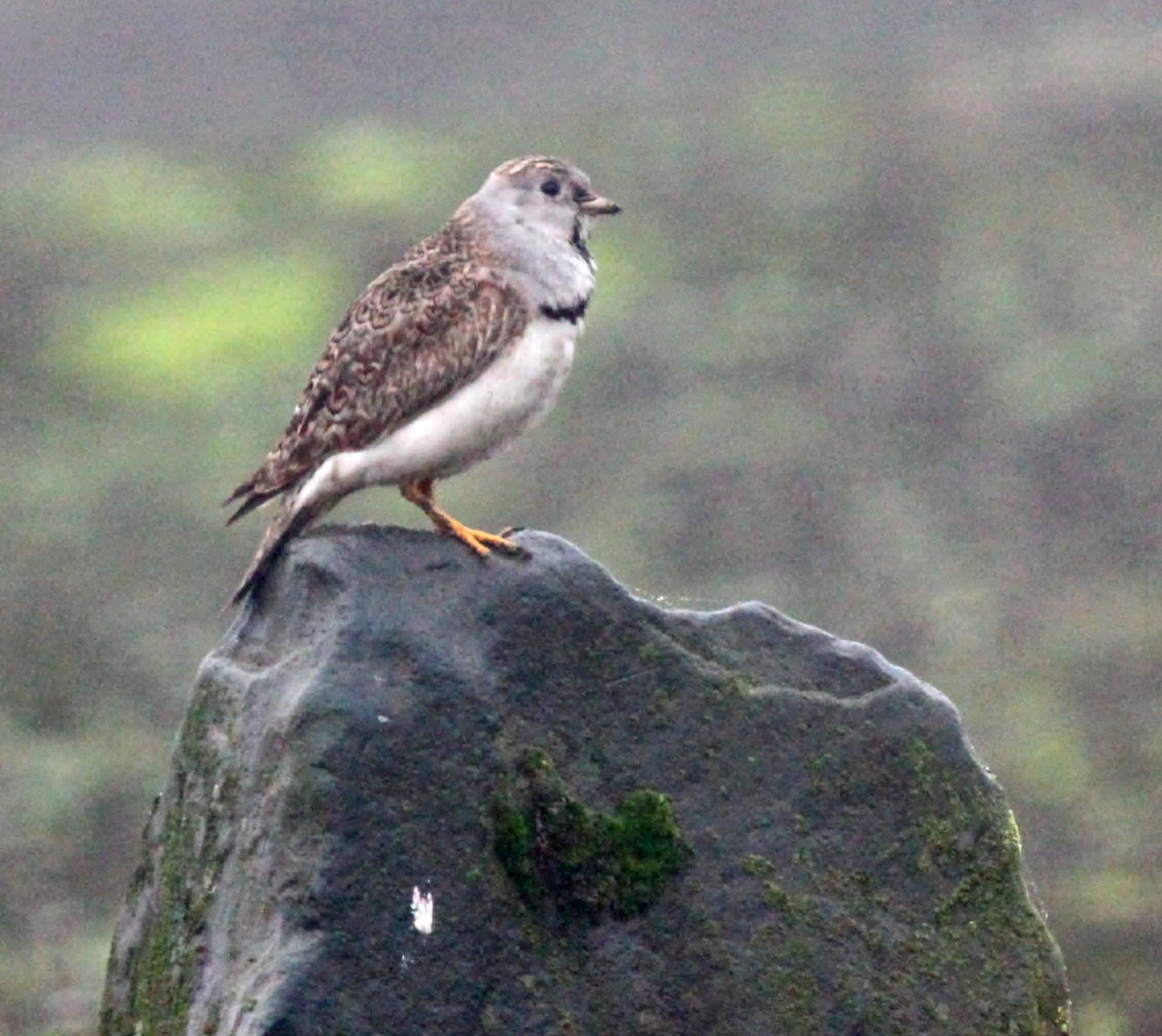
The Least Seedsnipe is the smallest seedsnipe, a sandy little bird that looks like a cross between a lark and a quail. It lives on bare, dry ground, from the coastal desert of Peru and Ecuador to the altiplano. The singing male repeats its dove-like call for hours, often in a fluttering display flight.
Voice
The song is a long, rhythmic series of hollow notes, poo-koo poo-koo poo-koo, from the ground, a rock or in display flight. When flushed a short, hoarse cheep.
Recording: Bernabe Lopez-Lanus — CC BY-NC-SA 3.0 · xeno-canto
Identification
16–19 cm, stocky, with a short, conical bill, short, yellow legs and long, pointed wings. The upperparts are sandy brown with black and pale scaling. The male has a grey face and breast, a white throat with a black stripe down the centre and a black border around the throat joining a black breast band; the belly is white. The female is brown, with a finely streaked breast and no black. In flight a narrow, white wing bar and dark underwings. Juveniles resemble the female.
Confusion species
Grey-breasted Seedsnipe Thinocorus orbignyianus is larger, the male lacks the black central throat stripe, and it lives in wet bogs high in the Andes. Females of the two species are very similar; note size and habitat. Puna Plover Anarhynchus alticola has a thin bill and longer legs, and runs in short bursts.
Habitat
Bare or sparsely vegetated sandy plains in the coastal desert, dry coastal scrub, lomas, field edges and, on the altiplano, dry, open plains with low shrubs, from sea level to about 4500 m. It eats seeds, buds and small leaves. It lives in pairs or, outside the breeding season, in small groups. The nest is a scrape on the ground.
Where the bird is most at home, classified by the vegetation units of the Andes and the west coast.


Range and movements
Absent from Colombia. In Ecuador in the dry coastal region of the south-west, mainly on the Santa Elena peninsula. In Peru along the dry coast over the whole length of the country and in the south also on the altiplano. In Bolivia on the altiplano; in the austral winter possibly also birds from the south. Absent from the Galápagos. Outside the guide area in Chile and Argentina, south to Tierra del Fuego; the southern birds move north in winter.
- Resident
- dark = core range, pale = thinly spread
How and when to look
Search bare sandy plains with scattered shrubs along the coast, for example on the Santa Elena peninsula in Ecuador and in the coastal desert near Lima and Paracas in Peru. Birds crouch flat on the ground and flush only just in front of your feet.
Conservation status
Least Concern. The species has a large range; habitat is lost locally to expanding irrigated agriculture and building along the coast.
Scientific name
Thinocorus rumicivorus | Eschscholtz, 1829
Eschscholtz described the species in 1829 and placed it straight away in the genus where it still stands. He introduced the genus Thinocorus in that same work. The genus name comes from Greek this, thinos, 'sand, beach', and korus, here 'lark'; Eschscholtz explained the name as 'beach' and 'lark'. The species name comes from Latin rumex, 'sorrel, dock', and -vorus, 'eating'. The specimen the first description was based on came from Concepción Bay, Chile.