All species › Waders, gulls and terns › Seedsnipes › Grey-breasted Seedsnipe
Grey-breasted Seedsnipe | Thinocorus orbignyianus
Punakwartelsnip | Agachona de pecho gris | Agachadeira-de-peito-cinza
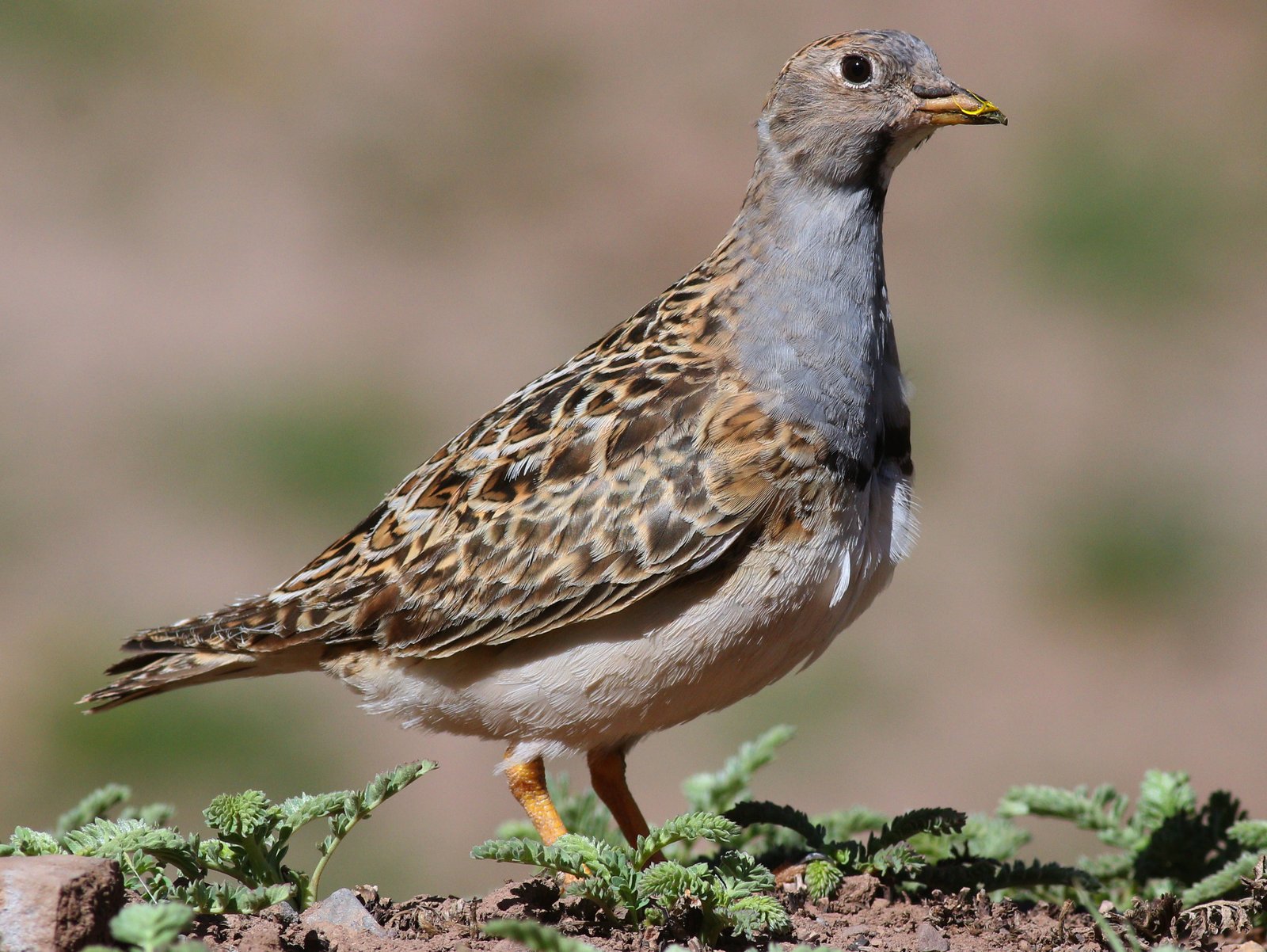
The Grey-breasted Seedsnipe is a stocky, quail-like seedsnipe of the bogs and wet grasslands of the high Andes. It walks with short steps among the cushion plants and crouches against the ground when disturbed. In the breeding season the male sings a dove-like, endlessly repeated song from a rock or in display flight.
Voice
The male's song is a long series of dove-like, hollow double notes, poo-koo poo-koo, from a rock or in an undulating display flight. When flushed a short, harsh chek.
Recording: Bernabe Lopez-Lanus — CC BY-NC-SA 3.0 · xeno-canto
Identification
21–24 cm, with a round head, a short, conical bill and short, yellow legs. The upperparts are scaled brown, black and sandy. The male has a grey face, grey neck and breast and a white throat bordered by a thin black line; a black band separates the breast from the white belly. The female lacks the grey and has a brown, finely streaked breast. In flight long, pointed wings with a narrow, pale wing bar. Juveniles resemble the female.
Confusion species
Least Seedsnipe Thinocorus rumicivorus is clearly smaller, and the male has a black stripe down the centre of the throat joining the black breast band; it mostly lives on drier, sandy ground. Rufous-bellied Seedsnipe Attagis gayi is much larger, with a rufous belly and no grey. Puna Snipe Gallinago andina shares the habitat but has a long bill and a striped head.
Habitat
Bofedales, cushion bogs, wet grassland along streams and lakes and the damp parts of the puna, mostly between 3500 and 5000 m. It eats leaves, buds and seeds of low plants. It lives in pairs or small groups. The nest is a scrape on the ground, often covered with plant material when the bird leaves it.
Where the bird is most at home, classified by the vegetation units of the Andes and the west coast.


Range and movements
Absent from Colombia and Ecuador. In Peru in the high Andes of the centre and south. In Bolivia in the western Andes and on the altiplano. Absent from the Galápagos. Outside the guide area in the Andes of Chile and Argentina, south to Patagonia.
- Resident
- dark = core range, pale = thinly spread
How and when to look
Search bofedales and wet grasslands on the puna, for example in the highlands of Junín, Cusco, Puno and Arequipa and on the Bolivian altiplano. In the breeding season the singing male gives itself away by its repeated call.
Conservation status
Least Concern. The species is locally common; drainage and overgrazing of bogs can degrade its habitat locally.
Scientific name
Thinocorus orbignyianus | Geoffroy Saint-Hilaire & Lesson, 1831
Geoffroy Saint-Hilaire & Lesson described the species in 1831 and placed it straight away in the genus where it still stands. The genus Thinocorus was introduced in 1829 by Eschscholtz. The genus name comes from Greek this, thinos, 'sand, beach', and korus, here 'lark'; Eschscholtz explained the name as 'beach' and 'lark'. The species name honours Alcide d'Orbigny (1802–1857), a French naturalist who travelled in South America from 1826 to 1834. The specimen the first description was based on came from Santiago, Chile.