All species › Waders, gulls and terns › Seedsnipes › Rufous-bellied Seedsnipe
Rufous-bellied Seedsnipe | Attagis gayi
Andeskwartelsnip | Agachona ventrirrufa | Agachadeira-de-barriga-ruiva
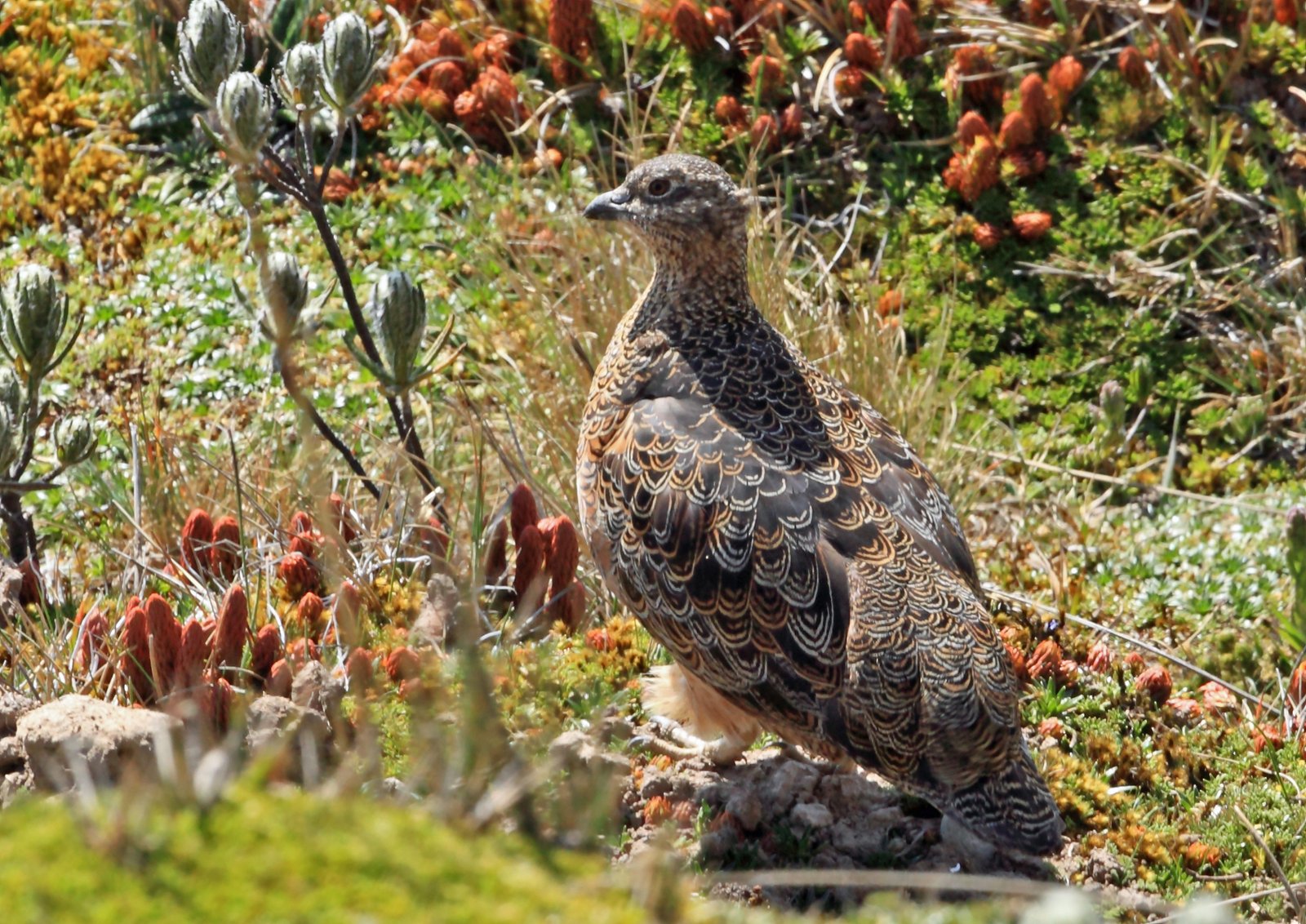
The Rufous-bellied Seedsnipe is the largest seedsnipe and lives higher than almost any other Andean bird, up to just below the snowline. With its stocky build, short legs and scaly brown plumage it resembles a ptarmigan more than a shorebird. It feeds on plant material and rarely drinks, taking its water from succulent cushion plants.
Voice
When flushed a rapid series of short, harsh calls, chuk-chuk-chuk; also a soft, dove-like cooing. In display flight a repeated, gurgling sound.
Recording: José María Loaiza B. — CC BY-NC-SA 4.0 · xeno-canto
Identification
27–30 cm, stocky and dove-like, with a small head, a short, conical bill and short, yellow legs. The upperparts are brown with black, cinnamon and pale scaling in a fine pattern. The throat and breast are scaled rufous-brown, and the belly is plain rufous to cinnamon. In flight long, pointed wings without a wing bar and rufous underwings. The sexes are alike; juveniles are more finely barred.
Confusion species
Grey-breasted Seedsnipe Thinocorus orbignyianus is much smaller, with a white throat and a white belly; the male has a grey breast. Puna Tinamou Tinamotis pentlandii is larger, with a striped head and a long neck, and rarely flies. Diademed Sandpiper-Plover Phegornis mitchellii is smaller and slimmer, with a long, thin bill and a white supercilium, and stays by streams in bogs.
Habitat
Bare mountain slopes with scree and cushion plants, the edges of bogs and bofedales and the highest grasslands, mostly between 4000 and 5500 m. It eats buds, leaves and seeds of low plants, especially cushion plants. It lives in pairs or small groups that crouch on the ground and flush only at the last moment. The nest is a scrape on the ground.
Where the bird is most at home, classified by the vegetation units of the Andes and the west coast.


Range and movements
Absent from Colombia. In Ecuador very locally in the highest part of the páramo, on a few high volcanoes in the centre and north. In Peru in the high Andes along the whole length of the country. In Bolivia in the western Andes and the high cordilleras. Absent from the Galápagos. Outside the guide area in the Andes of Chile and Argentina, south to Tierra del Fuego.
- Resident
- dark = core range, pale = thinly spread
How and when to look
Search scree slopes and cushion bogs just below the snowline, for example on Chimborazo and Antisana in Ecuador and on high passes in Peru and Bolivia. Birds often crouch flat on the ground; scan the slopes slowly before walking on.
Conservation status
Least Concern. Its habitat lies high and is little disturbed; the population is considered stable.
Scientific name
Attagis gayi | Geoffroy Saint-Hilaire & Lesson, 1831
Geoffroy Saint-Hilaire & Lesson described the species in 1831 and placed it straight away in the genus where it still stands. He introduced the genus Attagis in that same work. The genus name is Greek attagis, a name for a game bird in ancient texts, probably the Black Francolin. The species name honours Claude Gay (1800–1873), a French botanist and naturalist who described the natural history of Chile. The specimen the first description was based on came from Santiago, Chile.