All species › Waders, gulls and terns › Plovers and lapwings › Piping Plover
Piping Plover | Charadrius melodus
Dwergplevier | Chorlito melódico | Batuíra-melodiosa
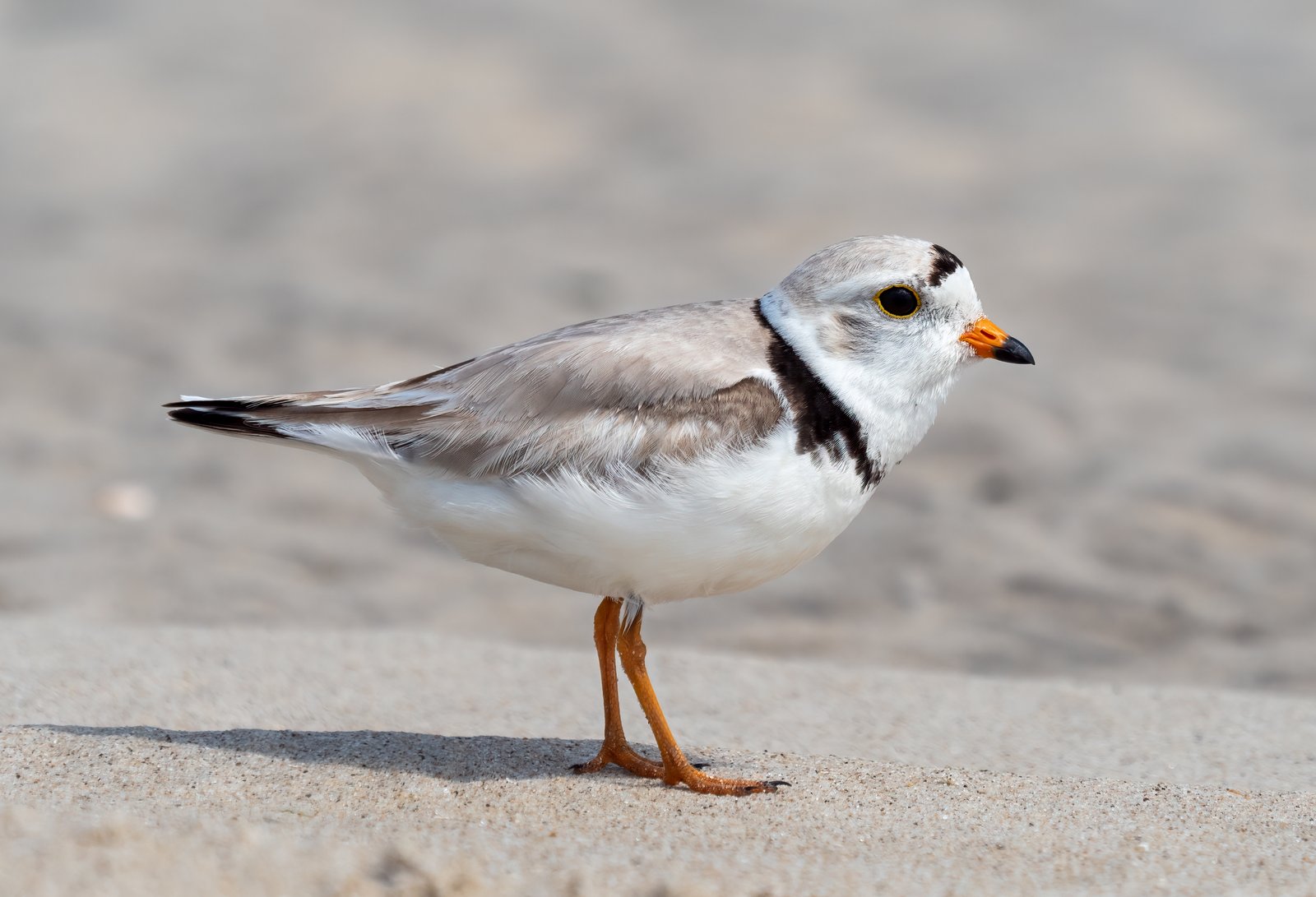
The Piping Plover is a small, very pale plover of North American sandy beaches, which occurs in the guide area only as a rare vagrant. It normally winters along the coasts of the south-eastern United States and in the Caribbean. The world population is small and intensively protected.
Voice
A soft, whistled peep-lo or peep, with a clear, piping tone.
Recording: Will Sweet — CC BY-NC-SA 4.0 · xeno-canto
Identification
17–18 cm, stocky, with a short bill and a round head. The upperparts are pale sandy grey, the colour of dry sand, and the underparts white. In breeding plumage a narrow black breast band, often broken, and a black band across the forehead; the bill is then orange with a black tip. In non-breeding plumage the bands are faint grey-brown and the bill is dark. The legs are orange. In flight a white rump and a white wing stripe. The sexes differ little.
Confusion species
Semipalmated Plover Charadrius semipalmatus is much darker brown above, with a dark cheek patch and a brown rump. Snowy Plover Anarhynchus nivosus is equally pale but slimmer, with a thin black bill, dark legs and only dark patches at the breast sides. Collared Plover Anarhynchus collaris is darker, with flesh-coloured legs and a thin black bill.
Habitat
Open sandy beaches, sandbars and the edges of coastal lagoons and mudflats. It takes small invertebrates on the sand and along the tideline, with short sprints and stops. It does not breed in the guide area.
Where the bird is most at home, classified by the vegetation units of the Andes and the west coast.


Range and movements
In the guide area recorded only exceptionally, on the coast in the north. Outside the guide area it breeds on the Atlantic coast of North America, around the Great Lakes and on the Great Plains, and winters along the coasts of the south-eastern United States, Mexico, the Bahamas and elsewhere in the Caribbean.
How and when to look
A possible vagrant deserves careful documentation with photographs; note the pale upperparts, orange legs and white rump in flight. Chances are mainly on sandy beaches on the Caribbean coast in the northern winter.
Conservation status
Near Threatened. The species suffers from disturbance and development of beaches; thanks to intensive protection of breeding sites, numbers have increased in parts of the breeding range.
Scientific name
Charadrius melodus | Ord, 1824
Ord described the species in 1824 and placed it straight away in the genus where it still stands. The genus Charadrius was introduced in 1758 by Linnaeus. The genus name comes from Greek kharadrios, an unidentified plain-coloured nocturnal bird of ravines and river valleys (from kharadra, 'ravine'). The species name comes from Greek melōdos, 'melodious', after the piping call. The specimen the first description was based on came from Great Egg Harbor, New Jersey, USA.