All species › Waders, gulls and terns › Plovers and lapwings › Snowy Plover
Snowy Plover | Anarhynchus nivosus
Sneeuwplevier | Chorlo nevado | Batuíra-nívea
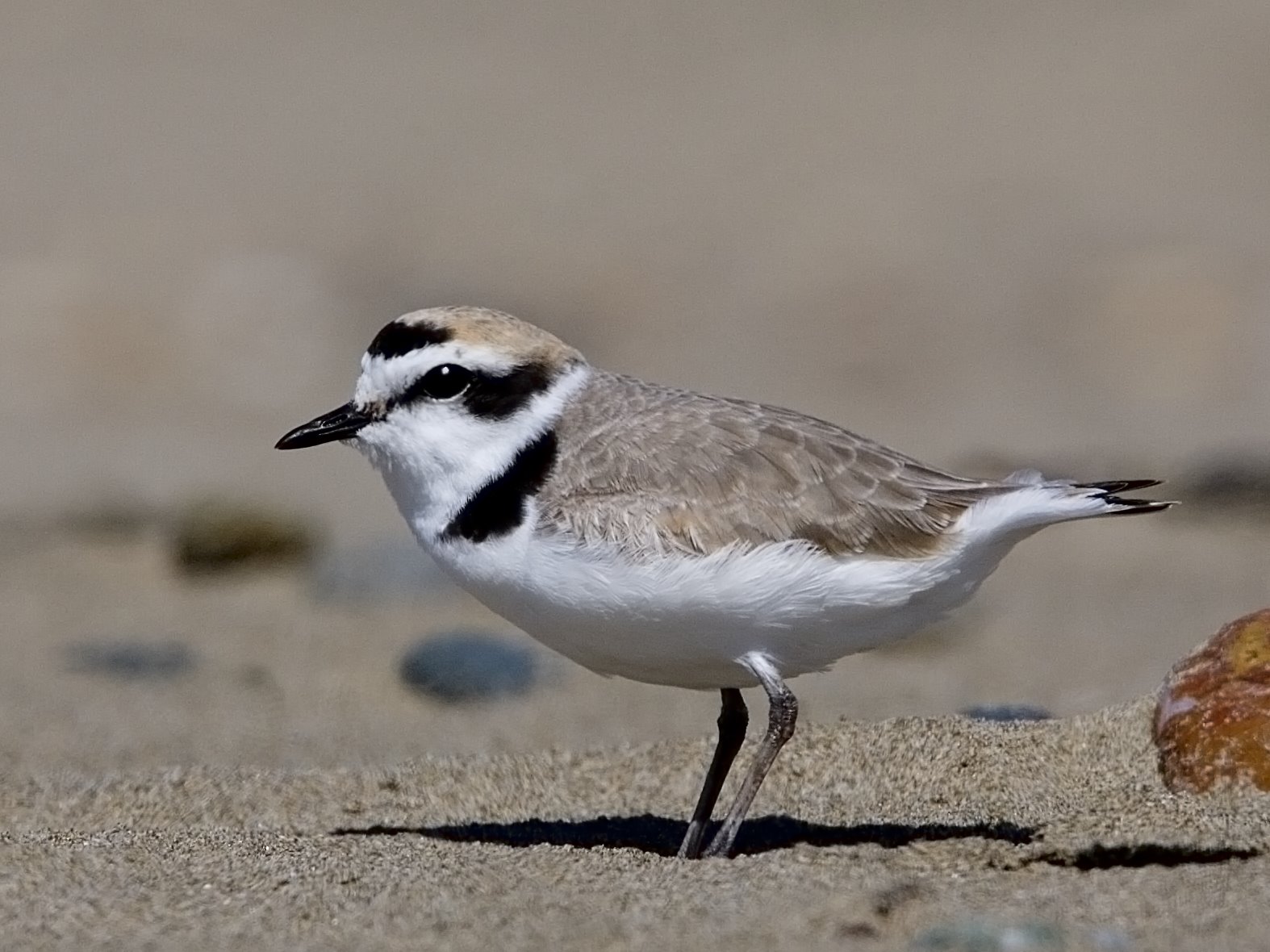
The Snowy Plover is a small, pale plover of sandy beaches and salt pans on the coast. With its sandy upperparts and white underparts it blends into dry sand. In the guide area a distinct population lives along the desert coast of Peru and Ecuador, and a small population breeds on the Caribbean coast of Colombia.
Voice
A soft, rising tu-weet or too-wee, and a low, short krut or prrt, especially in flight.
No recording with a suitable Creative Commons licence is available for this species yet.
Identification
15–17 cm, with a thin black bill and dark grey to blackish legs. The upperparts are pale sandy greyish brown, the underparts white, with a white collar. In breeding plumage the male has a black bar on the forecrown, a black ear patch and dark patches on the sides of the breast that do not form a complete band. In the female these markings are brown. Juveniles are even paler, with pale feather fringes and faint, greyish-brown breast patches.
Confusion species
Collared Plover Anarhynchus collaris has a complete black breast band, pink legs and no white collar. Semipalmated Plover Charadrius semipalmatus is darker brown, with a complete breast band, an orange-based bill and orange legs. Wilson's Plover Anarhynchus wilsonia is larger, with a much thicker bill and a complete breast band. Sanderling Calidris alba is just as pale in winter plumage but has a straight, longer bill and runs in flocks along the surf.
Habitat
Wide sandy beaches, bare sandy flats behind the beach, salt pans, salt marshes and the shores of lagoons and estuaries. It moves in short sprints and picks small crustaceans, insects and worms from the sand, often at the tide line and among washed-up seaweed. The nest is a shallow scrape in bare sand or on a salt flat, sometimes lined with shells or pebbles.
Where the bird is most at home, classified by the vegetation units of the Andes and the west coast.


Range and movements
In Colombia only on the Caribbean coast, mainly in La Guajira. In Ecuador along the coast of Santa Elena and Guayas, mainly at salt pans. In Peru along almost the entire coast, from Tumbes to Tacna. Absent from Bolivia and the Galápagos. Outside the guide area in North America, Mexico and the Caribbean, and along the Pacific coast south to Chile.
How and when to look
Walk slowly over wide, quiet beaches and along salt pans and watch for moving dots on the sand; birds often sit in a scrape in the sand and only run off as you approach.
Conservation status
Near Threatened (NT). Numbers are declining through disturbance of breeding beaches by people, dogs and vehicles, coastal development and the conversion of salt pans and tidal flats. Nests on open beaches are vulnerable to trampling and predation.
Scientific name
Anarhynchus nivosus | (Cassin, 1858)
Cassin described the species in 1858 as Aegialitis nivosa; because it was later moved to another genus, the author and year stand in brackets. The genus Anarhynchus was introduced in 1832 by Quoy & Gaimard. The genus name comes from Greek ana-, 'backward, up', and rhunkhos, 'bill', after the sideways-bent bill of the type species, the Wrybill. The species name comes from Latin nivosus, 'snowy', after the pale plumage. The specimen the first description was based on came from Presidio, California, USA.