All species › Waders, gulls and terns › Plovers and lapwings › Puna Plover
Puna Plover | Anarhynchus alticola
Punaplevier | Chorlo puneño | Batuíra-da-puna
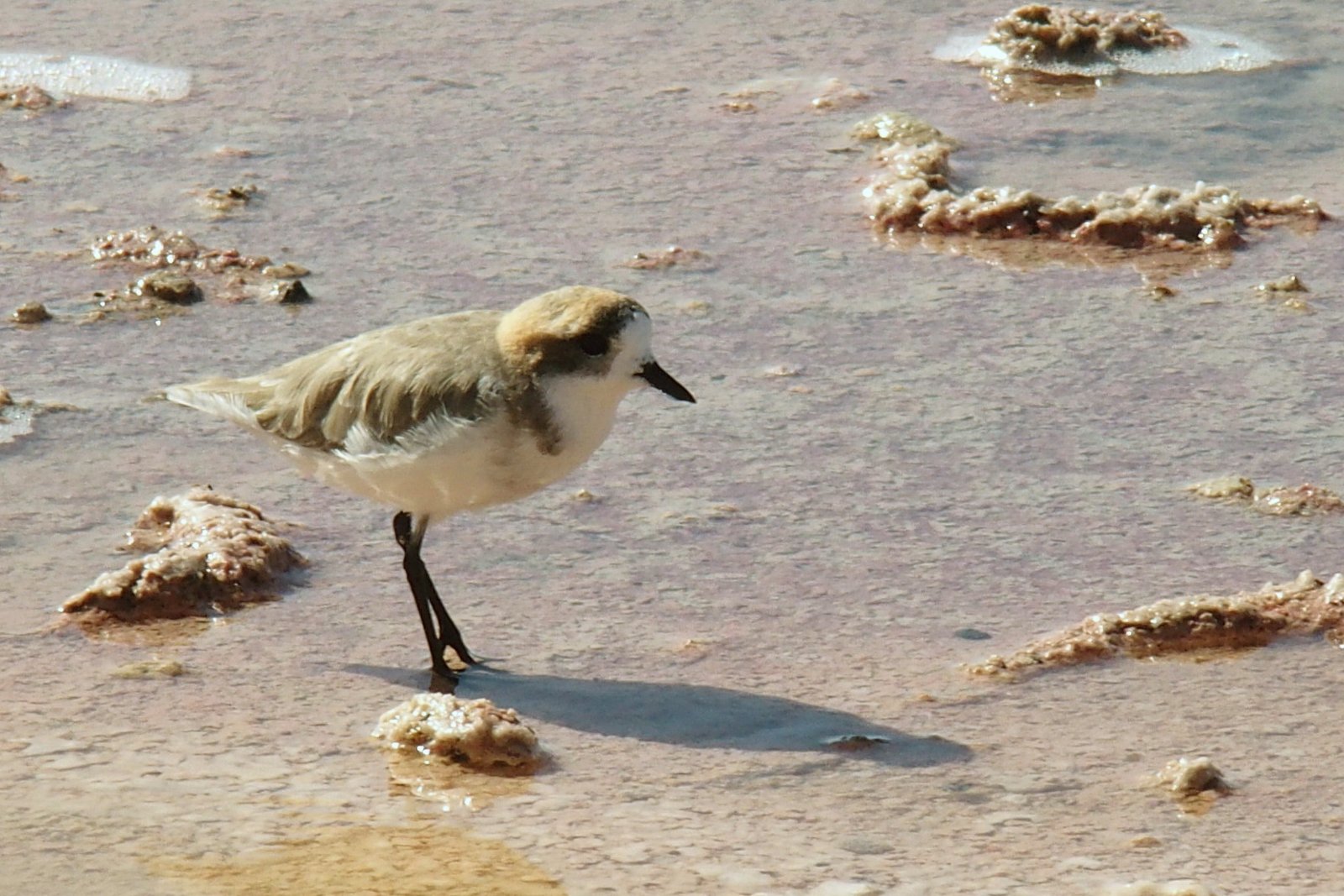
The Puna Plover is the plover of high-Andean lakes and bogs, where it breeds up to above 4500 m. It lives on bare, often saline lake shores on the altiplano and in the puna, together with flamingos, Andean Lapwings and sandpipers. It is one of the few small plovers that breed only in the high mountains.
Voice
A soft, short pit or kreet, often when flushed; in the breeding season a fast, trilled series of notes.
No recording with a suitable Creative Commons licence is available for this species yet.
Identification
17–18 cm, with a short black bill and blackish legs. The upperparts are greyish brown and the underparts white. In breeding plumage the forehead and a stripe above the eye are white, with a black bar on the forecrown and a rusty-tinged hindcrown. A single dark, greyish-brown to blackish band of variable width crosses the breast. In non-breeding plumage the head and breast band are duller and fainter. The sexes are nearly alike; juveniles have pale fringes to the upperpart feathers and a faint breast band.
Confusion species
Two-banded Plover Anarhynchus falklandicus has two breast bands and is a very rare visitor to the coast in the guide area. Semipalmated Plover Charadrius semipalmatus has a white collar, an orange-based bill and orange legs, and is rare in the high mountains. Diademed Sandpiper-Plover Phegornis mitchellii is smaller and darker, with a long, thin bill, a rufous nape and finely barred underparts, and lives along streams and in bogs. Tawny-throated Dotterel Oreopholus ruficollis is larger, with an ochre throat and a black belly patch, and lives in dry grassland.
Habitat
Bare shores of fresh and saline lakes, salt flats, bofedales and wet, closely grazed flats in the puna and on the altiplano, roughly between 3000 and 4800 m. It picks insects and their larvae, small crustaceans and other invertebrates from the shore and the mud. The nest is a shallow scrape on bare ground, often among pebbles or short grass.
Where the bird is most at home, classified by the vegetation units of the Andes and the west coast.


Range and movements
In Peru in the high mountains of the centre and south, including Lake Junín and Lake Titicaca. In Bolivia on the altiplano in the west. Highland birds rarely reach the coast of Peru in the austral winter. Absent from Colombia, Ecuador and the Galápagos. Outside the guide area in northern Chile and north-western Argentina.
How and when to look
Search the bare, saline shores of altiplano lakes and the edges of bofedales; birds often walk among flamingos and sandpipers and only draw attention when they fly up.
Conservation status
Least Concern. The species lives in a sparsely populated region; drying out of lakes and bogs through mining, water extraction and climate change can degrade its habitat locally.
Scientific name
Anarhynchus alticola | (Berlepsch & Sztolcman, 1902)
Berlepsch & Sztolcman described the species in 1902 as AEgialitis alticola; because it was later moved to another genus, the author and year stand in brackets. The genus Anarhynchus was introduced in 1832 by Quoy & Gaimard. The genus name comes from Greek ana-, 'backward, up', and rhunkhos, 'bill', after the sideways-bent bill of the type species, the Wrybill. The species name comes from Latin altus, 'high', and -cola, 'dweller', after its habitat high in the Andes. The specimen the first description was based on came from Ingapirca, Junín, Peru.