All species › Waders, gulls and terns › Plovers and lapwings › Two-banded Plover
Two-banded Plover | Anarhynchus falklandicus
Falklandplevier | Chorlo de doble collar | Batuíra-de-coleira-dupla
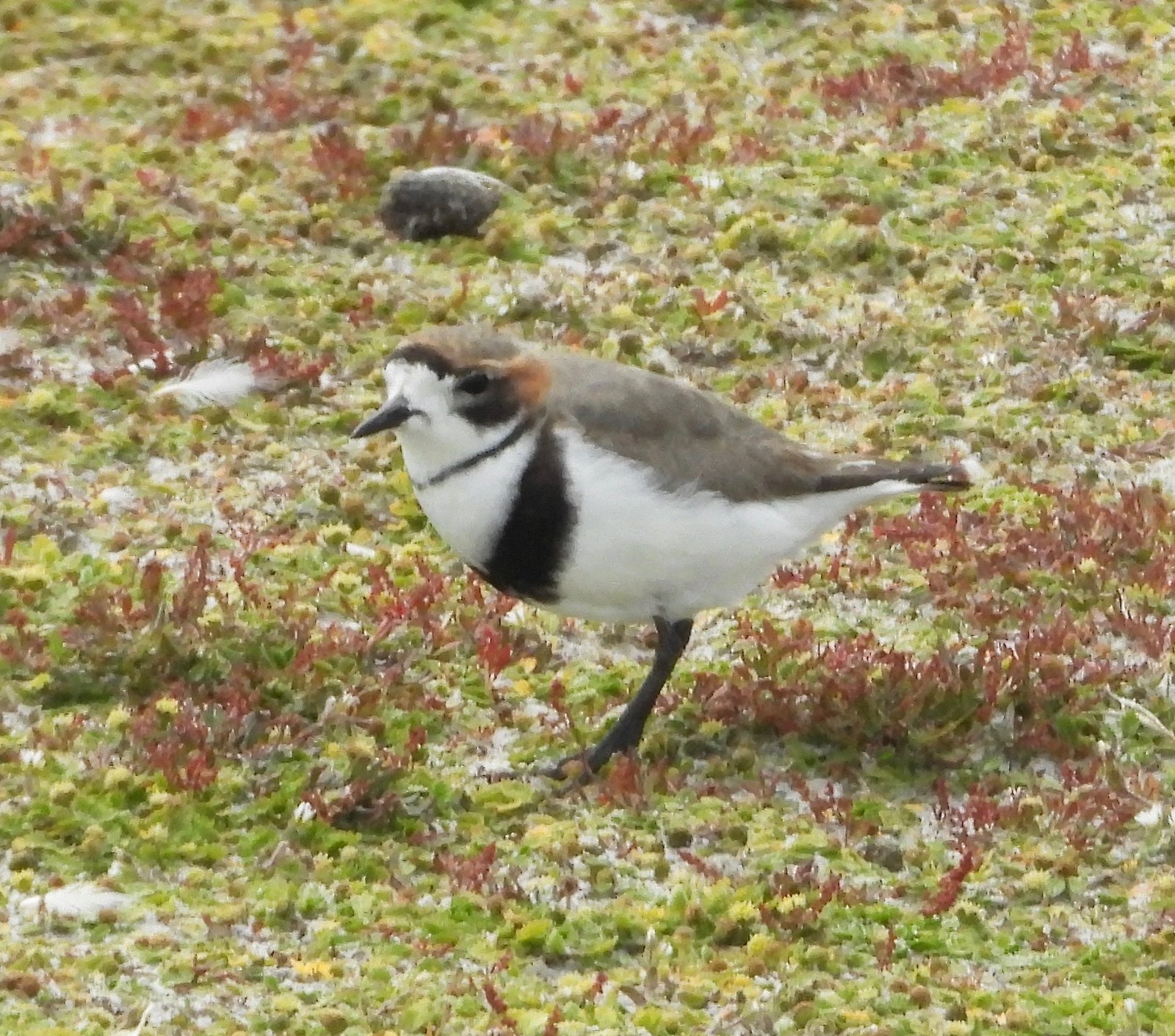
The Two-banded Plover is a plover of Patagonia and the Falkland Islands with two black bands across the neck and breast. After the breeding season part of the population moves north along the coasts of Argentina, Uruguay and Chile. The guide area lies at the far northern edge of this wintering range, and the species has been recorded here only a few times.
Voice
A soft, short pit and in flight a descending, trilled series of notes.
No recording with a suitable Creative Commons licence is available for this species yet.
Identification
18 cm, with a short black bill and dark grey legs. The upperparts are greyish brown and the underparts white. In breeding plumage the forehead and a stripe above the eye are white, with a black bar on the forecrown and a chestnut hindcrown and nape. A narrow black band crosses the lower neck and a broader black band the breast. In non-breeding plumage, to be expected in the guide area, the bands are greyish brown and fainter and the chestnut is largely lacking. The sexes are nearly alike; juveniles have pale feather fringes on the upperparts.
Confusion species
Puna Plover Anarhynchus alticola has a single breast band and lives on high-Andean lakes. Semipalmated Plover Charadrius semipalmatus has a single breast band, a white collar and orange legs. Killdeer Charadrius vociferus also has two breast bands but is much larger, with a long tail and a rufous rump. Collared Plover Anarhynchus collaris is smaller, with a single narrow breast band and pink legs.
Habitat
Sandy beaches, tidal flats and the shores of lagoons and estuaries on the coast; on the breeding grounds also bare flats and lake shores in the Patagonian steppe. It picks small invertebrates from sand and mud, often in small groups.
Where the bird is most at home, classified by the vegetation units of the Andes and the west coast.


Range and movements
In the guide area only a few records on the coast of southern Peru, during the austral winter. Absent from Colombia, Ecuador, Bolivia and the Galápagos. It breeds in southern Chile and Argentina and on the Falkland Islands, and winters north to Uruguay, southern Brazil and central Chile.
How and when to look
In the austral winter, check flocks of small plovers and sandpipers on beaches and at river mouths in southern Peru; look for a plover with two breast bands and dark legs.
Conservation status
Least Concern. The population in Patagonia and on the Falkland Islands is large; disturbance of beaches is a local threat.
Scientific name
Anarhynchus falklandicus | (Latham, 1790)
Latham described the species in 1790 as Charadrius falklandicus; because it was later moved to another genus, the author and year stand in brackets. The genus Anarhynchus was introduced in 1832 by Quoy & Gaimard. The genus name comes from Greek ana-, 'backward, up', and rhunkhos, 'bill', after the sideways-bent bill of the type species, the Wrybill. The species name refers to the Falkland Islands, not necessarily the only place the species occurs. The specimen the first description was based on came from Port Egmont, Falkland Islands.