All species › Waders, gulls and terns › Plovers and lapwings › Collared Plover
Collared Plover | Anarhynchus collaris
Halsbandplevier | Chorlo de collar | Batuíra-de-coleira
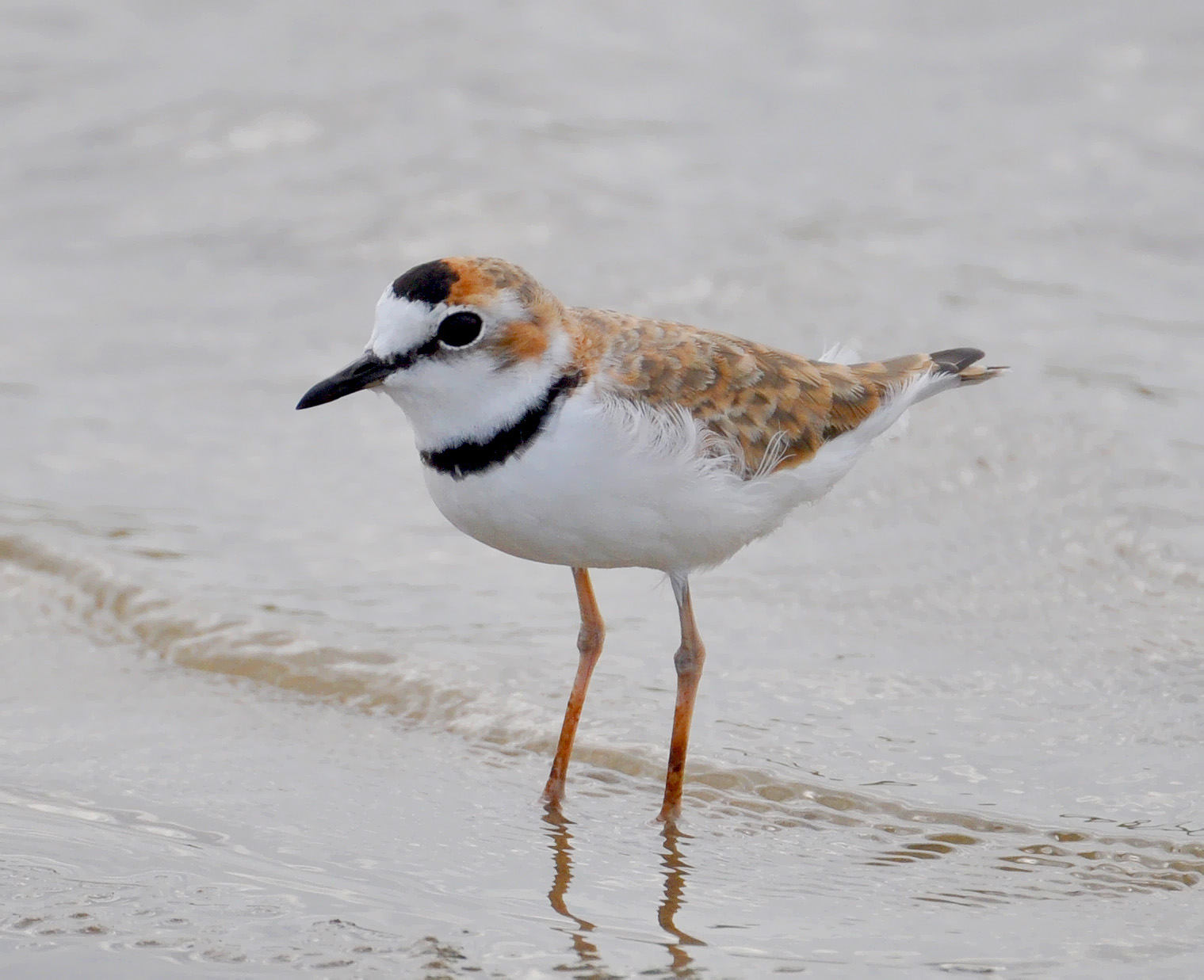
The Collared Plover is the smallest plover of the guide area, a slim, long-legged bird of river sandbars and beaches. Unlike most coastal plovers it is a true inhabitant of the interior, breeding on the sandbars of large lowland rivers. It lacks a white collar on the hindneck, a feature that separates it from the other small plovers with a breast band.
Voice
A short, sharp tseek or kreet, often in flight; also a dry, chirping chip-chip when alarmed.
No recording with a suitable Creative Commons licence is available for this species yet.
Identification
14–15 cm, with a thin black bill and rather long, pink to yellowish legs. The upperparts are greyish brown and the underparts white. The forehead is white, with a black bar on the forecrown above it; the hindcrown and sides of the neck are tinged chestnut. A narrow, complete black band crosses the breast; a white collar is lacking. The female is duller, with less black and rufous. Juveniles lack the black and rufous and have a greyish-brown, often broken breast band.
Confusion species
Semipalmated Plover Charadrius semipalmatus is larger, with a white collar, a short orange-based bill and orange legs. Snowy Plover Anarhynchus nivosus is paler, with only dark patches on the sides of the breast and dark legs, and lives on the coast. Wilson's Plover Anarhynchus wilsonia is larger, with a much thicker bill and a white collar. Piping Plover Charadrius melodus is a very rare vagrant with orange legs and a much paler, sandy back.
Habitat
Sand and gravel bars in rivers, shores of lakes and lagoons, sandy beaches, open sandy flats and bare fields near water, from sea level to about 1000 m, locally higher in dry valleys. It moves in short sprints and picks insects, small crustaceans and other invertebrates from the sand. The nest is a shallow scrape on a bare sandbar or beach, often near some driftwood or shells.
Where the bird is most at home, classified by the vegetation units of the Andes and the west coast.


Range and movements
In Colombia widespread in the lowlands, along both coasts, in the Magdalena Valley, the llanos and along the rivers of the Amazon basin. In Ecuador along the coast and on the sandbars of Amazonian rivers. In Peru along the coast and along the large rivers of the Amazon basin. In Bolivia along the rivers of the northern and eastern lowlands. Absent from the Galápagos. Outside the guide area from Mexico through Central America to Brazil, northern Argentina and Chile.
- Resident
- dark = core range, pale = thinly spread
How and when to look
Search sandbars in large rivers in the dry season, when water levels are low, or wide sandy beaches on the coast. Birds often stand still and only become visible when they make a short run.
Conservation status
Least Concern. The species is widespread; disturbance of sandbars and beaches and changes in river levels caused by dams can reduce breeding success locally.
Scientific name
Anarhynchus collaris | (Vieillot, 1818)
Vieillot described the species in 1818 as Charadrius collaris; because it was later moved to another genus, the author and year stand in brackets. The genus Anarhynchus was introduced in 1832 by Quoy & Gaimard. The genus name comes from Greek ana-, 'backward, up', and rhunkhos, 'bill', after the sideways-bent bill of the type species, the Wrybill. The species name comes from Latin collaris, 'of the neck', after the breast band. The specimen the first description was based on came from Paraguay.