All species › Waders, gulls and terns › Plovers and lapwings › Wilson's Plover
Wilson's Plover | Anarhynchus wilsonia
Dikbekplevier | Chorlito piquigrueso | Batuíra-bicuda
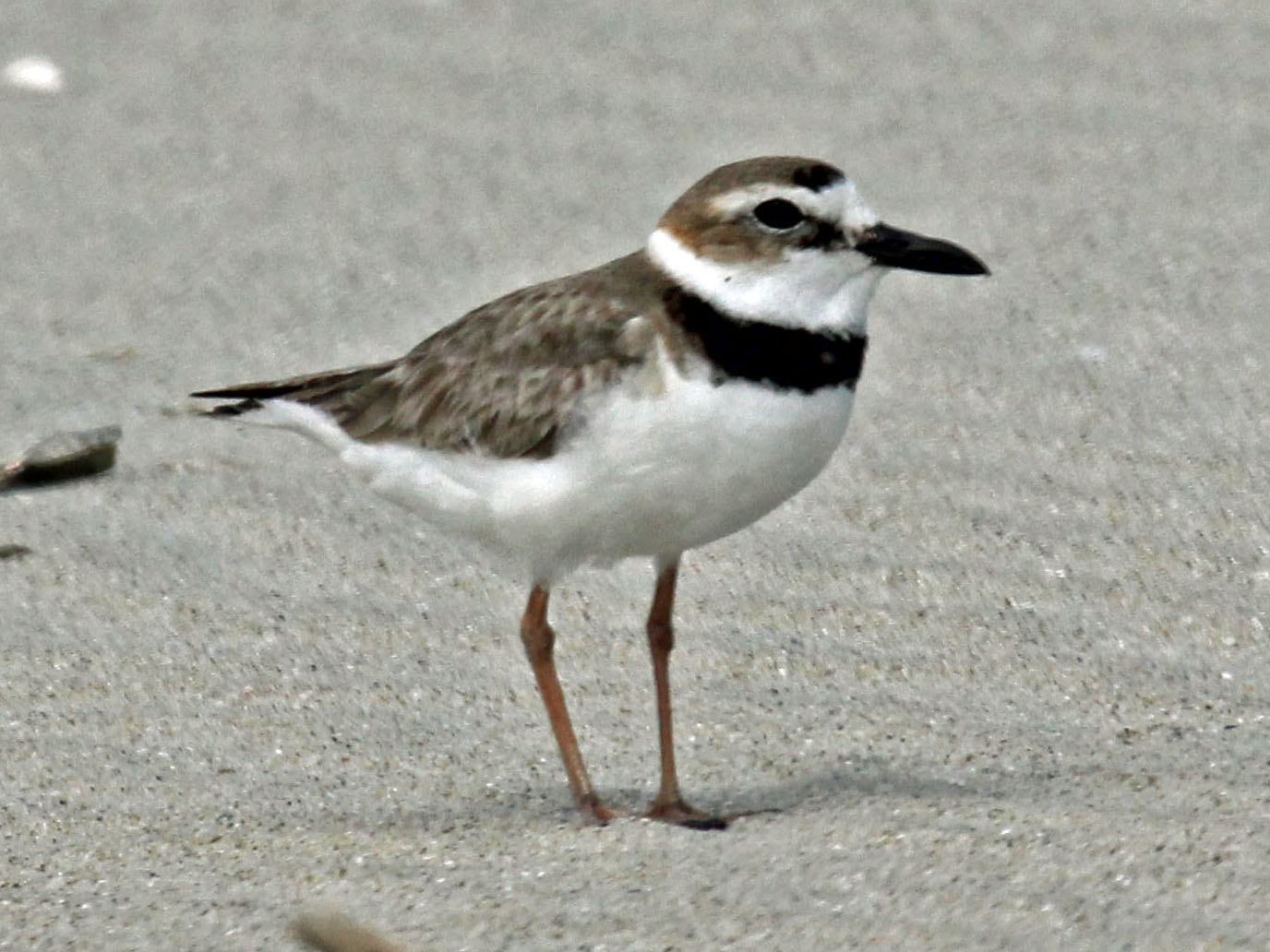
Wilson's Plover is a medium-sized plover of sandy beaches and tidal flats on the warm coasts of the Americas. It stands out by its long, heavy black bill, which is much stouter than in the other small plovers. In the guide area it breeds along the Pacific coast from Colombia to northern Peru and on the Caribbean coast of Colombia.
Voice
A dry, sharp quit or weet, often repeated when disturbed; also a short, rattling dzrrt when alarmed on the breeding grounds.
No recording with a suitable Creative Commons licence is available for this species yet.
Identification
18–20 cm, with a large head, a long, thick black bill and flesh-pink to greyish-pink legs. The upperparts are greyish brown, and the forehead and a stripe above the eye are white. In breeding plumage the male has a black bar on the forecrown, black lores and a broad black breast band; Pacific birds often show a rusty tinge on the cheeks and crown. In the female the breast band and head stripes are brown, often with a rusty wash. Juveniles resemble the female, with pale fringes to the upperpart feathers and an often broken breast band.
Confusion species
Collared Plover Anarhynchus collaris is smaller, with a thin bill, a narrower breast band and no white collar. Semipalmated Plover Charadrius semipalmatus is smaller, with a short orange-based bill, orange legs and a white collar. Snowy Plover Anarhynchus nivosus is smaller and paler, with a thin bill and only dark patches on the sides of the breast.
Habitat
Sandy beaches, tidal flats, lagoons, salt pans and open spots near mangroves, from sea level to a few metres above it; it rarely goes inland. It feeds mainly on crabs, also on worms and other small invertebrates, which it catches with short runs and a quick peck. The nest is a shallow scrape in sand or shells above the tide line.
Where the bird is most at home, classified by the vegetation units of the Andes and the west coast.


Range and movements
In Colombia along the Caribbean coast, including La Guajira, and along the Pacific coast. In Ecuador along the whole coast, locally more numerous at lagoons and salt pans in Santa Elena and Guayas. In Peru along the coast in the north, mainly in Tumbes and Piura, scarcer further south. Absent from Bolivia and the Galápagos. Outside the guide area along the coasts of the United States, Mexico and Central America, in the Caribbean and along the north coast of South America to Brazil.
- Resident
- dark = core range, pale = thinly spread
How and when to look
Search wide beaches and mudflats near lagoons and salt pans, especially at low tide, when the birds hunt crabs. In the breeding season pairs walk on the higher, dry parts of the beach.
Conservation status
Least Concern. The population suffers locally from disturbance of beaches, coastal development and the conversion of tidal flats to shrimp farms.
Scientific name
Anarhynchus wilsonia | (Ord, 1814)
Ord described the species in 1814 as Charadrius wilsonia; because it was later moved to another genus, the author and year stand in brackets. The genus Anarhynchus was introduced in 1832 by Quoy & Gaimard. The genus name comes from Greek ana-, 'backward, up', and rhunkhos, 'bill', after the sideways-bent bill of the type species, the Wrybill. The species name honours Alexander Wilson (1766–1813), Scottish-American ornithologist and a friend of Ord. The specimen the first description was based on came from Cape May, New Jersey, USA.