All species › Waders, gulls and terns › Plovers and lapwings › Andean Lapwing
Andean Lapwing | Vanellus resplendens
Andeskievit | Avefría andina | Quero-quero-andino
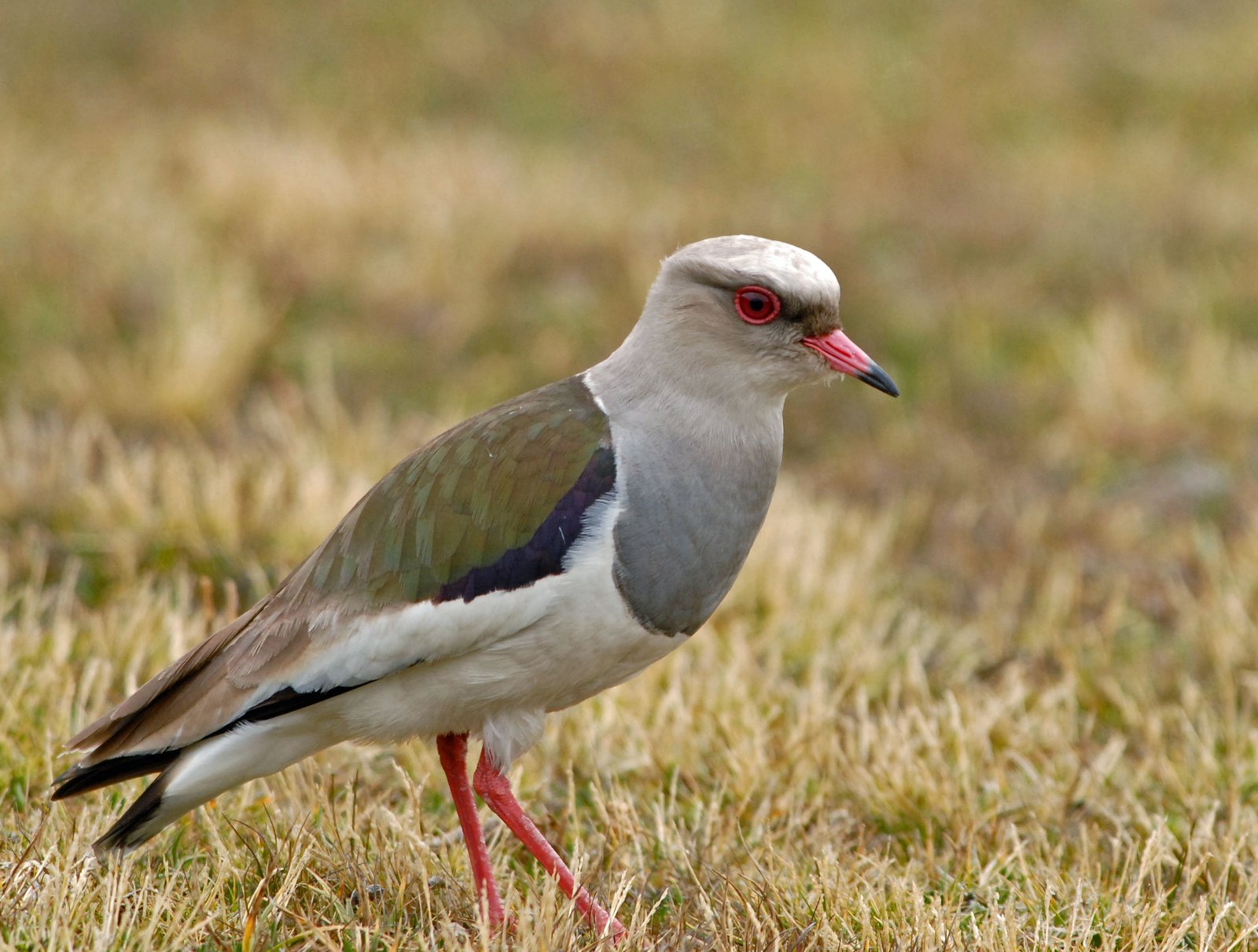
The Andean Lapwing is the lapwing of the high Andes, a familiar sight on the puna and in the wet grasslands and bogs of the central Andes. It lives in pairs or small groups and calls loudly at any disturbance. Despite its plain grey head and neck it has a glossy, green and purple mantle, to which the scientific name (resplendens, shining) refers.
Voice
A loud, shrill kree-kree-kree or kyek-kyek, often in flight; it reacts to any disturbance.
Recording: José María Loaiza B. — CC BY-NC-SA 4.0 · xeno-canto
Identification
33–36 cm. The head, neck and breast are plain pale grey and the belly white, without a crest. The mantle and wing coverts are olive-brown with a green and purple gloss. The eye and eye-ring are red, the bill pink with a black tip, and the legs pink. In flight a white triangle on the wing between the black primaries and the brown coverts, a white rump and a black tail band. The sexes are alike; juveniles are browner, with pale feather fringes.
Confusion species
Southern Lapwing Vanellus chilensis has a crest and a black throat and breast, and usually lives much lower. Tawny-throated Dotterel Oreopholus ruficollis is slimmer and buffier, with a tawny throat and a black belly patch. Pied Plover Hoploxypterus cayanus is smaller, with a black-and-white head and breast pattern, and lives in the lowlands.
Habitat
Wet and dry grassland of the puna and páramo, bogs and bofedales, lake shores and fields and pasture in the high Andes, mostly between 3000 and 4600 m. It takes insects and other invertebrates on the ground. The nest is a scrape on the ground among short grass.
Where the bird is most at home, classified by the vegetation units of the Andes and the west coast.


Range and movements
In Colombia only rarely in the far south. In Ecuador locally in the Andes, mainly in the centre and south. In Peru in the Andes along the whole length of the country. In Bolivia in the Andes and on the altiplano. Absent from the Galápagos. Outside the guide area in northern Chile and north-western Argentina.
- Resident
- dark = core range, pale = thinly spread
How and when to look
In the wet grasslands and bofedales around puna lakes, for example around Lake Titicaca and in the highlands of Cusco and Junín; birds give themselves away by their alarm calls.
Conservation status
Least Concern. The species is common and tolerates livestock grazing and small-scale farming.
Scientific name
Vanellus resplendens | (Tschudi, 1843)
Tschudi described the species in 1843 as Charadrius resplendens; because it was later moved to another genus, the author and year stand in brackets. The genus Vanellus was introduced in 1760 by Brisson. The genus name is Medieval Latin for 'lapwing', a diminutive of Latin vannus, 'winnowing fan', after the sound of the wingbeats. The species name is Latin resplendens, 'shining, glittering', after the glossy wing feathers. The specimen the first description was based on came from Andes, Peru.