All species › Waders, gulls and terns › Plovers and lapwings › Southern Lapwing
Southern Lapwing | Vanellus chilensis
Chileense kievit | Avefría tero | Quero-quero
The Southern Lapwing is the large, noisy lapwing of open grassland over much of South America. It has benefited from deforestation and the creation of pasture and is expanding in the guide area, including into Andean valleys and to the western side of the Andes. When threatened it raises the alarm with loud calls and dive-bombs intruders.
Voice
A loud, shrill and persistent keh-keh-keh or tero-tero, often in flight and also at night; it reacts to any disturbance.
Recording: Manuel Grosselet — CC BY-NC-SA 4.0 · xeno-canto
Identification
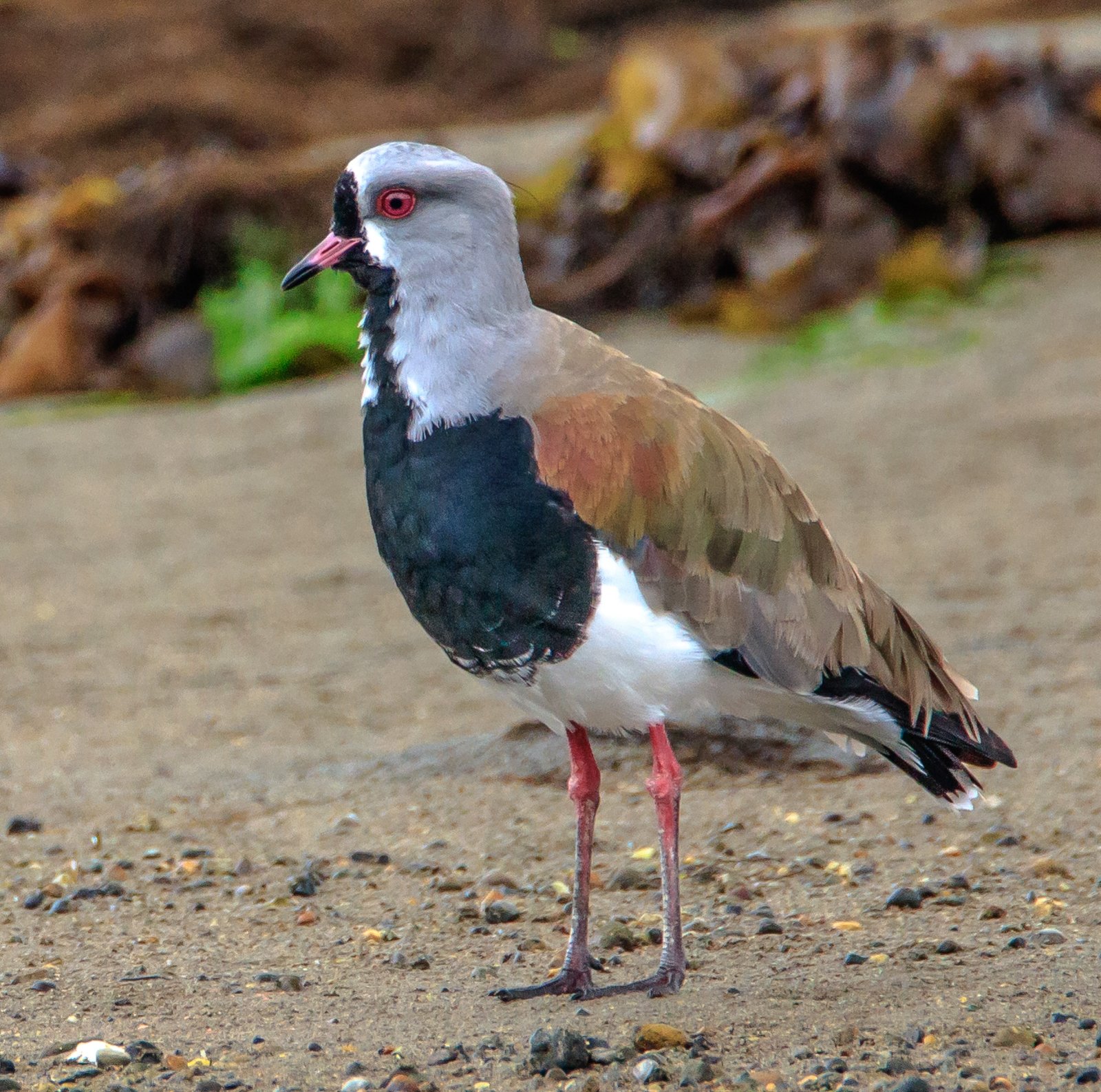
32–38 cm. The head and neck are grey, with a black forehead and a black throat that continues into a broad black breast band, and a thin black crest on the hindcrown. The back is grey-brown, and the scapulars have a bronze-green and purple gloss. The belly is white. The eye, eye-ring and bill base are red, the bill tip black. There is a red spur at the bend of the wing. In flight a broad white band across the rounded, otherwise black wings, a white rump and a black tail band. The legs are pink. The sexes are alike; juveniles are duller, with a shorter crest.
Confusion species
Andean Lapwing Vanellus resplendens has no crest and no black throat and breast, and lives high in the Andes. Pied Plover Hoploxypterus cayanus is smaller, with a sharp black-and-white pattern on head and breast and no crest. Masked Lapwing Vanellus miles, an exceptional vagrant, has yellow facial wattles and a white throat.
Habitat
Open grassland, pasture, savanna, riverbanks and sandbars, marsh edges, airfields, playing fields and lawns, mainly in the lowlands but locally to over 2500 m in Andean valleys. It takes insects, worms and other invertebrates on the ground. The nest is a scrape in short grass or on bare ground; both parents defend it vigorously.
Where the bird is most at home, classified by the vegetation units of the Andes and the west coast.


Range and movements
In Colombia widespread in the lowlands east of the Andes, in the Caribbean lowlands and in the Magdalena and Cauca valleys, and locally up to the Bogotá plateau. In Ecuador in the eastern lowlands and, increasingly, in the west and in Andean valleys. In Peru in the Amazonian lowlands and locally further west. In Bolivia widespread in the lowlands. Absent from the Galápagos. Outside the guide area from Panama to Tierra del Fuego.
- Resident
- dark = core range, pale = thinly spread
How and when to look
In almost any pasture or savanna in the lowlands east of the Andes, for example in the Llanos; birds announce themselves at once with their alarm call when approached.
Conservation status
Least Concern. The species benefits from deforestation and cattle ranching and is increasing in the guide area.
Scientific name
Vanellus chilensis | (Molina, 1782)
Molina described the species in 1782 as Parra Chilensis; because it was later moved to another genus, the author and year stand in brackets. The genus Vanellus was introduced in 1760 by Brisson. The genus name is Medieval Latin for 'lapwing', a diminutive of Latin vannus, 'winnowing fan', after the sound of the wingbeats. The species name refers to Chile, not necessarily the type locality. The specimen the first description was based on came from Chile.