All species › Waders, gulls and terns › Plovers and lapwings › Semipalmated Plover
Semipalmated Plover | Charadrius semipalmatus
Amerikaanse bontbekplevier | Chorlito semipalmeado | Batuíra-de-bando
The Semipalmated Plover is the commonest small plover on the coasts of the guide area outside the breeding season. It breeds in the North American Arctic and winters along the Pacific and Caribbean coasts and on the Galápagos. The name refers to the small webs between the toes.
Voice
A clear, rising chu-wee, often in flight. At roosts also soft, short calls.
Recording: JAYRSON ARAUJO DE OLIVEIRA — CC BY-NC-SA 4.0 · xeno-canto
Identification
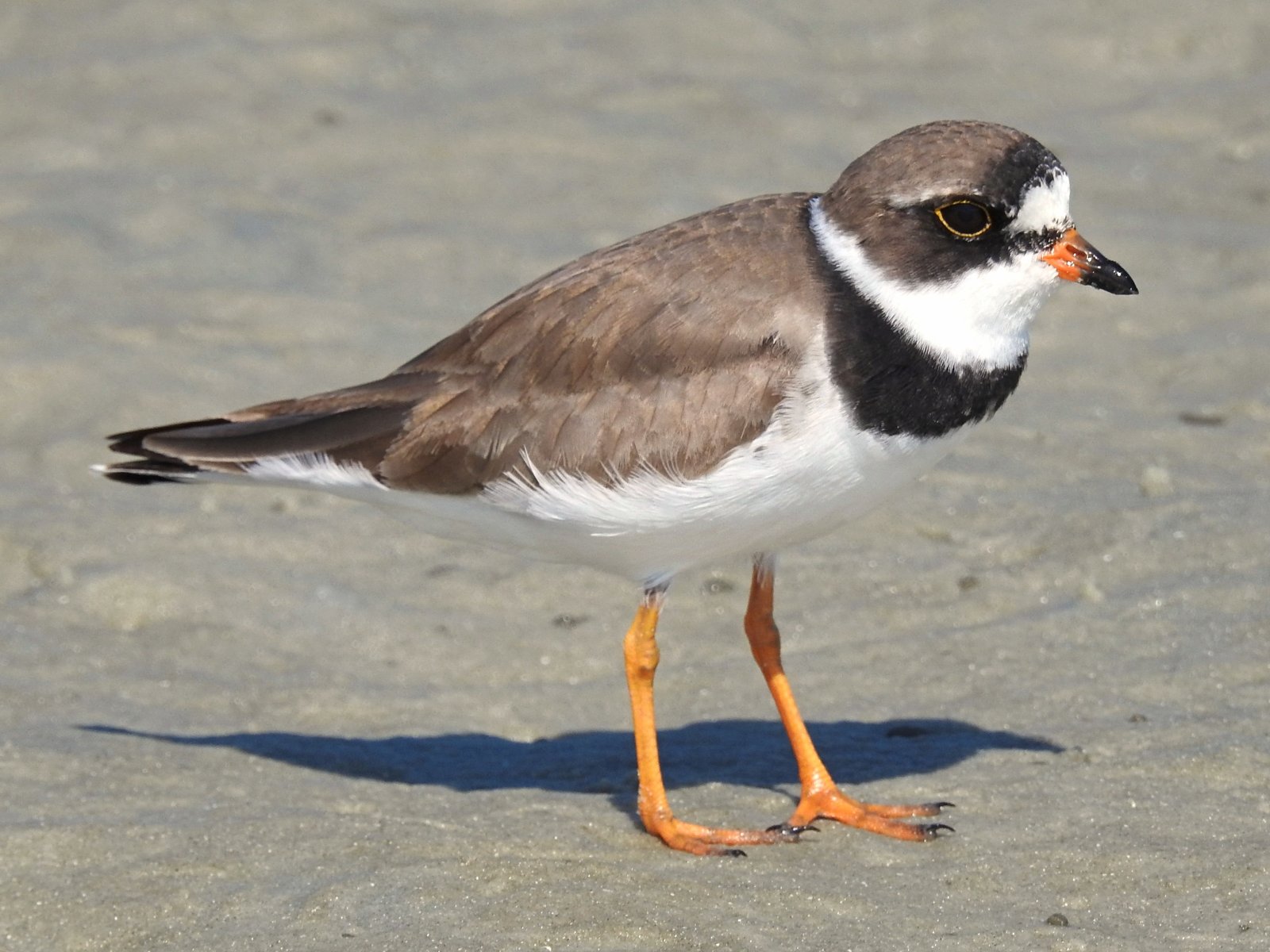
17–19 cm, compact, with a short bill and a round head. The upperparts are plain dark grey-brown and the underparts white, with a white collar and one breast band that is black in breeding plumage and brown in non-breeding plumage. The forehead is white, with a dark lore and cheek patch. The bill is orange with a black tip in breeding plumage, mostly dark in non-breeding plumage. The legs are orange-yellow. There are small webs between the outer toes. The sexes differ little. Juveniles have pale fringes to the upperpart feathers.
Confusion species
Wilson's Plover Anarhynchus wilsonia is larger, with a heavy black bill and flesh-coloured legs. Collared Plover Anarhynchus collaris is slimmer, without a white collar, with a thin black bill and flesh-coloured legs. Snowy Plover Anarhynchus nivosus is much paler, with only dark patches at the breast sides and dark legs. Killdeer Charadrius vociferus is much larger, with two breast bands and an orange-brown rump.
Habitat
Mudflats, sandy beaches, estuaries, lagoons, salt pans, shrimp ponds and river mouths; inland scarce on riverbanks and lakes, on passage also high in the Andes. It takes worms, small crustaceans and other invertebrates on the mud, running and stopping. It roosts in flocks, often with other shorebirds. It does not breed in the guide area.
Where the bird is most at home, classified by the vegetation units of the Andes and the west coast.


Range and movements
In Colombia along the Caribbean and Pacific coasts and on San Andrés. In Ecuador along the whole coast and on the Galápagos. In Peru along the whole coast. In Bolivia a scarce passage migrant in the lowlands and on the altiplano. In Amazonia rare on riverbanks. Outside the guide area it breeds in Alaska and Canada and winters from the coasts of the United States to Chile and Argentina.
- Resident
- dark = core range, pale = thinly spread
How and when to look
On mudflats and beaches at low tide and at high-tide roosts along the whole coast, for example in the estuaries and salt pans of Ecuador and Peru, mainly from September to April.
Conservation status
Least Concern. The species depends on undisturbed mudflats and roosts; locally these are lost to shrimp farms, building and disturbance.
Scientific name
Charadrius semipalmatus | Bonaparte, 1825
Bonaparte described the species in 1825 and placed it straight away in the genus where it still stands. The genus Charadrius was introduced in 1758 by Linnaeus. The genus name comes from Greek kharadrios, an unidentified plain-coloured nocturnal bird of ravines and river valleys (from kharadra, 'ravine'). The species name comes from Latin semi-, 'half', and palmatus, 'webbed', after the partial webbing between the toes. The specimen the first description was based on came from Coast of New Jersey, USA.