All species › Waders, gulls and terns › Plovers and lapwings › Killdeer
Killdeer | Charadrius vociferus
Killdeerplevier | Chorlitejo culirrojo | Batuíra-gritadeira
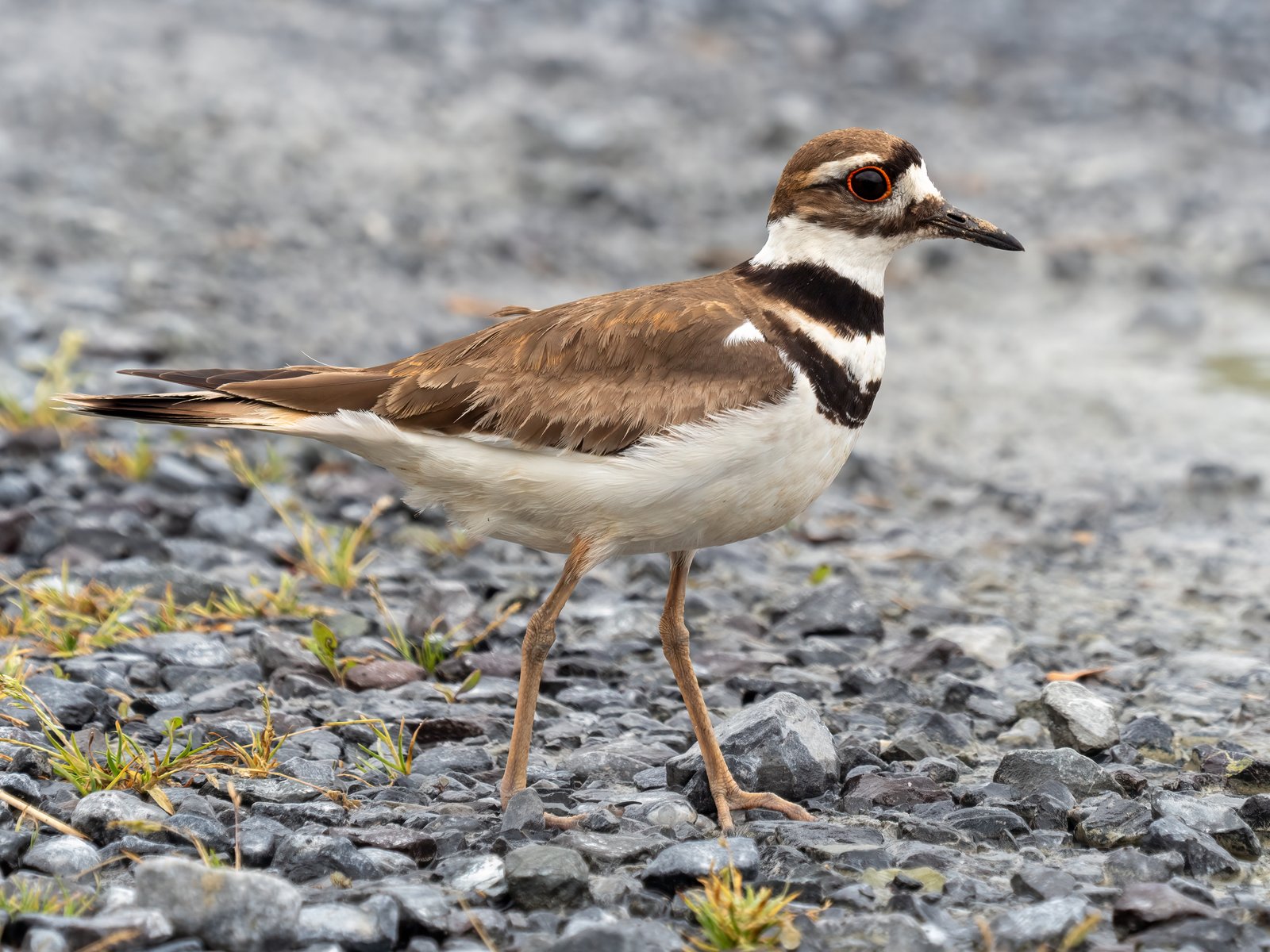
The Killdeer is a large, long-tailed plover with two black breast bands, named after its loud call. In the guide area a distinct resident subspecies, peruvianus, lives in the dry coastal belt of Ecuador and Peru. It often breeds far from water, in fields, pasture and bare ground near villages.
Voice
A loud, shrill kill-dee or dee-ee, often repeated in series, also at night. When disturbed a rapid, trilling tee-tee-tee.
Recording: Rory Nefdt — CC BY-NC-SA 4.0 · xeno-canto
Identification
23–26 cm, with a fairly long tail and long wings. The upperparts are brown and the underparts white, with two black bands across the breast. The forehead and a stripe behind the eye are white, the rest of the head brown with a black lore. The eye has a red eye-ring. In flight the orange-brown rump and tail base and the white wing stripe stand out. The bill is black and the legs flesh-coloured. The sexes are alike. Young birds shortly after hatching have only one breast band.
Confusion species
Semipalmated Plover Charadrius semipalmatus is much smaller, with one breast band, a short bill with an orange base and orange legs. Wilson's Plover Anarhynchus wilsonia has one broad breast band and a heavy black bill. Collared Plover Anarhynchus collaris is smaller and slimmer, without a white collar and with one narrow breast band. None of these has the orange-brown rump.
Habitat
Open, bare or short-grassed ground: fields, pasture, irrigated land, river gravel bars, lagoon edges, airfields and waste ground near villages, mainly in the coastal lowlands, locally high up in the western valleys. It takes insects and other invertebrates on the ground, with the run-and-stop action typical of plovers. The nest is a scrape on bare ground; when disturbed the parents perform a broken-wing display.
Where the bird is most at home, classified by the vegetation units of the Andes and the west coast.


Range and movements
In Ecuador in the dry south-west (subspecies peruvianus). In Peru along the whole coast and in the western valleys. In Colombia only as a rare winter visitor from North America, mainly in the north. In Bolivia not or hardly recorded; a vagrant to the Galápagos. Outside the guide area from North America to Central America and the Caribbean, and in northern Chile.
- Resident
- dark = core range, pale = thinly spread
How and when to look
In fields, river valleys and irrigated areas along the Peruvian coast and in south-western Ecuador. Birds often announce themselves with their call first and then run off across the bare ground.
Conservation status
Near Threatened. Numbers in North America have been declining for decades; the resident birds in the guide area appear locally common and tolerate farmland well.
Scientific name
Charadrius vociferus | Linnaeus, 1758
Linnaeus described the species in 1758 and placed it straight away in the genus where it still stands. He introduced the genus Charadrius in that same work. The genus name comes from Greek kharadrios, an unidentified plain-coloured nocturnal bird of ravines and river valleys (from kharadra, 'ravine'). The species name comes from Latin vociferus, 'loud-crying', after the loud call. The specimen the first description was based on came from South Carolina, USA.