All species › Passerines › Antbirds › Humaita Antbird
Humaita Antbird | Myrmelastes humaythae
Humaitámiervogel | Hormiguero de Humaitá | Formigueiro-do-humaitá
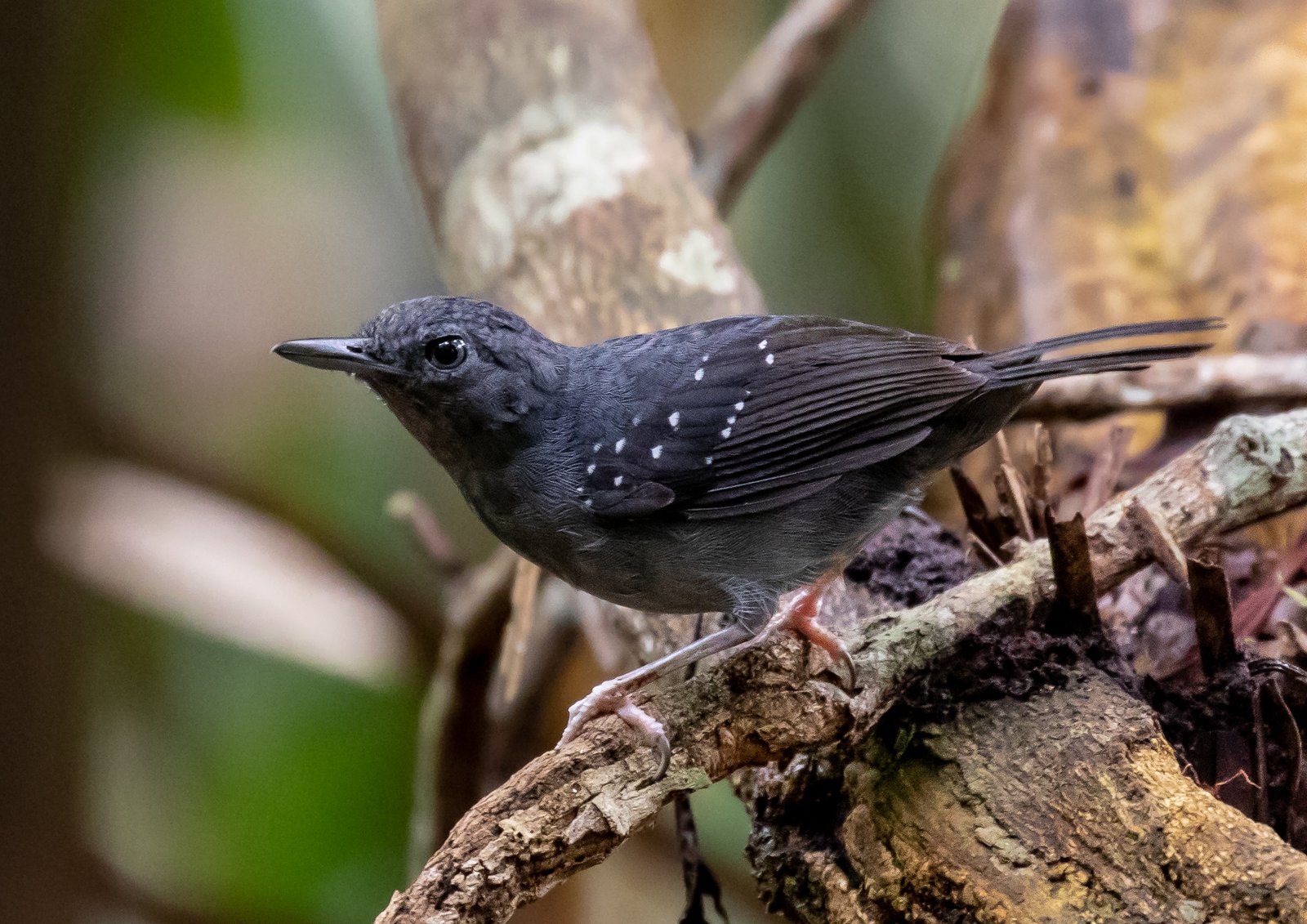
The Humaita Antbird is an antbird of streams and wet spots in terra firme forest in south-western Amazonia. It was long treated as a subspecies of the Spot-winged Antbird and has been recognised as a separate species on the basis of its song; the name refers to Humaitá on the Madeira in Brazil. In the guide area it occurs only in the far south-east of Peru and northern Bolivia.
Voice
The song is a long trill that rises in pitch; the pace speeds up at the start, stays even in the middle and slows at the end. Calls are a long, descending whistle, an abrupt note, single or in series of two to five, and a short rattle.
Recording: Guilherme Melo — CC BY-NC-SA 4.0 · xeno-canto
Identification
14–16 cm, with a black bill and pink legs. The male is medium grey, with an olive-brown tinge to the upperparts, blackish-grey wings and tail and broad white tips to the wing coverts; the throat and underparts are paler grey. The female has a brown crown and upperparts, a grey face, blackish-brown wings with pale cinnamon tips to the coverts, a pale tawny throat and belly and olive-brown flanks.
Confusion species
Brownish-headed Antbird Myrmelastes brunneiceps is very similar, but the female has a dark brown crown and a brown, not grey, face; it lives higher, at the foot of the Andes, and has a different song. Plumbeous Antbird Myrmelastes hyperythrus is larger, with blue bare skin around the eye. Silvered Antbird Sclateria naevia has a longer bill and white underparts.
Habitat
Floor and understorey of evergreen terra firme lowland forest, especially on poorly drained ground and along small watercourses. It forages in pairs close to the ground, taking insects and other arthropods. Little is known about its breeding.
Where the bird is most at home, classified by the vegetation units of the Andes and the west coast.


Range and movements
Colombia: absent. Ecuador: absent. Peru: only in eastern Madre de Dios. Bolivia: in the north, in Pando. Absent from the Galápagos. Outside the guide area in western Amazonian Brazil, south of the Amazon east to the Madeira and north of it between the lower Japurá and the Rio Negro.
- Resident
- dark = core range, pale = thinly spread
How and when to look
Search along forest streams in the lowland forest of eastern Madre de Dios or in Pando; the long, rising trill is the best feature against Brownish-headed Antbird.
Conservation status
Least Concern. In the guide area only in a small marginal area; elsewhere in Amazonia fairly common.
Scientific name
Myrmelastes humaythae | (Hellmayr, 1907) (GBIF: Schistocichla humaythae)
Hellmayr described the species in 1907 as Sclateria schistacea humaythae; because it was later moved to another genus, the author and year stand in brackets. The genus Myrmelastes was introduced in 1858 by Sclater. The genus name combines Greek murmēx, 'ant', and lēistēs, 'robber'. The species name refers to Humaitá on the Rio Madeira in Brazil. The specimen the first description was based on came from Humaitá, Rio Madeira, Brazil.