All species › Passerines › Antbirds › Brownish-headed Antbird
Brownish-headed Antbird | Myrmelastes brunneiceps
Bruinkopmiervogel | Hormiguero cabecipardo | Formigueiro-de-cabeça-parda
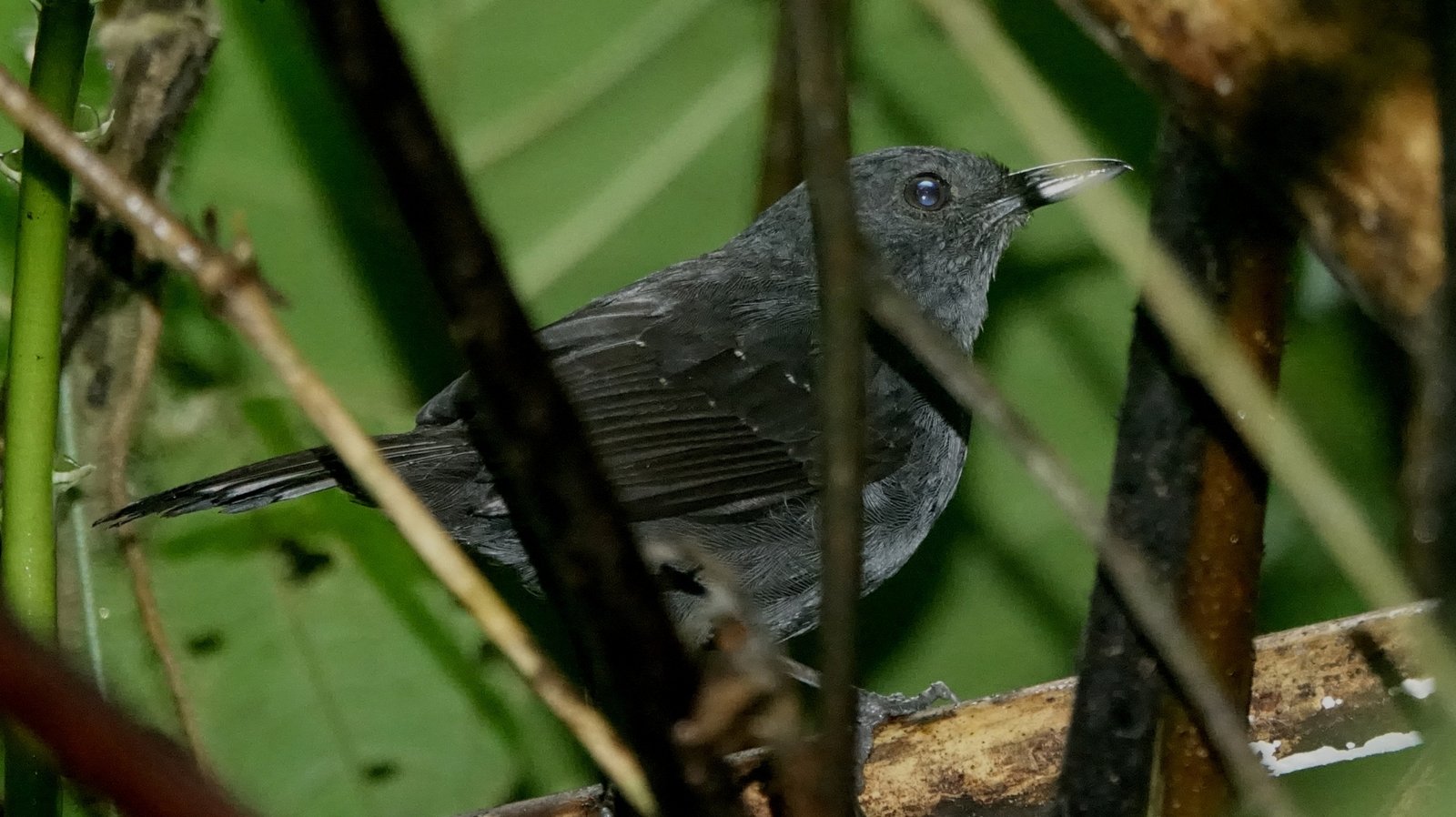
The Brownish-headed Antbird is an antbird of streams in forest at the foot of the Andes in south-eastern Peru and western Bolivia. It was described as a subspecies of the Spot-winged Antbird and has been recognised as a separate species on the basis of its song. Its entire range lies within the guide area.
Voice
The song is a rapid, accelerating series of high, ringing notes. Calls are a long, descending whistle, an abrupt note, single or in series, and a short rattle.
Recording: Jacob Wijpkema — CC BY-NC-SA 4.0 · xeno-canto
Identification
14–16 cm, with a black bill. The male is dark grey above, with blackish-grey wings and tail and broad white tips to the wing coverts, forming wing bars; the throat and underparts are medium grey. The female has a dark brown crown and face, olive-brown upperparts, blackish-brown wings with pale cinnamon tips to the coverts, a dark tawny throat and belly and olive-brown flanks.
Confusion species
Humaita Antbird Myrmelastes humaythae lives lower, in the lowlands of eastern Madre de Dios and Pando; the female has a grey face and the song is a long, rising trill. Plumbeous Antbird Myrmelastes hyperythrus is larger, with blue bare skin around the eye, and lives in várzea. Goeldi's Antbird Akletos goeldii is larger, with a red iris, and lives in bamboo.
Habitat
Floor and understorey of evergreen terra firme forest in the foothills of the Andes, especially on poorly drained ground and along small streams, up to about 1400 m. It forages in pairs close to the ground, taking insects and other arthropods. Little is known about its breeding.
Where the bird is most at home, classified by the vegetation units of the Andes and the west coast.


Range and movements
Colombia: absent. Ecuador: absent. Peru: in the south-east, in Cusco, Madre de Dios and Puno. Bolivia: in the west, in La Paz. Absent from the Galápagos. Does not occur outside the guide area.
- Resident
- dark = core range, pale = thinly spread
How and when to look
In the foothill forest of Manu, the Tambopata valley or the Yungas of La Paz, search along small streams in the understorey; the rapid, ringing series gives the bird away.
Conservation status
Least Concern. The range is small, but lies largely in forest that is still intact, partly in protected areas.
Scientific name
Myrmelastes brunneiceps | (Zimmer, 1931) (GBIF: Schistocichla brunneiceps)
Zimmer described the species in 1931 as Schistocichla leucostigma brunneiceps; because it was later moved to another genus, the author and year stand in brackets. The genus Myrmelastes was introduced in 1858 by Sclater. The genus name combines Greek murmēx, 'ant', and lēistēs, 'robber'. The species name comes from Medieval Latin brunneus, 'brown', and Latin -ceps, 'headed'. The specimen the first description was based on came from Chaquimayo, Carabaya, Puno, Peru.