All species › Passerines › Antbirds › Wing-banded Antbird
Wing-banded Antbird | Myrmornis torquata
Bonte mierlijster | Hormiguero alifranjeado | Pinto-do-mato-carijó
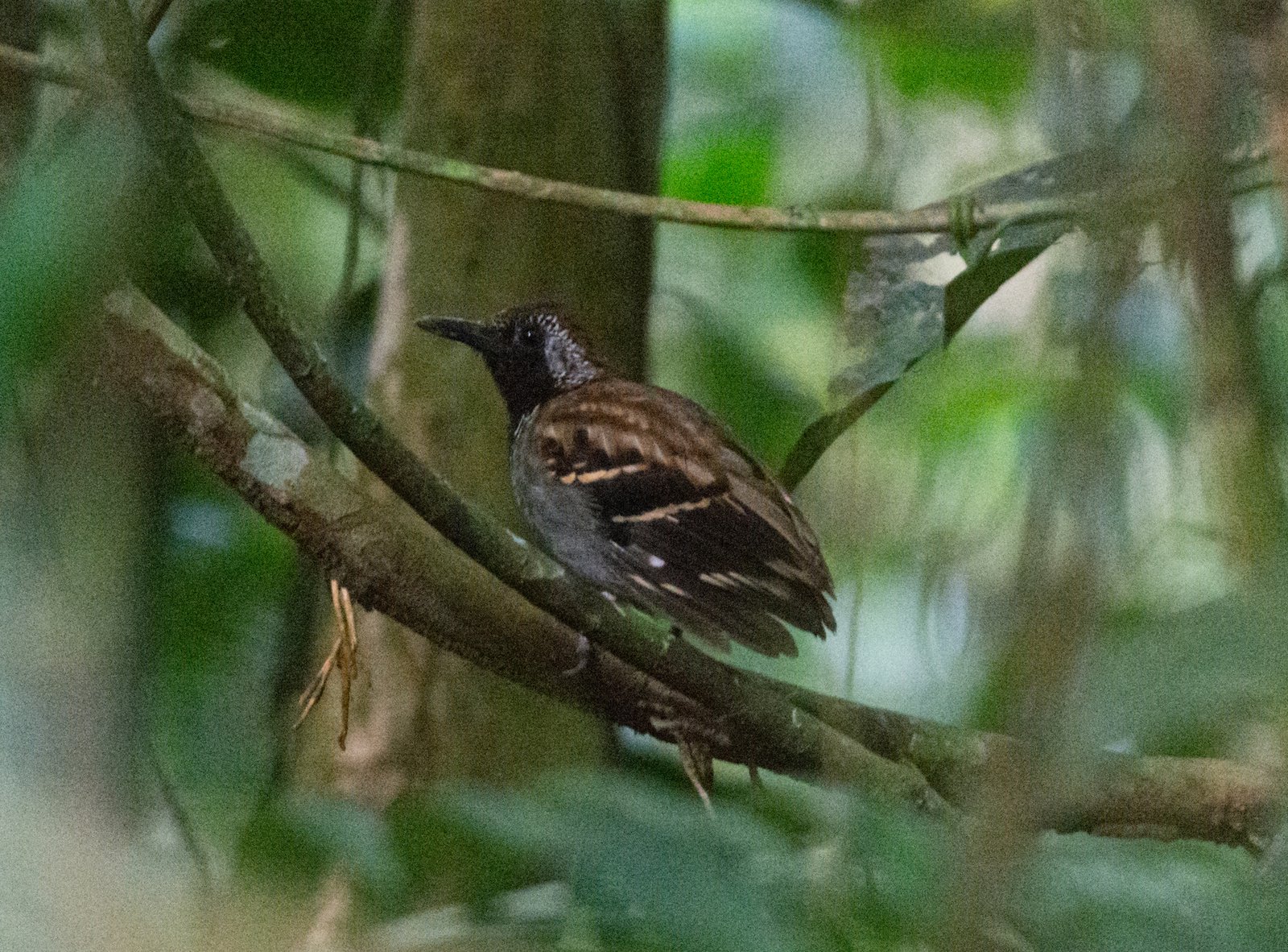
Despite its Dutch name meaning 'antthrush', the Wing-banded Antbird is a dumpy, short-tailed member of the typical antbirds that lives almost entirely on the forest floor. It hops through the leaf litter, flipping leaves with its bill in search of invertebrates. It does not join mixed flocks or follow army ants.
Voice
A series of a few to about thirty rising, ringing whistles, weew-weew-weew; in the form stictoptera faster and with upslurred notes. The call is a nasal churr.
Recording: JAYRSON ARAUJO DE OLIVEIRA — CC BY-NC-SA 4.0 · xeno-canto
Identification
14–15 cm, dumpy, with a short tail, short legs and a fairly long, straight bill. Bare blue skin around the eye. Crown and upperparts warm rufous-brown; wings black with broad ochre to rufous bands. The face is speckled black and white. The male has a black throat and upper breast and a grey lower breast and belly; the female has a cinnamon-rufous upper breast. Juveniles have a dark chocolate crown and nape. The form stictoptera west of the Andes is darker, with broader wing bands.
Confusion species
Antthrushes such as Rufous-capped Antthrush Formicarius colma and Black-faced Antthrush Formicarius analis also live on the forest floor, but lack wing bands and walk with a cocked tail rather than hopping. Short-tailed Antthrush Chamaeza campanisona has streaked underparts. Leaftossers (Sclerurus) are plain brown, without wing bands or a black throat.
Habitat
The floor of humid terra firme rainforest in the lowlands and foothills, often in hilly terrain; in South America seldom above 900 m. It eats mainly arthropods and occasionally small snails. The nest is a cup of plant fibres and fungal threads, usually less than 2 m above the ground; the clutch is a single egg.
Where the bird is most at home, classified by the vegetation units of the Andes and the west coast.


Range and movements
Colombia: in the northwest (Chocó and Antioquia, form stictoptera) and in the southeastern Amazon basin. Ecuador: scarce and local in the northeast. Peru: in the northern Amazon basin. Absent from Bolivia and the Galápagos. Outside the guide area from Nicaragua to Panama, and in Venezuela, the Guianas and Brazil.
- Resident
- dark = core range, pale = thinly spread
How and when to look
In hilly terra firme forest, listen for the series of rising whistles and the rustle of flipped leaves. Standing still beside an open patch of forest floor gives the best chance of the bird coming into view.
Conservation status
Not Evaluated in this species concept; the northern and southern forms are each assessed as Least Concern. Numbers are thought to be declining through deforestation; the species is thinly distributed everywhere.
Scientific name
Myrmornis torquata | (Boddaert, 1783)
Boddaert described the species in 1783 as Formicarius torquatus; because it was later moved to another genus, the author and year stand in brackets. The genus Myrmornis was introduced in 1783 by Hermann. The genus name comes from Greek murmēx, 'ant', and ornis, 'bird'. The species name is Latin torquatus, 'collared'. The specimen the first description was based on came from Cayenne, French Guiana.