All species › Parrots › African and New World parrots › Hyacinth Macaw
Hyacinth Macaw | Anodorhynchus hyacinthinus
Hyacinthara | Guacamayo jacinto | Arara-azul
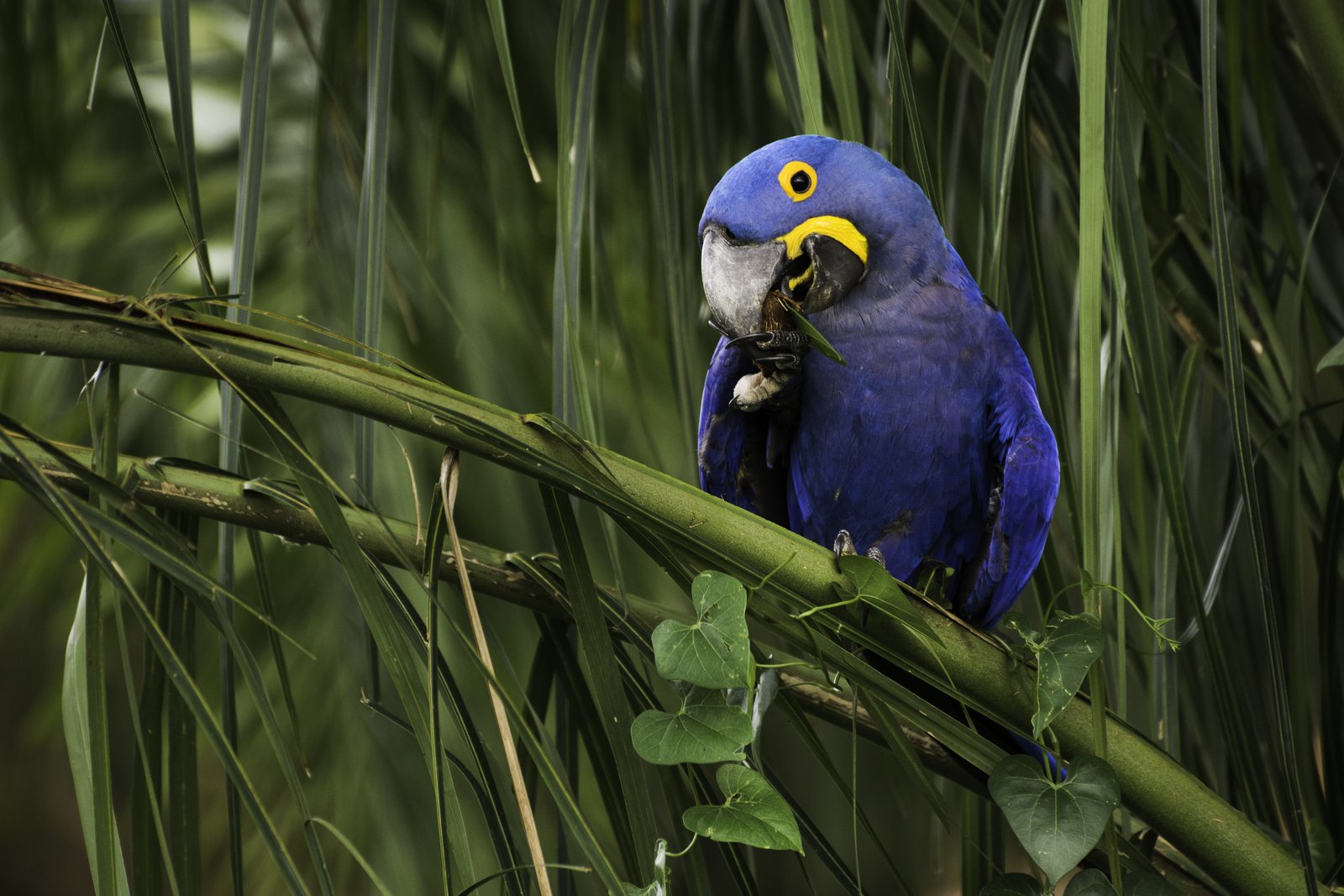
The Hyacinth Macaw is the largest parrot in the world, entirely cobalt blue with a huge black bill. It specialises in hard palm nuts, which it cracks with its bill. In the guide area it occurs only in the far east of Bolivia, at the edge of the Pantanal, where it is rarely recorded.
Voice
Loud, deep, raucous screeches, often a rolling kraaa-aa, in flight and at the roost; also growling and grating sounds.
Recording: JAYRSON ARAUJO DE OLIVEIRA — CC BY-NC-SA 4.0 · xeno-canto
Identification
95–100 cm, with a very long, pointed tail and a massive, strongly hooked black bill. The whole plumage is deep cobalt blue, the flight feathers and tail dark grey below. A bare yellow ring around the eye and a bare yellow strip along the base of the lower mandible contrast with the blue. The sexes are alike. Juveniles have a shorter tail and paler yellow skin.
Confusion species
Not confusable in the guide area. Blue-and-yellow Macaw Ara ararauna is blue above but golden yellow below, with a white face. The other large macaws, such as Red-and-green Macaw Ara chloropterus, are mainly red. Other blue macaws of the genus Anodorhynchus occur only in Brazil.
Habitat
Semi-open country with palms, gallery forest, palm swamps and the edges of seasonally flooded savanna and dry forest, in the lowlands. It feeds mainly on the nuts of palms such as Attalea phalerata and Acrocomia aculeata, which it takes in the tree or on the ground, even from cattle dung. It nests in cavities in large trees, especially Sterculia apetala, and in rock cavities.
Where the bird is most at home, classified by the vegetation units of the Andes and the west coast.


Range and movements
In Bolivia only in eastern Santa Cruz, along the border with Brazil, in the Bolivian Pantanal and adjacent areas; there are few records. Absent from Colombia, Ecuador, Peru and the Galápagos. Outside the guide area in Brazil, mainly in the Pantanal and the cerrado of the interior and in parts of the eastern Amazon, and in north-eastern Paraguay.
- Resident
- dark = core range, pale = thinly spread
How and when to look
In the guide area only in the Bolivian Pantanal in the far east of Santa Cruz, where pairs and small groups forage in palm-rich savanna and gallery forest. The Brazilian Pantanal, just outside the guide area, offers more opportunities.
Conservation status
Vulnerable. The population declined sharply in the 20th century through trapping for the cage-bird trade and the loss of nest trees and palms; protection and nest-box programmes in Brazil have increased the population in the Pantanal. The species is listed on Appendix I of CITES.
Scientific name
Anodorhynchus hyacinthinus | (Latham, 1790)
Latham described the species in 1790 as Psittacus hyacinthinus; because it was later moved to another genus, the author and year stand in brackets. The genus Anodorhynchus was introduced in 1824 by Spix. The genus name comes from Greek anodous, 'toothless', and rhunkhos, 'bill', for the bill lacking a tooth-like notch. The species name comes from Latin hyacinthinus, 'hyacinth-blue', for the deep blue plumage. The specimen the first description was based on came from Rio Tapajós, Brazil.