All species › Parrots › African and New World parrots › Scaly-naped Amazon
Scaly-naped Amazon | Amazona mercenarius
Schubnekamazone | Amazona nuquiescamosa | Papagaio-de-nuca-escamosa
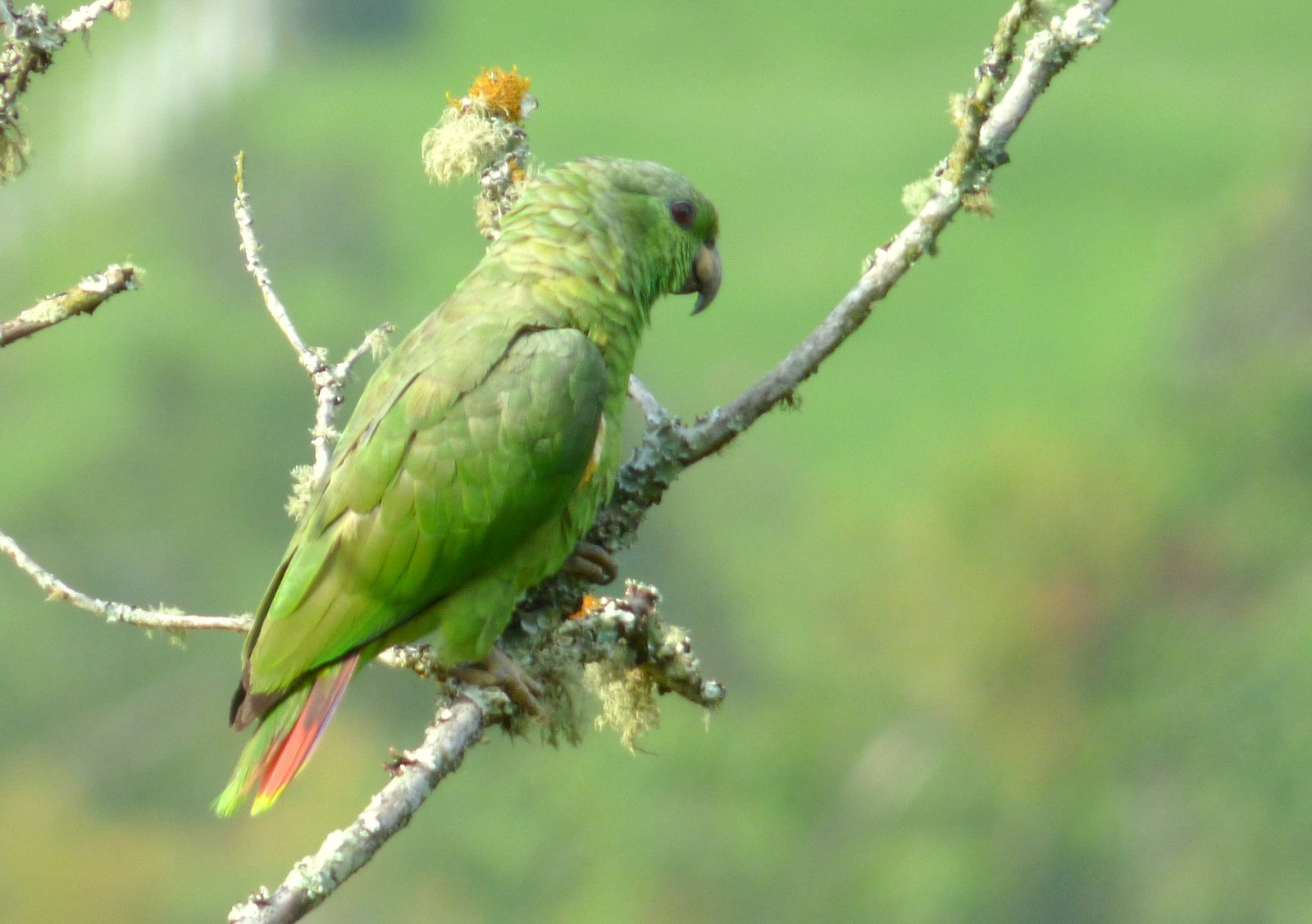
The Scaly-naped Amazon is the amazon of the high mountains: no other Amazona lives so high in the Andes. In the morning and evening, groups fly noisily over the mountain slopes between roosts and feeding trees. It is largely green, without red or yellow on the head, and is named after the dark edges of the nape feathers.
Voice
Loud, harsh, rolling calls such as kurr-ek and kree-ak, mainly in flight and often by the whole group at once. Perched groups chatter more softly.
Recording: Juan Freile — CC BY-NC-SA 4.0 · xeno-canto
Identification
32–34 cm, stocky, with a short, rounded tail. The plumage is green, slightly more yellowish on the head and underparts. The feathers of the hindcrown and nape have dark edges, giving a scaly pattern. The outer secondaries show a red wing speculum, which is absent in birds from the Sierra Nevada de Santa Marta. The tail is green with a broad yellowish-green terminal band and red at the base of the outer feathers. The bill is greyish. The sexes are alike; juveniles are duller, with less red.
Confusion species
Speckle-faced Parrot Pionus tumultuosus is smaller, with a purplish-red or grey-speckled head, a yellow bill and red undertail coverts. Red-billed Parrot Pionus sordidus has a red bill and a bluish throat. Mealy Amazon Amazona farinosa is larger, with a white eye-ring and often some yellow on the crown, and lives in the lowlands. All Pionus species fly with deep wingbeats; the Scaly-naped Amazon beats shallowly, with the wings staying below the body line.
Habitat
Humid montane forest, cloud forest and upper montane rainforest, also forest edges, forest fragments and semi-open country with trees, mainly between 1600 and 3400 m, locally lower. It eats fruit, seeds and flowers in the treetops. It lives in pairs and groups, which roost communally. The nest is in a cavity high in a tree.
Where the bird is most at home, classified by the vegetation units of the Andes and the west coast.


Range and movements
In Colombia in the three Andean ranges and in the Sierra Nevada de Santa Marta. In Ecuador on both slopes of the Andes, more local on the western slope. In Peru on the eastern slope along the whole length of the country. In Bolivia on the eastern slope south to Cochabamba and western Santa Cruz. Absent from the Galápagos. Outside the guide area marginally in western Venezuela.
- Resident
- dark = core range, pale = thinly spread
How and when to look
Search in the early morning from a viewpoint above cloud forest; groups give themselves away by their harsh calls long before they come into view. Watch the shallow wingbeat to separate them from Pionus parrots.
Conservation status
Least Concern. Deforestation of the Andean slopes and capture for the cage-bird trade cause local declines.
Scientific name
Amazona mercenarius | (Tschudi, 1844) (GBIF: Amazona mercenaria)
Tschudi described the species in 1844 as Psittacus mercenarius; because it was later moved to another genus, the author and year stand in brackets. The genus Amazona was introduced in 1830 by Lesson. The genus name is a Latinised form of Amazone, the name the French naturalist Buffon gave these parrots in the 18th century, believing they came from the Amazon jungles. The species name comes from Latin mercenarius, 'mercenary', from merces, 'hire, reward'. Why Tschudi (1844) chose this name is unknown. The specimen the first description was based on came from Peru.