All species › Gamebirds › Partridges, pheasants, grouse and allies › Indian Peafowl
Indian Peafowl | Pavo cristatus
Blauwe pauw | Pavo real común | Pavão-indiano
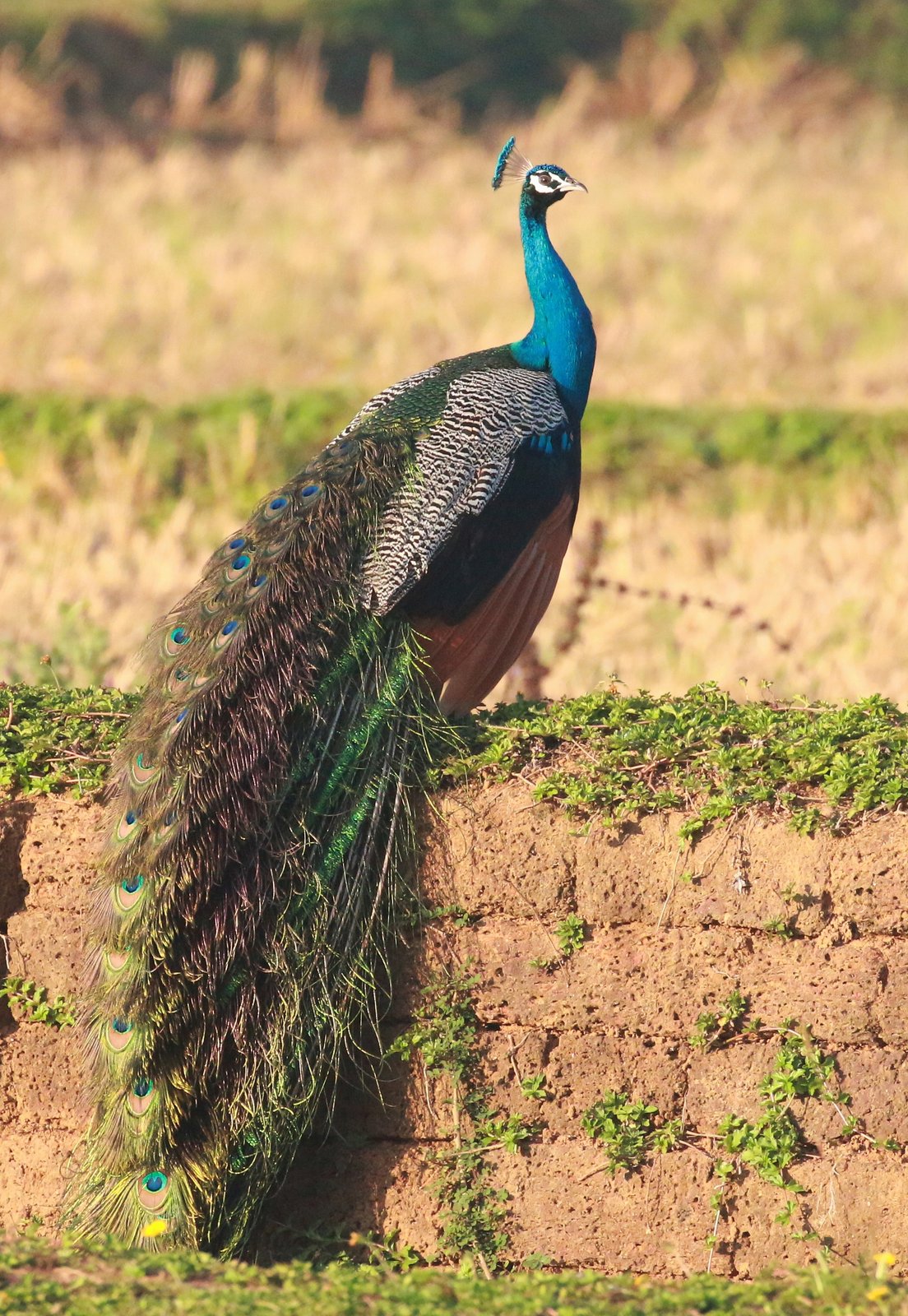
The Indian Peafowl originates from India and Sri Lanka and is kept in the guide area as an ornamental bird on farms, haciendas, in parks and zoos. Free-roaming and escaped birds are seen here and there, but no self-sustaining wild population is known. The male is recognisable by its long train covered in eyespots.
Voice
A loud, wailing, trumpeting call, often repeated, mainly at dawn and dusk and in the breeding season. Short, harsh screams when alarmed.
Recording: Uku Paal — CC BY-NC-SA 4.0 · xeno-canto
Identification
Male 180–230 cm including the train of 100–160 cm, female 90–100 cm. The male has a blue neck and breast, a fan-shaped crest of feathers with bare shafts and a tuft at the tip, and a glossy green train of elongated upper tail coverts with eyespots; the primaries are rufous. The female is brown, with a green neck, white belly and the same crest, but no train. Young males resemble the female. White and pied domestic forms are common.
Confusion species
In the guide area there is no native species with which an adult male can be confused. Females and young recall large fowl in silhouette, such as the domestic turkey Meleagris gallopavo, or guans such as Andean Guan Penelope montagnii, but these lack the fan-shaped crest, and guans live in trees in the forest.
Habitat
In the guide area near people: farmyards, gardens, parks, haciendas and pasture with trees, mainly in the lowlands and warm valleys. In its native range open forest, forest edge and farmland. It eats seeds, shoots, fruit, insects and small animals. It roosts in tall trees; the nest is on the ground.
Where the bird is most at home, classified by the vegetation units of the Andes and the west coast.


Range and movements
Kept and locally free-roaming in Colombia, Ecuador, Peru and Bolivia; most records concern birds at farms, parks and zoos. Not known as a feral species on the Galápagos. The native range is India, Sri Lanka and adjacent parts of South Asia.
- Summer visitor (c. Apr–Sep)
- Winter visitor (c. Oct–Mar)
- Passage (Mar–Apr, Oct–Nov)
- dark = core range, pale = thinly spread
How and when to look
Free-roaming birds are seen mainly in parks, on estates and at tourist haciendas. When recording a sighting, note whether the birds are captive or feral.
Conservation status
Least Concern; common in its native range. In the guide area an introduced species with no known effect on native wildlife.
Scientific name
Pavo cristatus | Linnaeus, 1758
Linnaeus described the species in 1758 and placed it straight away in the genus where it still stands. He introduced the genus Pavo in that same work. The genus name is Latin pavo, 'peacock'. The species name is Latin cristatus, 'crested'. The specimen the first description was based on came from India.