All species › Gamebirds › New World quail › Starred Wood Quail
Starred Wood Quail | Odontophorus stellatus
Stippelborsttandkwartel | Corcovado estrellado | Uru-de-topete
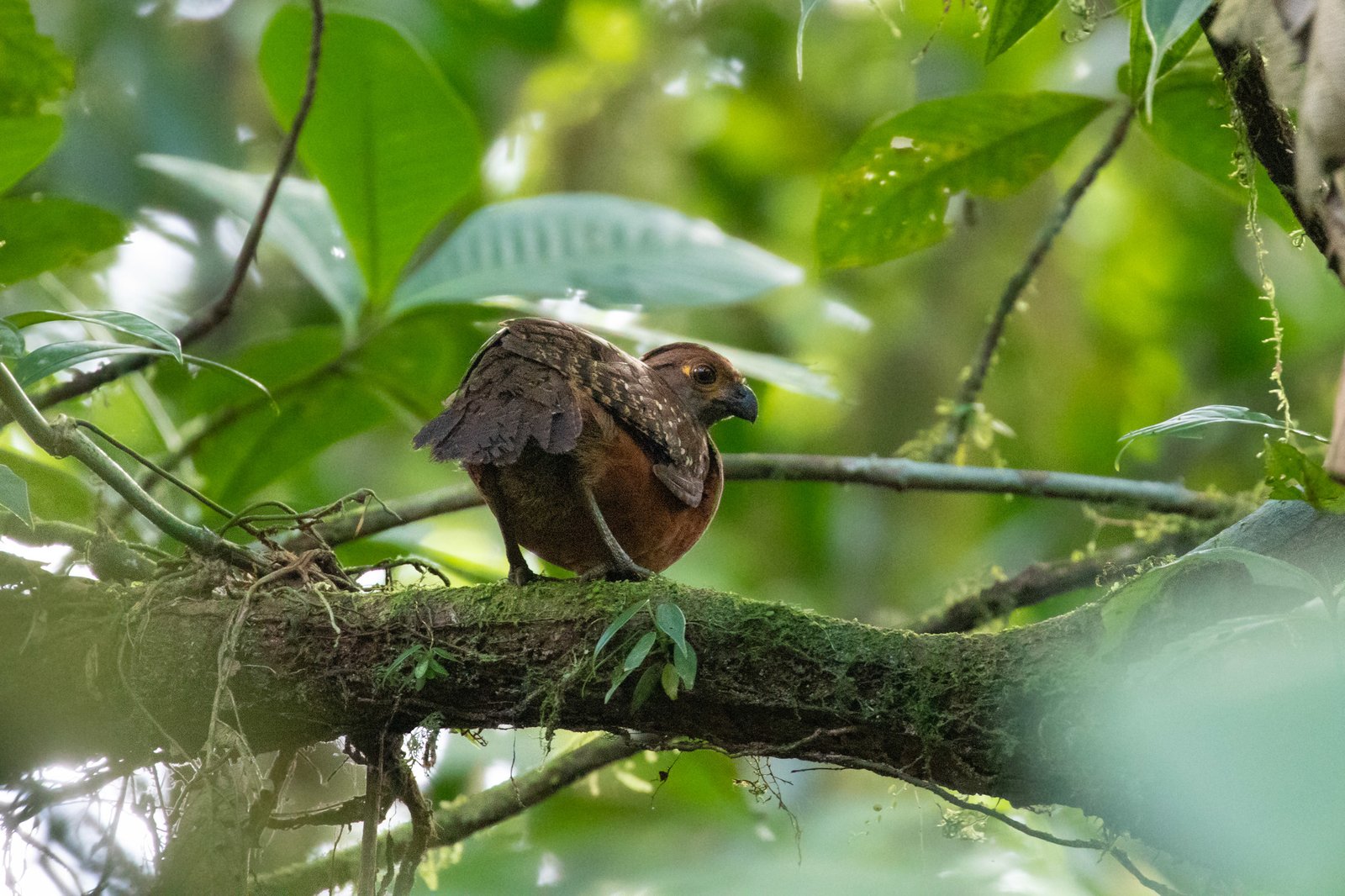
The Starred Wood Quail is a wood quail of rainforest in western Amazonia. The small white spots on the rusty breast give it its name. The male has a rufous crest, the female a blackish one.
Voice
A loud, fast and rhythmic duet of repeated, rolling notes, mainly at dawn and dusk. Also soft contact notes within the group.
Recording: Jerome Fischer — CC BY-NC-SA 4.0 · xeno-canto
Identification
25–27 cm, compact, with a short tail and a full crest. In the male the crest is rufous, in the female blackish brown. The face and throat are dark, the neck and upper breast grey. The upperparts are brown, finely mottled black, with pale spots on the wings. The breast and belly are rusty, with small white spots on the breast. Juveniles are duller.
Confusion species
Marbled Wood Quail Odontophorus gujanensis, which partly shares the same forest, is greyish brown and mottled, with orange-red skin around the eye, a brown crest and no grey neck or white spots. Rufous-breasted Wood Quail Odontophorus speciosus lives higher, on the eastern slope, and has uniform rufous or grey underparts. Tinamous such as Variegated Tinamou Crypturellus variegatus have a thin bill, no crest and almost no tail.
Habitat
The floor of humid lowland terra firme rainforest, locally also in the low foothills and in old secondary forest, up to about 500 m. Groups search the leaf litter for seeds, fruit and invertebrates. The nest is on the ground.
Where the bird is most at home, classified by the vegetation units of the Andes and the west coast.


Range and movements
In Ecuador in the eastern lowlands. In Peru in the Amazonian lowlands. In Bolivia in the northern lowlands, in Pando, Beni and northern La Paz. Absent from Colombia and the Galápagos. Outside the guide area in western Brazilian Amazonia.
- Resident
- dark = core range, pale = thinly spread
How and when to look
Listen at dawn for the duet in terra firme forest around the lodges along the Napo in Ecuador or at Tambopata in Peru. Groups move off at any noise; wait quietly on a forest trail.
Conservation status
Least Concern. Large range, but the species disappears where forest is cleared and is hunted locally.
Scientific name
Odontophorus stellatus | (Gould, 1843)
Gould described the species in 1843 as Ortyx (Odontophorus) stellata; because it was later moved to another genus, the author and year stand in brackets. The genus Odontophorus was introduced in 1816 by Vieillot. The genus name comes from Greek odous, odontos, 'tooth', and -phoros, 'bearing', after the serrated edge of the bill. The species name is Latin stellatus, 'starred', after the white spots on the breast. The specimen the first description was based on came from Brazil.