All species › Gamebirds › New World quail › Stripe-faced Wood Quail
Stripe-faced Wood Quail | Odontophorus balliviani
Vlekbuiktandkwartel | Corcovado enmascarado | Uru-de-cara-listrada
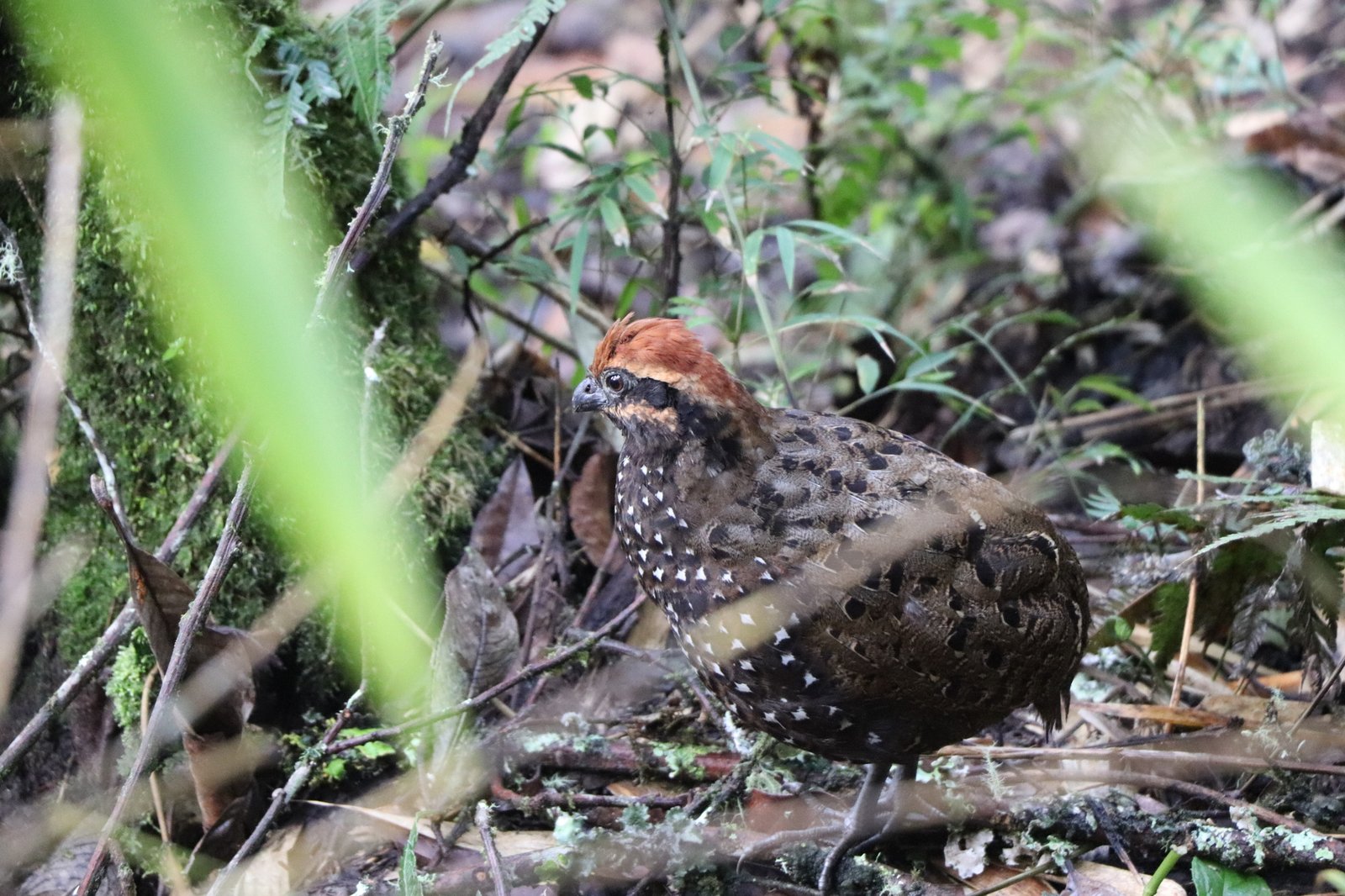
The Stripe-faced Wood Quail is the wood quail of upper Yungas forest in south-eastern Peru and Bolivia. A rufous eyebrow and dark stripe through the eye give the head a striped look, and the underparts are covered in large pale spots. It lives higher than the other wood quails of the eastern slope.
Voice
A loud, rhythmic duet of repeated notes, mainly at dawn and dusk. Also soft contact notes within the group.
Recording: Jacob Wijpkema — CC BY-NC-SA 4.0 · xeno-canto
Identification
26–28 cm, compact, with a short tail and a short, brown crest. The head is rufous, with a dark stripe through the eye and a dark moustachial stripe. The upperparts are brown, mottled black, with pale spots on the back and wings. The underparts are rufous to chestnut, with large white to pale buff, black-edged spots. The sexes are similar. Juveniles are duller, with less distinct spots.
Confusion species
Rufous-breasted Wood Quail Odontophorus speciosus lives lower on the eastern slope and has a blackish throat and uniform rufous or grey underparts without large spots. Marbled Wood Quail Odontophorus gujanensis lives in the lowlands and is greyish brown and mottled, with orange-red skin around the eye.
Habitat
The floor of humid montane forest and cloud forest, also forest edge with bamboo and old secondary forest, at roughly 1500 to 3300 m. Groups search the leaf litter for seeds, fruit and invertebrates. The nest is on the ground.
Where the bird is most at home, classified by the vegetation units of the Andes and the west coast.


Range and movements
In Peru on the eastern slope of the Andes in Cusco and Puno. In Bolivia on the eastern slope in La Paz and Cochabamba. Absent from Colombia, Ecuador and the Galápagos. Endemic to the guide area.
- Resident
- dark = core range, pale = thinly spread
How and when to look
Listen at dawn for the duet in cloud forest along the Manu road through the Kosñipata valley in Peru, or along mountain roads in the Yungas of La Paz in Bolivia.
Conservation status
Least Concern. The range is limited, but large parts of the montane forest are still intact.
Scientific name
Odontophorus balliviani | Gould, 1846
Gould described the species in 1846 and placed it straight away in the genus where it still stands. The genus Odontophorus was introduced in 1816 by Vieillot. The genus name comes from Greek odous, odontos, 'tooth', and -phoros, 'bearing', after the serrated edge of the bill. The species name honours José Ballivián (1805–1852), President of Bolivia from 1841 to 1847, when Gould described the species. The specimen the first description was based on came from Cocapata, Cochabamba, Bolivia.