All species › Passerines › New World blackbirds, troupials and allies › Jamaican Oriole
Jamaican Oriole | Icterus leucopteryx
Witvleugeltroepiaal | Turpial de Jamaica | Corrupião-da-jamaica
The Jamaican Oriole is a greenish-yellow oriole of Jamaica, which in the guide area lives only on the Colombian island of San Andrés in the western Caribbean. A subspecies of its own, lawrencii, occurs there, brighter yellow than the birds on Jamaica. A third subspecies, from Grand Cayman, has not been seen since 1967 and is considered extinct.
Voice
The song is a whistled phrase of a few clear notes, rendered on Jamaica as you cheat. Calls include a single or two-note whistle and a short chatter.
Recording: Nick Komar — CC BY-NC-SA 4.0 · xeno-canto
Identification
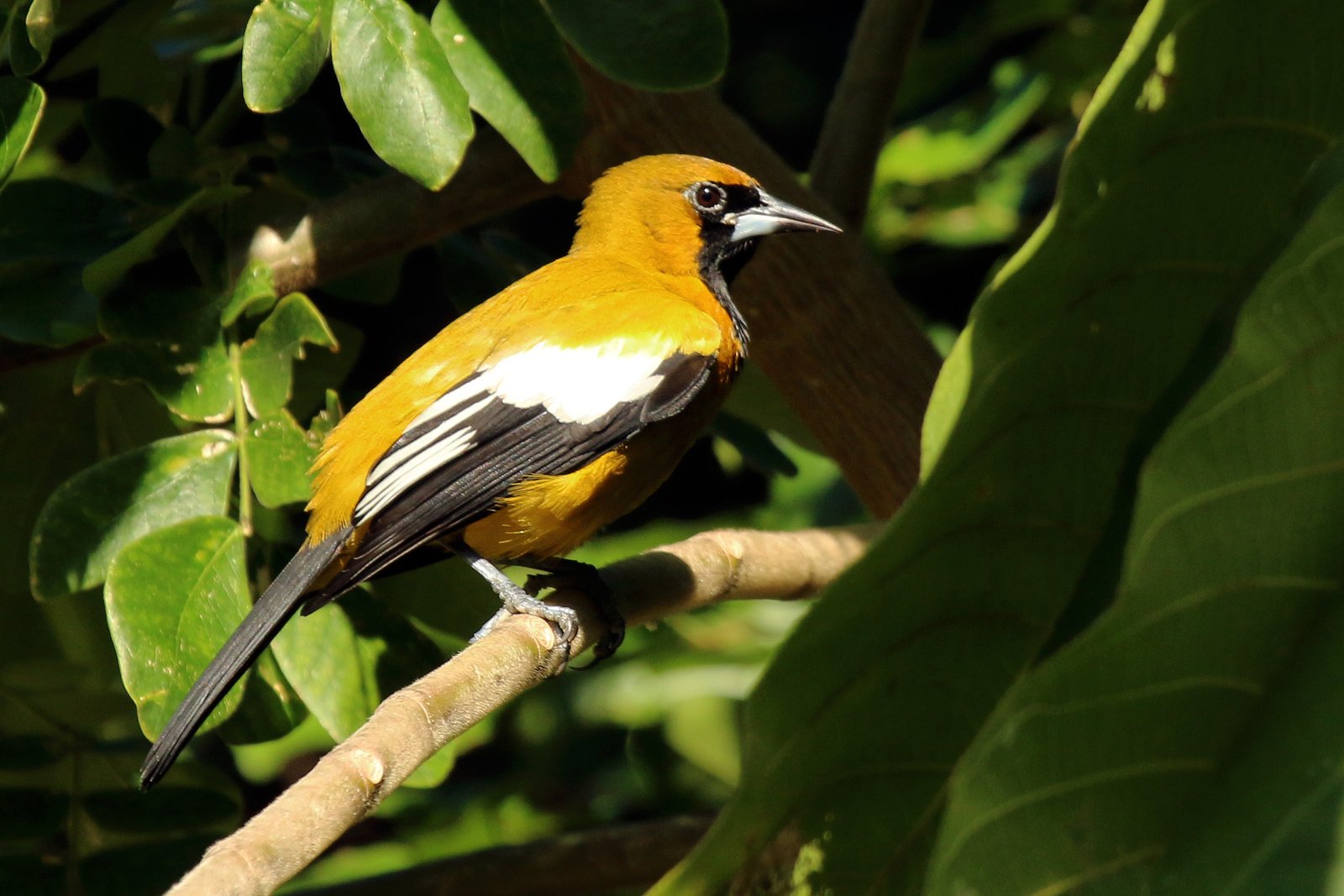
20–21 cm, with a pointed bill and a medium-length tail. The upperparts are olive-yellow to yellowish green, the underparts brighter lemon-yellow; birds on San Andrés are brighter yellow than those on Jamaica. A black mask merges into a black throat and upper breast. The wings are mostly black, with white edgings and a large white patch on the closed wing; the tail is black. The bill is bluish grey with a black culmen. The sexes are nearly alike; the female is somewhat duller.
Confusion species
Baltimore Oriole Icterus galbula, a winter visitor from North America, is orange rather than yellow; the male has an all-black head, while the female lacks the black throat and has two narrow white wing bars. Orchard Oriole Icterus spurius, also a winter visitor, is smaller; the female is greenish yellow without a black throat, the male black and chestnut.
Habitat
On San Andrés in gardens, coconut plantations, scrub and remnant woodland; on Jamaica in almost all forest types, from sea level into the mountains. It searches foliage, dead leaves and bark for insects and also eats fruit and nectar. The nest is a hanging, woven pouch.
Where the bird is most at home, classified by the vegetation units of the Andes and the west coast.


Range and movements
In the guide area only on San Andrés (Colombia). Absent from mainland Colombia, Ecuador, Peru, Bolivia and the Galápagos. Outside the guide area on Jamaica.
- Resident
- dark = core range, pale = thinly spread
How and when to look
Check gardens and coconut palms on San Andrés; birds often search palm fronds for insects and give themselves away by their whistles.
Conservation status
Least Concern. On San Andrés the range is small and habitat use has not been studied; loss of woodland and scrub to building is a possible threat there.
Scientific name
Icterus leucopteryx | (Wagler, 1827)
Wagler described the species in 1827 as Ps[arocolius] Leucopteryx; because it was later moved to another genus, the author and year stand in brackets. The genus Icterus was introduced in 1760 by Brisson. The genus name comes from Greek ikteros, 'jaundice'; the icterus was a yellow bird (probably the Eurasian Golden Oriole) whose sight was believed to cure jaundice. The species name comes from Greek leukos, 'white', and pterux, 'wing', for the white wing patch. The specimen the first description was based on came from Saint Andrew, Jamaica.