All species › Passerines › New World blackbirds, troupials and allies › Venezuelan Troupial
Venezuelan Troupial | Icterus icterus
Troepiaal | Turpial venezolano | Corrupião-venezuelano
The Venezuelan Troupial is a large orange-and-black oriole of dry, open country in northern South America, and the national bird of Venezuela. It builds no nest of its own, but takes over the nests of other birds, often after driving off the owners. In the guide area it lives only in northern and eastern Colombia.
Voice
The song is a series of loud, clear, whistled phrases of two or three notes, often repeated for long periods; pairs also sing in duet. It also gives a dry, harsh rattle.
Recording: Rosendo Manuel Fraga — CC BY-NC-SA 4.0 · xeno-canto
Identification
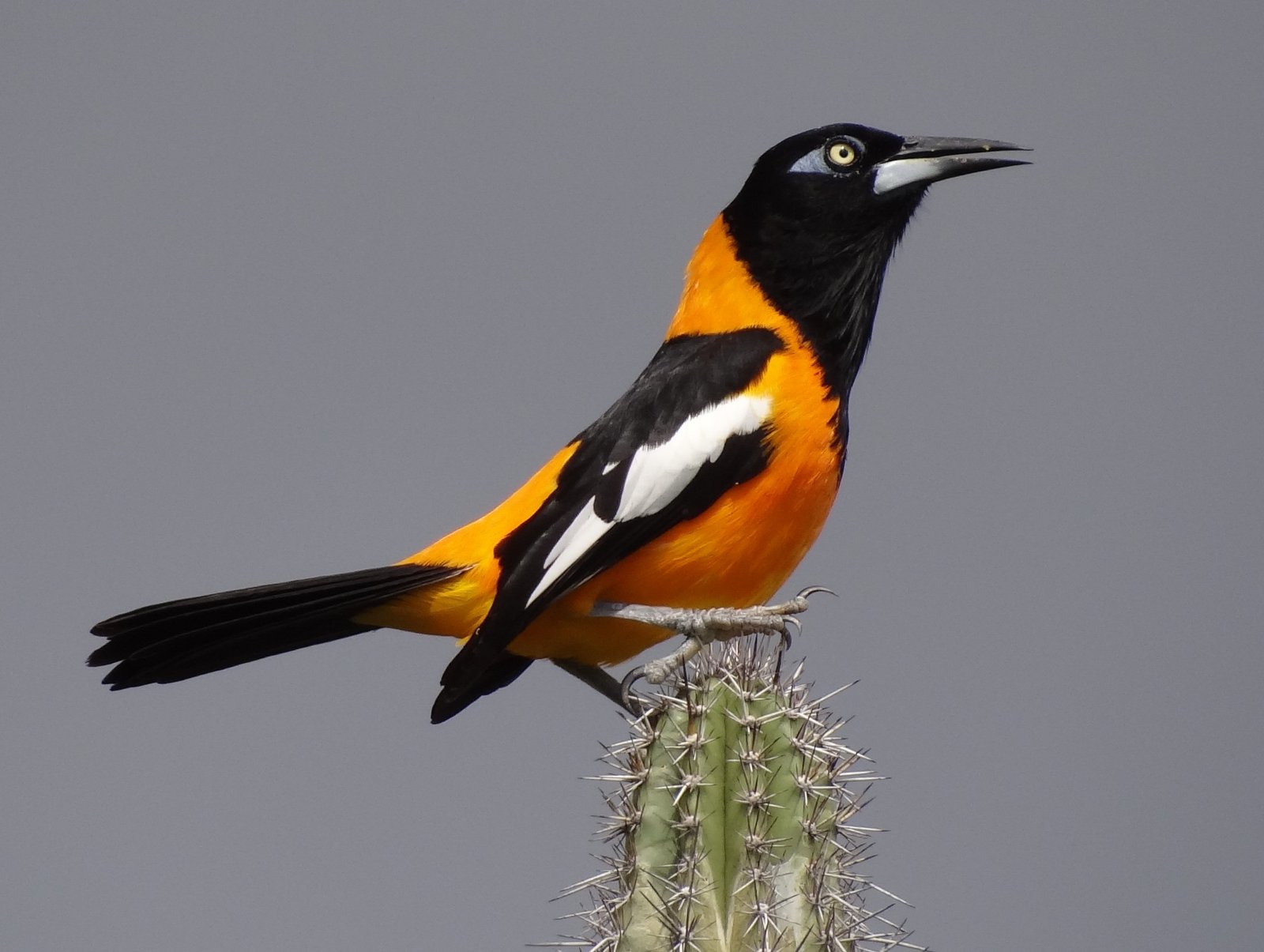
23–27 cm, with a long tail and a strong, pointed bill. The head, throat, breast and mantle are black; the throat feathers are somewhat elongated, giving the lower edge of the bib a ragged look. The rest of the body, including a broad band across the nape, is orange-yellow to orange. The wings are black with a large white patch and an orange shoulder patch. A patch of bare blue skin surrounds the yellow eye. The sexes are alike; juveniles are duller with less black.
Confusion species
Yellow Oriole Icterus nigrogularis is smaller and yellow, with only a black mask and bib, and lacks blue skin around the eye. Orange-crowned Oriole Icterus auricapillus is smaller, with an orange crown, a black face and a black back without an orange nape band. Oriole Blackbird Gymnomystax mexicanus has a yellow head, an all-black back and black wings without white, and lives along rivers and marshes.
Habitat
Dry forest, thorn scrub and cactus vegetation, open savanna with scattered trees, gallery forest and the edges of farmyards and pastures, mostly below 500 m. It eats fruit, insects and nectar. For breeding it takes over the nest of another bird, such as the stick nests of thornbirds Phacellodomus or the domed nests of Great Kiskadee Pitangus sulphuratus, sometimes eating the owners' eggs or young.
Where the bird is most at home, classified by the vegetation units of the Andes and the west coast.


Range and movements
In Colombia in the Caribbean lowlands, from La Guajira west to the lower Magdalena, and east of the Andes in the Llanos of Arauca, Casanare, Meta and Vichada. Absent from Ecuador, Peru, Bolivia and the Galápagos. Outside the guide area in Venezuela and on Aruba, Curaçao and Bonaire; introduced to Puerto Rico and some other Caribbean islands.
- Resident
- dark = core range, pale = thinly spread
How and when to look
Search the dry scrub of La Guajira and the Llanos for birds singing from a bare branch or a cactus; they sing most in the early morning.
Conservation status
Least Concern. Locally birds are trapped for the cage-bird trade.
Scientific name
Icterus icterus | (Linnaeus, 1766)
Linnaeus described the species in 1766 as O[riolus] icterus; because it was later moved to another genus, the author and year stand in brackets. The genus Icterus was introduced in 1760 by Brisson. The genus name comes from Greek ikteros, 'jaundice'; the icterus was a yellow bird (probably the Eurasian Golden Oriole) whose sight was believed to cure jaundice. The species name repeats the genus name, from Greek ikteros, 'jaundice', the name of a yellow bird. The specimen the first description was based on came from Cayenne, French Guiana.